
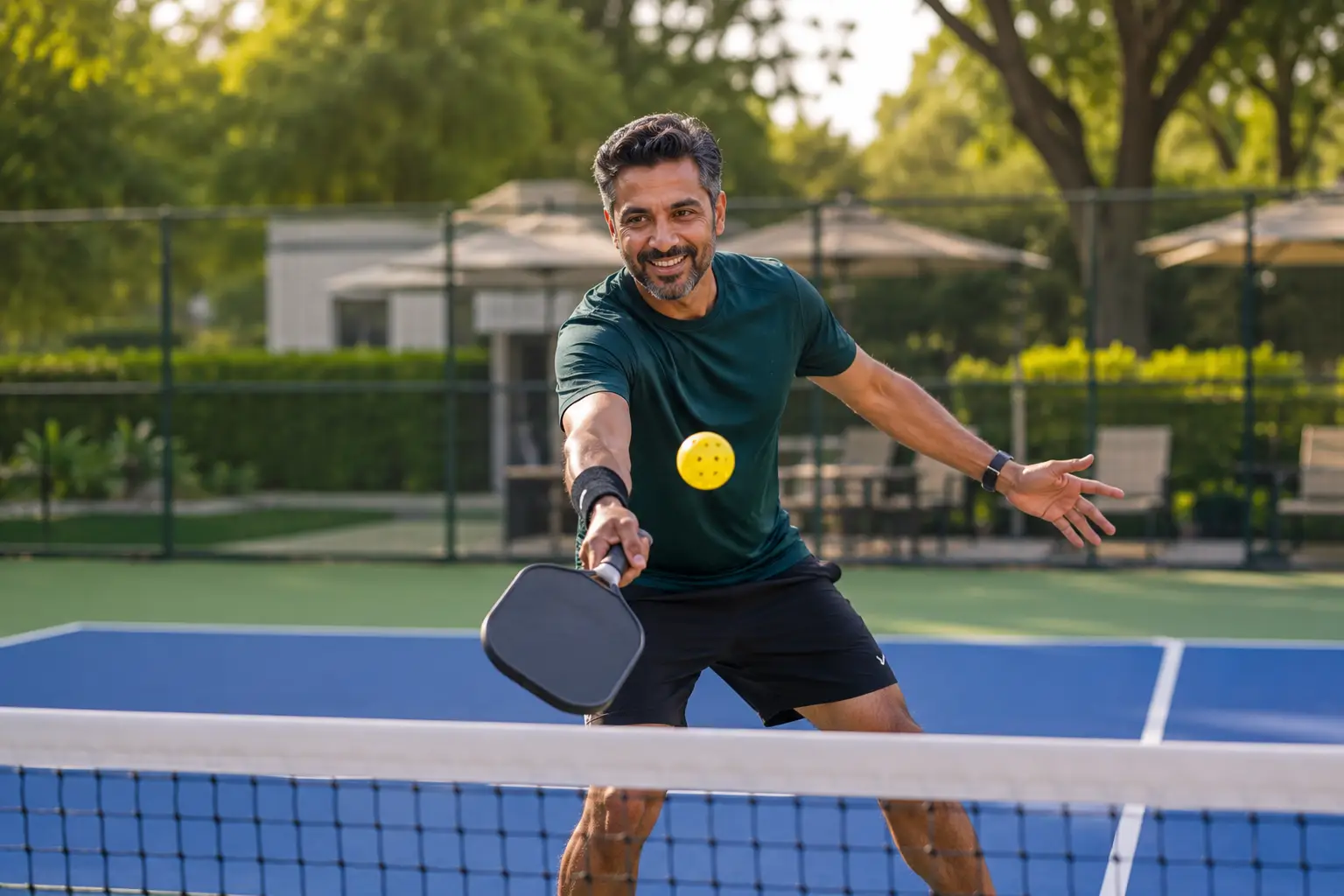
Every sport will tell you it is good for you, and technically, every sport is right. But not all exercise is created equal - and the science is increasingly clear that racket sports occupy a uniquely beneficial position in the fitness landscape. Whether your weapon of choice is a padel racket, a pickleball paddle, a squash racket, or a traditional tennis racket, the category as a whole delivers health benefits that outpace many other forms of physical activity.
One of the most cited studies in this space, published in the British Journal of Sports Medicine and based on a large Danish cohort study, tracked over 8,500 people over 25 years and found that racket sports were associated with the greatest reduction in all-cause mortality - outperforming swimming, cycling, running, and gym-based exercise. That is not a small finding.
But what is it, specifically, about racket sports that makes them so effective? Here are seven health benefits supported by research - and why regularly picking up a paddle or racket may be one of the best decisions you can make for your long-term wellbeing.
1. Cardiovascular Fitness That Does Not Feel Like Cardio
Most people know they should do more cardio. Most people also find sustained cardio - long runs, cycling sessions, treadmill workouts - tedious enough to skip. Racket sports solve this problem elegantly because the cardiovascular intensity is built into the activity itself. You are too busy tracking the ball, repositioning, and plotting your next shot to notice that you are also getting a thorough aerobic workout.
Research published in the International Journal of Sports Medicine has shown that recreational padel players achieve an average heart rate of around 75–80% of their maximum during a typical match. For pickleball, studies from the United States and Europe have found comparable figures. This puts both sports firmly in the moderate-to-vigorous exercise zone - the range that the World Health Organisation recommends for cardiovascular health benefits.
The interval nature of racket sports - short bursts of high-intensity effort followed by brief rest periods between points - also closely mimics high-intensity interval training (HIIT), which has its own well-documented benefits for metabolic health and cardiovascular efficiency.
2. Significantly Lower Impact on Joints
This benefit is particularly relevant as the average age of racket sport players continues to rise, and it is one of the primary reasons pickleball has seen such extraordinary adoption among people over 50. Running and high-impact gym workouts can take a cumulative toll on knees, hips, and ankles over time. Racket sports - particularly pickleball and padel - involve a great deal of lateral movement and short sprints on surfaces designed to absorb impact, without the repetitive pounding of distance running.
A study by the University of Wisconsin found that pickleball players reported significantly less musculoskeletal pain than participants in running-based exercise programmes over a comparable period. The short court dimensions in pickleball - about a quarter the size of a tennis court - mean lower sprint distances and less extreme directional changes, reducing the likelihood of acute joint stress. Padel's synthetic turf surface similarly provides a degree of shock absorption that hard courts do not.
For anyone managing an existing knee, hip, or lower back condition - or simply looking to stay active into their fifties, sixties, and beyond - this lower-impact profile is not just a convenience. It can be the difference between sustaining an active lifestyle and being sidelined by chronic injury.
3. Cognitive Sharpness and Brain Health
The brain benefits of racket sports are among the most compelling and underappreciated findings in sports science. Unlike steady-state cardio, which primarily engages the body, racket sports demand constant cognitive engagement. Every point requires rapid decision-making - reading the trajectory of the ball, anticipating your opponent's movement, selecting the right shot, and adjusting your position - all within fractions of a second.
This kind of dynamic, problem-solving physical activity has been shown to stimulate neuroplasticity - the brain's ability to form and reorganise neural connections. Research from the University of Edinburgh found that activities combining physical exertion with cognitive challenge were particularly effective at protecting against age-related cognitive decline. Regular racket sport players have been shown to perform better in tests of executive function, spatial awareness, and reaction time compared to age-matched individuals doing less cognitively demanding forms of exercise.
For younger players, this translates into sharpened focus and better stress management. For older players, it may be one of the most accessible tools available for protecting long-term brain health.
4. Superior Balance, Coordination, and Agility
Playing padel or pickleball at any level requires you to constantly adjust your body position in response to a moving object, typically while also managing your court position relative to your partner and your opponents. This trains what sports scientists call proprioception - your body's ability to sense its own position in space - in a way that is almost impossible to replicate through static gym exercises.
The multi-directional movements demanded by racket sports - lateral shuffles, cross-steps, split-steps, forward lunges - develop functional agility that transfers directly to everyday life. Research published in the European Journal of Sport Science found that regular racket sport players showed significantly better scores in balance tests, dynamic stability assessments, and coordination measures compared to age-matched controls who exercised but did not play racket sports. For older adults specifically, improved balance is one of the strongest predictors of reduced fall risk - a major factor in long-term health and independence.
5. Social Connection and Mental Health
Here is a health benefit that often gets omitted from the "exercise is good for you" conversation: the profoundly positive effect of social sport on mental health. Racket sports are, by their nature, deeply social. You cannot play padel alone. Pickleball doubles is the standard format. Even singles tennis and squash involve two people who, by the end of a match, usually know each other a little better than they did before.
A 2023 meta-analysis published in the Journal of Sport and Health Science reviewed data from over 200 studies and found that social sport - exercise conducted with others in an interactive, relationship-based format - produced significantly larger reductions in depression, loneliness, and anxiety than equivalent solo exercise. The effect was especially pronounced in team and partner sports, where the quality of social interaction is higher and more consistent.
Racket sports communities, whether built around a venue, a platform like Rackonnect, or an informal group, tend to generate particularly strong bonds. There is something about the shared experience of competition, the instant vulnerability of a match, and the post-game debrief over a cold drink that accelerates friendship in a way that sharing a treadmill row simply does not.
6. Full-Body Muscle Engagement
A common misconception is that racket sports are primarily upper-body workouts. In reality, the legs, core, and lower back are working continuously throughout any match. The split-step before every return, the explosive push-off to reach a wide ball, the rotation through the hips on a groundstroke - all of these movements demand and develop muscular strength and endurance across the entire kinetic chain.
Studies using electromyographic analysis on padel players have found significant activation in the quadriceps, glutes, core stabilisers, and shoulder girdle muscles during a standard match. Pickleball, while less explosive than padel, generates comparable lower-body activation due to the frequency of directional changes and the need for quick reaction steps at the kitchen line.
Over time, regular play builds functional strength - the kind that supports everyday movement, posture, and injury prevention - rather than the isolated muscle hypertrophy you develop in the weights room. For most people who are not training for bodybuilding competitions, functional strength is actually more useful.
7. Longevity - The Most Compelling Benefit of All
We started this piece by referencing the Danish cohort study on mortality and racket sports. It is worth returning to it, because the finding is striking enough to bear repeating. After adjusting for age, sex, smoking status, alcohol consumption, education, and other variables, racket sports were associated with a 47% reduction in all-cause mortality risk compared to a sedentary lifestyle. Swimming came in second at 28%. Running was third.
The researchers hypothesised that this outsized longevity benefit comes from the combination of factors unique to racket sports: cardiovascular conditioning, muscle engagement, cognitive stimulation, low injury risk relative to high-intensity sports, and crucially, social engagement - all packaged into a single activity. No other category of exercise delivers all five of those simultaneously.
More recent research has replicated and expanded on this finding across different populations and geographies. The conclusion holds: if you want to add healthy years to your life, picking up a racket - any racket - is one of the most evidence-backed choices available to you.
Getting Started: You Do Not Need to Be an Athlete
One of the most important things to understand about racket sports, particularly padel and pickleball, is that you do not need to be fit or experienced to start enjoying them. Both sports have a gentle learning curve for absolute beginners and are designed so that casual rallying - even in your very first session - is possible within minutes of picking up the paddle. The health benefits described above begin accumulating from your first session and compound over time.
If you are based in India, the easiest way to find a court and a partner is through the Rackonnect platform. Search for venues near you, check availability, and use the partner-matching feature to find someone at your level. Your first game does not have to be perfect. It just has to happen.
Your body - and your brain - will thank you for it.