
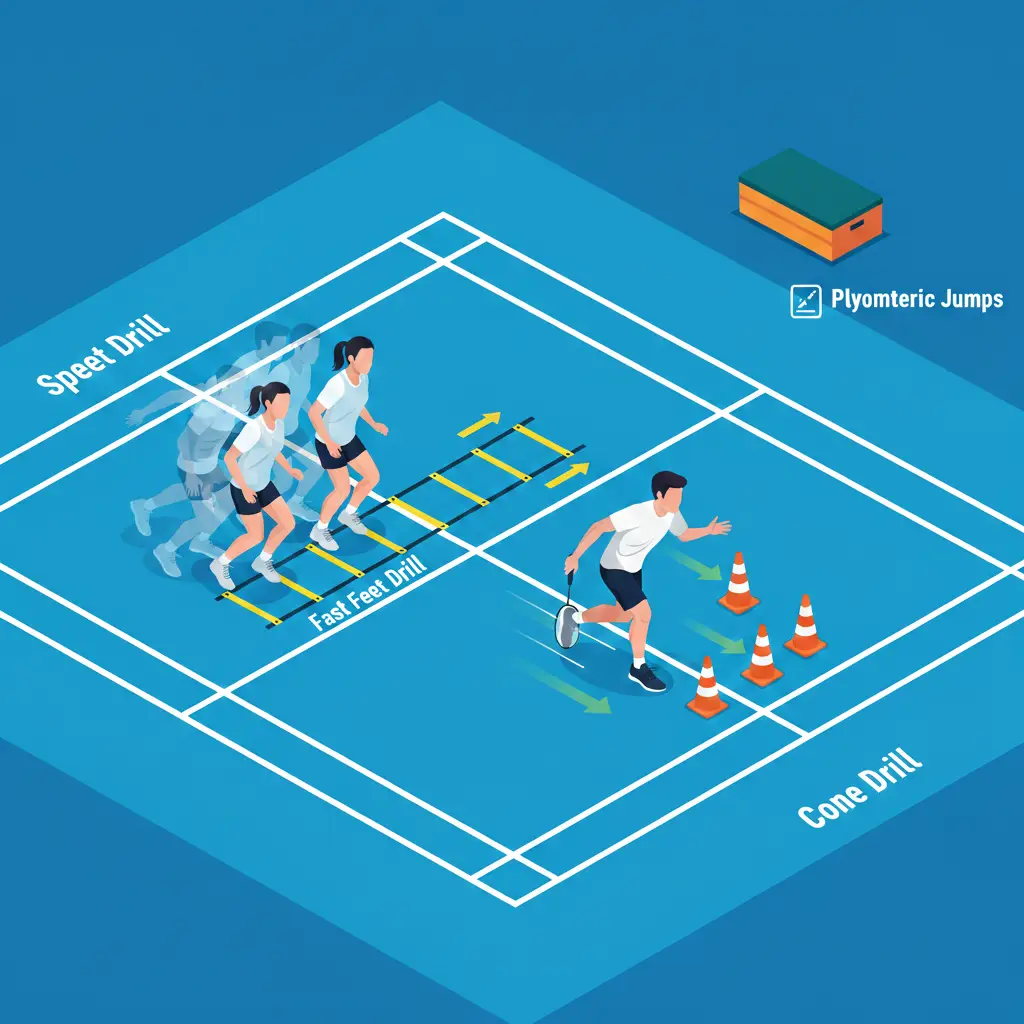
Introduction: Why Speed Decides Badminton Matches
Speed is one of the most decisive factors in modern badminton. At competitive levels, matches are often won not by power alone, but by who reaches the shuttle faster and recovers quicker between shots.
Badminton is a high-intensity, multi-directional sport that demands explosive acceleration, rapid deceleration, and lightning-fast reaction time — all within the same rally. Players must respond to shuttle speeds exceeding 300 km/h while constantly changing direction across the court.
Speed training for badminton players is not just about running faster in a straight line. It involves developing court-specific movement patterns, improving neuromuscular coordination, strengthening lower-body explosiveness, and sharpening reaction speed. When properly structured, speed training enhances footwork efficiency, reduces injury risk, and significantly improves match performance at every level.
Whether you train at a recreational club or compete in tournaments across Delhi, Noida, Gurugram, or elsewhere in India, this complete guide gives you the science, drills, and structured programme to develop explosive speed that directly translates onto the court.
Quick Overview: What This Guide Covers
1. Why speed and agility matter in badminton → Multi-directional movement, recovery speed, tactical advantage, injury prevention
2. The science behind speed development → Neuromuscular adaptation, explosive power, deceleration control, footwork efficiency
3. Warm-up and injury prevention → Dynamic warm-up routine, safe training principles
4. 8 proven speed and agility drills → Shadow footwork, multi-shuttle feeding, agility ladder, plyometric bounds, reaction drills
5. 6-week progressive speed training programme → Foundation, power development, and match simulation phases
6. Integrating speed training into match play → Pre-match activation, fatigue management, level-specific guidance
7. Common training mistakes to avoid → Technique errors, overtraining, neglecting strength and recovery
Why Speed and Agility Matter in Badminton
Badminton is one of the fastest racket sports in the world. Unlike linear sports such as sprinting, badminton requires explosive movement in multiple directions — forward, backward, lateral, and diagonal — often within fractions of a second.
1. Multi-Directional Movement Demands
A single rally may require a forward lunge to the net, a quick backward recovery to the baseline, a side-step to intercept a fast drive, and an explosive jump for a smash — all in sequence. Each of these movements depends on rapid acceleration and controlled deceleration. Players who lack speed consistently arrive late to the shuttle, forcing weak returns and losing tactical advantage on nearly every rally.
2. Faster Recovery Between Shots
Speed is not just about reaching the shuttle — it is about recovering efficiently to the base position after every shot. Quick recovery allows players to maintain balance for the next stroke, stay prepared rather than scrambling, reduce energy wastage across long matches, and improve rally consistency under pressure. Elite players demonstrate exceptional recovery speed, which is what allows them to control rallies and dictate tempo even when under pressure.
3. Competitive Edge and Tactical Advantage
Superior speed improves court coverage across all six corners, defensive transitions from backcourt to net, counter-attack opportunities after defending smashes, and reaction time during fast mid-court exchanges. Players with better agility can turn defensive situations into offensive opportunities, placing opponents under constant pressure.
4. Injury Prevention Benefits
Properly structured speed training improves neuromuscular control, landing mechanics, and joint stability. Strengthening both acceleration and braking ability reduces stress on the knees and ankles — the most common injury sites for badminton players at every level.
Speed and agility are foundational performance pillars. Without them, even strong technical skills and smart tactics cannot be fully executed.
The Science Behind Speed Training in Badminton
Understanding how speed develops helps players train smarter and achieve better results in less time.
1. Neuromuscular Adaptation
Speed is largely controlled by the nervous system, not just muscle size. When you train explosively, motor units are recruited more efficiently, reaction time improves measurably, and muscle firing becomes better coordinated. Over time, this leads to faster and more controlled movements on court — movements that feel automatic under match pressure.
2. Explosive Power Development
Lower-body power plays a major role in acceleration. Plyometric training — such as jump squats, lateral bounds, and tuck jumps — enhances the stretch-shortening cycle of muscles. This allows players to generate force quickly, improve first-step explosiveness from the split step, and increase both vertical and horizontal propulsion. Research in badminton athletes has shown that structured plyometric programmes significantly improve agility scores and short-distance sprint performance.
3. Acceleration and Deceleration Control
Badminton requires rapid starts and equally rapid stops. Training both acceleration and braking ability improves directional change efficiency, balance under pressure, and joint stability during lunges. Deceleration ability is frequently overlooked but is essential for injury prevention and efficient energy use across a full match.
4. Sport-Specific Footwork Efficiency
Speed without technique is ineffective on a badminton court. Efficient footwork patterns reduce unnecessary steps, conserve energy across long matches, and increase shot precision. When speed training is combined with shadow drills and multi-shuttle practice, on-court performance improvements become significantly more noticeable.
5. Progressive Overload and Recovery
Speed training must be structured progressively — starting with moderate intensity, increasing explosive demands gradually, and allowing adequate recovery between sessions. Since speed training stresses the nervous system heavily, rest and recovery are not optional — they are when adaptation actually happens.
Warm-Up and Injury Prevention for Speed Training
Before any high-intensity speed session, a proper warm-up is essential. Badminton involves explosive lunges, sudden stops, and rapid directional changes. Without adequate preparation, the risk of ankle, knee, and hamstring injuries increases significantly.
Dynamic Warm-Up Routine (10–12 Minutes)
Light cardiovascular activation (3 minutes):
Skipping rope or light jogging
High knees — 30 seconds
Butt kicks — 30 seconds
Lateral shuffles — 2 × 20 metres
Mobility exercises (4 minutes):
Leg swings — front-to-back and side-to-side
Hip openers
Ankle mobility rotations
Walking lunges with torso rotation
Activation drills (3 minutes):
Mini squat jumps — 2 × 8 reps
Quick-feet drills — 2 × 20 seconds
Short acceleration sprints — 3 × 10 metres
This progression raises heart rate gradually while activating all key muscle groups used in badminton speed training.
Injury Prevention Principles
Focus on proper landing mechanics — land softly on the mid-foot, not the heel
Keep knees aligned over toes during jumps and lunges at all times
Avoid excessive training volume in early weeks of a new programme
Prioritize recovery between intense sessions — 48 hours minimum
Incorporate deceleration drills and strengthen the glutes, hamstrings, and calves for joint stability
Speed development must always follow a progressive overload principle. Increase intensity gradually rather than jumping immediately into maximum-effort sessions.
8 Proven Speed and Agility Drills for Badminton Players
These eight sport-specific drills are designed to improve acceleration, agility, reaction time, and explosive movement directly on the badminton court.
Drill 1: Shadow Footwork Drill
Purpose: Improve court-specific movement patterns and recovery speed.
Start at the center base position
Move explosively to all six corners of the court — no shuttle
Simulate a shot at each corner with correct technique
Return to base after every movement
Sets/Reps: 4–6 rounds of 30 seconds with 30 seconds rest
Progression: Increase tempo over weeks or add a partner calling random directions to add reaction demand.
Shadow footwork builds efficient movement patterns and reinforces the technical speed that transfers directly into matches.
Drill 2: Multi-Shuttle Feeding Drill
Purpose: Enhance reaction speed and court coverage under realistic pressure.
A coach or partner feeds shuttles rapidly to different corners
Player reacts and returns each shuttle as quickly as possible
Emphasis is on explosive first movement — not shot quality
Sets/Reps: 3–5 sets of 30–45 seconds with 60-second rest
This drill closely replicates match intensity and improves reactive agility better than any solo drill.
Drill 3: Agility Ladder Drills
Purpose: Improve foot speed, coordination, and ground contact time.
Perform quick in-and-out steps through ladder squares
Include lateral steps, crossover patterns, and single-leg entries
Sets/Reps: 3–4 patterns × 2 rounds each with full recovery
Ladder drills enhance neuromuscular coordination and reduce the time each foot spends on the ground — directly improving first-step speed.
Drill 4: Four-Corner Cone Drill
Purpose: Develop change-of-direction speed and acceleration-braking cycles.
Place cones at all four court corners
Sprint from the center to each cone and return to center after each
Maintain a low body position throughout
Sets/Reps: 4 rounds × 20–30 seconds with full recovery
This drill strengthens both the acceleration and the braking phases that occur dozens of times in every match.
Drill 5: Plyometric Lateral Bounds
Purpose: Build explosive lateral power for wide retrievals and side lunges.
Jump sideways from one leg to the other explosively
Land softly and stabilize your balance before the next jump
Sets/Reps: 3 sets × 8–10 reps each side with 90-second rest
Improves push-off strength for all side-court lunges and wide net retrievals.
Drill 6: Tuck Jumps
Purpose: Improve vertical explosiveness for jump smashes and net intercepts.
Jump upward and drive both knees toward your chest at the peak
Land softly on mid-foot and immediately reset
Sets/Reps: 3 sets × 6–8 reps with 90-second rest
Enhances the lower-body power used in jump smashes and explosive net movements.
Drill 7: Resisted Band Sprints
Purpose: Improve acceleration power and first-step explosiveness.
Attach a resistance band securely around your waist
Sprint 10–15 metres explosively against the resistance
Focus on powerful, driving first 3 steps
Sets/Reps: 5–6 short sprints with full recovery between each
Specifically strengthens the acceleration phase that determines whether you reach a drop shot or net shot in time.
Drill 8: Reaction Ball or Partner Reaction Drill
Purpose: Improve reaction time and start speed from a neutral position.
Partner drops a reaction ball unpredictably — or points randomly to a direction
React immediately and sprint toward that direction
Sets/Reps: 3–4 rounds × 20 seconds with 40-second rest
Enhances the split-second decision-making and first-step reaction that separates fast players from slow ones in live match conditions.
💡 Want to run these drills under proper coaching guidance? Rackonnect's certified coaches design structured speed and footwork training programmes tailored to your playing level. Explore coaching programmes →
6-Week Progressive Speed Training Programme
A structured progression ensures consistent improvement without overtraining or injury.
Training frequency: 2–3 speed sessions per week with at least 48 hours between high-intensity sessions. Combine with regular badminton court practice.
Weeks 1–2: Foundation Phase
Focus: Technique and movement efficiency — establish correct patterns before adding intensity.
Shadow Footwork Drill — 4 rounds of 30 seconds
Agility Ladder — 3 patterns × 2 rounds
Four-Corner Cone Drill — 3 rounds
Light Plyometrics (Lateral Bounds) — 2 sets × 8 reps
Intensity: Moderate Goal: Master movement patterns and establish correct landing mechanics.
Weeks 3–4: Power Development Phase
Focus: Explosive acceleration and first-step power.
Shadow Footwork (faster tempo) — 5 rounds of 30 seconds
Multi-Shuttle Feeding Drill — 4 sets of 40 seconds
Tuck Jumps — 3 sets × 6 reps
Resisted Band Sprints — 5 reps with full recovery
Intensity: High Goal: Improve first-step explosiveness and measurable change-of-direction speed.
Weeks 5–6: Performance and Match Simulation Phase
Focus: Reactive agility and match-speed execution under fatigue.
Multi-Shuttle Feeding Drill — 5 sets of 45 seconds
Reaction Ball / Partner Reaction Drill — 4 rounds
Four-Corner Cone Drill (maximum effort) — 4 rounds
Combination Drill (Shadow Footwork into Sprint) — 3 sets
Intensity: High with full recovery between sets Goal: Execute speed drills at match intensity and sustain performance under fatigue.
Monitoring Progress
Track these measurable markers across the 6 weeks:
Time to complete the four-corner cone drill
Number of successful multi-shuttle returns per set
Reaction time improvement in partner reaction drills
Reduced fatigue levels during late-game rallies
Progress gradually and always prioritize quality over volume. One clean, explosive repetition is worth more than five slow, tired ones.
Integrating Speed Training into Match Play
Speed training is most effective when it directly enhances on-court performance. Performing drills in isolation without connecting them to match play limits how much improvement transfers.
1. Combine Speed with Technical Practice
Instead of separating fitness and skill sessions entirely, integrate speed drills directly into court practice:
Perform 2 rounds of shadow footwork before every match play session
Add short multi-shuttle bursts between rally sets
Use reaction drills before defensive practice sessions
This approach trains the body to apply speed under realistic playing conditions — not just in isolation.
2. Pre-Match Speed Activation Routine
Before competition, avoid heavy fatigue. Use a light activation routine instead:
3 × 10-metre acceleration sprints
2 rounds of quick agility ladder
2 sets of reactive shadow movements
5–6 explosive split-step lunges
This activates the nervous system and improves initial reaction speed without draining energy reserves before the match begins.
3. Managing Fatigue During the Season
During tournament periods, reduce plyometric volume, focus more on reactive drills at lower total volume, maintain speed intensity but lower overall repetitions, and prioritize sleep and recovery above extra sessions.
Speed declines quickly when players are fatigued. Maintaining freshness is critical for consistent match performance across multi-match tournament days.
4. Speed Training for Different Player Levels
Beginner players
Emphasize footwork technique and correct movement patterns first
Avoid excessive plyometrics until landing mechanics are established
Focus on coordination, balance, and split step timing
Intermediate players
Introduce structured plyometric drills with proper progression
Increase multi-directional speed training volume
Begin tracking measurable performance metrics
Advanced players
Use complex reactive drills with unpredictable stimulus
Add resisted sprint variations and heavier plyometric loading
Train under match-like pressure and fatigue conditions
🏸 Book a court and put your speed training into practice today. Rackonnect operates premium badminton facilities across Delhi NCR and North India:
Common Mistakes in Speed Training for Badminton Players
Mistake 1: Ignoring Movement Technique
Speed without proper movement mechanics leads to inefficiency and injury risk. Poor foot placement, incorrect lunging angles, and flat-footed landings waste energy and increase joint stress over time.
Fix: Focus on short, explosive first steps, a low center of gravity during direction changes, and balanced, soft landings on the mid-foot.
Mistake 2: Too Much Volume Too Soon
Speed training heavily stresses the nervous system. Excessive repetitions — especially in the first weeks — lead to fatigue, slower reaction time in subsequent sets, and significantly increased injury risk.
Fix: Start with moderate volume and increase gradually over weeks. Quality repetitions with full recovery are always more effective than long, exhausting sessions at reduced effort.
Mistake 3: Neglecting Strength Training
Explosive speed depends on underlying strength. Without adequate lower-body strength, plyometrics become less effective and injury risk rises.
Fix: Include squats, lunges, Romanian deadlifts, and core stability work alongside speed drills. Strength provides the physical foundation that speed training builds upon.
Mistake 4: Skipping Recovery
Recovery is when neuromuscular adaptation actually occurs. Without it, speed gains plateau or reverse.
Fix: Allow 48 hours between intense speed sessions, stay properly hydrated, prioritize 7–9 hours of sleep, and include mobility work after every training session.
Mistake 5: Training Speed in Isolation from Badminton
Players who only train speed drills off-court and never integrate them into court practice see limited transfer to match performance.
Fix: Combine speed drills with shadow footwork, multi-shuttle practice, and match simulation so the body learns to apply speed in context — not just in a straight-line sprint.
Frequently Asked Questions (FAQ)
Q: How many times per week should badminton players do speed training? Two to three sessions per week is ideal for most players. Ensure at least 48 hours of recovery between high-intensity speed sessions. During heavy match periods, reduce to one session per week and focus on maintenance rather than development.
Q: Is plyometric training safe for young or beginner players? Yes, when properly supervised and performed with correct technique. Beginners should start with low-impact variations such as lateral bounds and small hops, focusing on landing mechanics before progressing to tuck jumps or resisted sprints.
Q: How long does it take to see speed improvements? Most players notice measurable improvements in 4–6 weeks with consistent training and proper progressive overload. Visible on-court improvements — faster recovery, quicker first step — are typically noticeable within the first 3 weeks.
Q: Can speed training improve defensive skills in badminton? Absolutely. Faster acceleration and improved reaction time directly enhance defensive retrieval speed, counter-attacking transitions, and the ability to reach wide or short shuttles that would otherwise force errors.
Q: What is the most important speed quality for badminton players? First-step explosiveness from the split step is the most critical speed quality in badminton. It determines whether you reach the shuttle early enough to play an attacking shot or late enough to be forced into a defensive return. All speed training should ultimately serve this quality.
Q: Should speed training be done before or after badminton practice? Speed and agility drills should ideally be performed at the beginning of a session when the nervous system is fresh — not after long court practice when fatigue is already present. Save conditioning work like interval runs for the end of sessions.
Q: How do I know if my speed training is working? Track specific markers: your time on the four-corner cone drill, how many multi-shuttle returns you complete per set, your recovery speed between rally simulations, and subjective fatigue levels during late-game rallies. Improvement in these areas confirms the training is transferring.
Conclusion: Make Speed Your Competitive Advantage
Speed is not optional in modern badminton — it is essential. Players who invest in structured speed training gain a significant competitive advantage through improved court coverage, faster recovery between shots, and sharper reaction time under pressure.
By combining sport-specific footwork drills, plyometric training, and the 6-week progressive programme in this guide, you can develop the explosive acceleration and agile movement patterns that directly translate into better match performance.
Speed development is a gradual process. Prioritize technique in every session, train with controlled intensity, recover adequately between sessions, and measure your progress consistently. The results will come — and they will show up in every rally.
Ready to accelerate your badminton development with structured coaching and premium courts?