
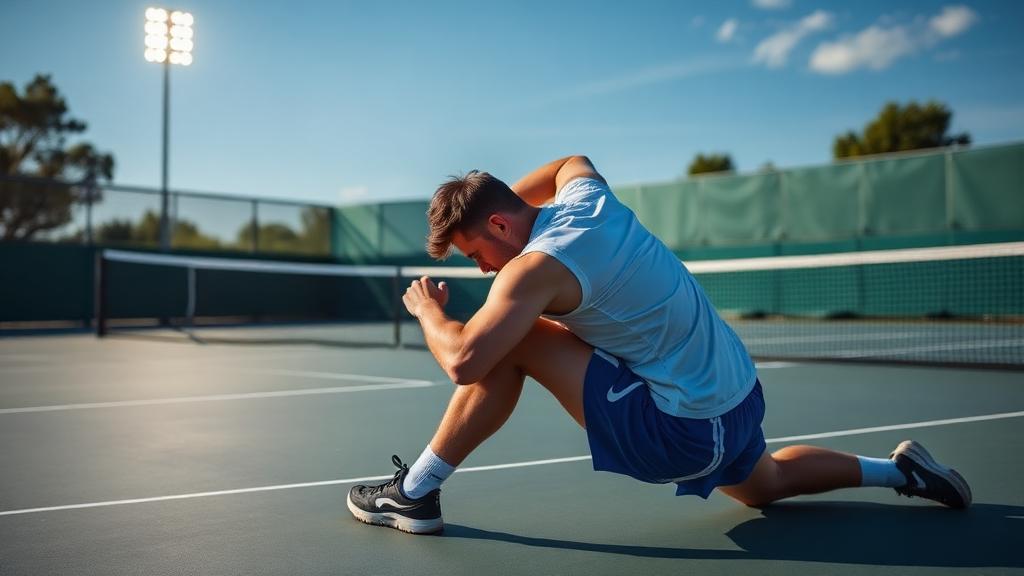
Introduction: Why Injury Prevention Is the Foundation of Long-Term Tennis
Tennis is one of the most rewarding racket sports - physically demanding, tactically rich, and genuinely enjoyable at every level of play. But it is also one of the sports most associated with overuse injuries, particularly at the elbow, shoulder, knee, and wrist.
The good news is that the vast majority of common tennis injuries are preventable. They do not happen randomly - they happen because of incorrect equipment, poor technique, inadequate warm-up, insufficient strength in key muscle groups, or insufficient recovery between sessions.
Players who invest time in injury prevention training do not just get injured less often - they also play better, move more efficiently, and enjoy the sport for longer. Whether you play recreationally on weekends or train competitively across North India, this complete guide gives you everything you need to protect your body and keep playing consistently.
Quick Overview: Injury Prevention Areas Covered
1. Choosing the right equipment → Racket grip size, string tension, shoes, and court surface matching
2. Warm-up before every session → Dynamic activation, sport-specific movement, and progressive intensity
3. Strength training for tennis players → Shoulder, core, and leg conditioning that prevents the most common injuries
4. Footwork and movement mechanics → Why correct movement reduces injury risk dramatically
5. Technique correction → How poor groundstroke and serve technique directly causes injury
6. Shoulder injury prevention → The most vulnerable joint in tennis - specific care strategies
7. Cool-down and recovery → Stretching, ice application, and between-session recovery
8. Common tennis injuries and how to prevent each → Tennis elbow, rotator cuff, knee strain, ankle sprains
1. Choosing the Right Equipment
Equipment choices directly affect injury risk - and this is the area most recreational players overlook entirely.
Racket Grip Size
Using a racket with an incorrect grip size is one of the leading causes of tennis elbow (lateral epicondylitis) - the most common tennis injury at club level.
How to measure correct grip size: Hold the racket in a forehand grip. The gap between your fingertips and the base of your palm should fit your index finger from your other hand. Too small a grip forces excessive forearm muscle contraction to maintain control - creating chronic strain. Too large a grip prevents proper wrist snap and increases elbow stress.
Grip sizes: Racket grips are measured in millimetres or by number (L1–L5 in European sizing, 4⅛ to 4⅝ inches in US sizing). When in doubt, choose the smaller of two sizes and add an overgrip - this is more adjustable than starting too large.
String Tension
String tension has a direct relationship with arm comfort and injury risk.
Lower tension (45–52 lbs): More power and greater shock absorption - the strings flex more on contact, reducing the impact transmitted to the arm. Better for players with arm or elbow sensitivity.
Higher tension (53–60+ lbs): More control, less power assistance, and significantly more impact transmission to the arm and elbow. Only appropriate for advanced players with established, efficient technique.
Recommendation for most recreational players: String tension in the 48–54 lbs range provides good playability with manageable arm impact. If you experience elbow or forearm discomfort, reduce tension by 4–6 lbs before making technique changes.
String Type
Polyester strings: Used by most professionals for control, but extremely arm-unfriendly due to stiffness. Not recommended for recreational or club players unless their technique and physical conditioning specifically support it.
Multifilament or synthetic gut strings: Significantly more arm-friendly, with better shock absorption. The right choice for the majority of non-professional players.
Tennis Shoes and Court Surface Matching
Playing in the wrong shoes for the court surface is a direct cause of ankle sprains, knee strain, and hip discomfort.
Hard court shoes - Reinforced outsole durability, extra cushioning, and specific tread patterns for grip on acrylic or concrete. The cushioning is critical - hard courts transmit more shock than clay or grass.
Clay court shoes - Herringbone tread pattern that grips clay without clogging, allows sliding rather than stopping - reducing knee and ankle stress during direction changes.
Never use running shoes - Insufficient lateral ankle support for the explosive side-to-side movements of tennis. Running shoes are designed for forward motion and will increase injury risk significantly during court play.
2. Warm-Up Before Every Tennis Session
A proper warm-up is the single most effective injury prevention measure available - and the most commonly skipped. Playing at full intensity from a cold start dramatically increases muscle, tendon, and ligament injury risk.
Phase 1: Light Cardiovascular Activation (3–5 Minutes)
Begin with movement that gradually raises heart rate and body temperature:
Light jogging - forward, then backward, then lateral
High knees - 30 seconds
Heel kicks (butt kicks) - 30 seconds
Side shuffles across the baseline - 2 lengths
This raises core body temperature, increases blood flow to muscles, and prepares the cardiovascular system for higher intensity.
Phase 2: Dynamic Stretching and Sport-Specific Movements (5-7 Minutes)
Dynamic stretching - moving stretches, not held static positions - activates muscles without reducing power output the way static stretching before play does.
Key dynamic stretches for tennis:
Arm circles - small to large, forward and backward
Shoulder cross-body swings - progressive range
Hip circles - both directions
Leg swings - front-to-back and side-to-side
Walking lunges with torso rotation - mimics the serve loading position
Ankle rolls - 10 rotations each direction
Phase 3: Tennis-Specific Activation (5 Minutes)
Before hitting at full pace, ease into stroke play:
Mini-tennis - rally from the service line at reduced pace
Groundstroke rallies at 50–60% pace from the baseline - forehand then backhand
Serve motion practice without full power - focus on shoulder rotation and contact point
Volley exchanges at the net
Never begin a session with full-pace serves or overhead smashes - the rotator cuff is particularly vulnerable when cold and the acceleration demands of serving are among the highest in all racket sports.
3. Strength Training for Tennis Injury Prevention
Strength training is not just for performance - it is one of the most evidence-based injury prevention tools available to tennis players at every level. Specific muscle group weaknesses directly correlate with the most common tennis injuries.
Shoulder and Rotator Cuff Strength
Shoulder injuries are the most prevalent serious injury in tennis, particularly for players who serve frequently. The rotator cuff - a group of four muscles stabilising the shoulder joint - is under enormous load during the serve and overhead.
Essential shoulder strengthening exercises:
External rotation with resistance band - Attach a resistance band at elbow height. Keep elbow at 90 degrees, rotate forearm outward against resistance. 3 sets of 15 reps each arm.
Side-lying external rotation - Lying on your side, rotate a light dumbbell upward from hip to vertical. 3 sets of 12 reps.
Scapular retraction rows - Seated cable or band rows focusing on squeezing the shoulder blades together. 3 sets of 15 reps. Strengthens the muscles stabilising the shoulder blade during serving motion.
Y-T-W raises - Lying face down on a bench, raise arms into Y, T, and W positions with light dumbbells. Builds comprehensive shoulder blade muscle endurance. 2 sets of 10 per position.
Core Strength and Stability
Every tennis stroke - groundstrokes, volleys, serves - involves trunk rotation. The core is the link between lower body power and upper body racket speed. Weak core muscles force other structures to compensate, increasing injury risk throughout the kinetic chain.
Essential core exercises for tennis:
Rotational plank - Standard plank with alternate hip rotations toward the floor. 3 sets of 10 each side.
Dead bug - Lying on back, extend alternate arm and leg while maintaining a flat lower back. 3 sets of 10 each side.
Pallof press - Resist a band pulling sideways - specifically trains the anti-rotation core stability that stabilises your body during groundstrokes. 3 sets of 12 each side.
Russian twists with medicine ball - 3 sets of 20 twists. Builds rotational endurance specific to groundstroke production.
Leg Strength for Court Movement
Lower body strength enables correct court positioning, explosive directional changes, and the leg drive that powers efficient stroke mechanics. Without it, players compensate by overloading the arm and shoulder.
Essential leg exercises:
Lateral lunges - Step wide to one side, lower into a single-leg squat position, return. 3 sets of 12 each leg. Directly mimics the wide defensive stance used during wide groundstrokes.
Split squats - Front foot elevated or standard. 3 sets of 10 each leg. Builds single-leg strength critical for lunge stability.
Calf raises - 3 sets of 20. Calf endurance prevents Achilles tendon overload during baseline rallying.
Glute bridges - 3 sets of 15. Glute strength protects the knee and lower back during explosive court movement.
💡 Want a personalised strength and conditioning programme for tennis? Rackonnect's certified coaches at venues across Delhi NCR design injury prevention programmes tailored to your playing level and physical condition. Explore coaching
4. Footwork and Movement Mechanics
Correct footwork is one of the most underappreciated injury prevention tools in tennis. Poor movement mechanics - arriving late to the ball, being off-balance at contact, or using incorrect stopping technique - create compensatory strain on the arm, shoulder, and back.
Why Footwork Prevents Injury
When you arrive at the ball early and in balance, you can use full body rotation to generate power - reducing the load on the arm and shoulder. When you arrive late, you compensate by swinging harder with the arm alone - directly increasing elbow and shoulder injury risk.
The relationship is direct: Better footwork → better position → better technique → less injury.
Key Footwork Habits for Injury Prevention
Split step - A small hop performed as your opponent makes contact, landing on both feet simultaneously with knees slightly bent. This loaded, balanced position allows faster directional movement and reduces the ankle roll risk of moving from a flat-footed standing position.
Recovery steps - After every shot, recover toward the center of the court using small crossover steps. This prevents overextension on the next shot and keeps you balanced at contact.
Proper stopping technique - On clay, controlled sliding stops are correct technique and safe. On hard courts, use controlled deceleration steps - never plant one foot and stop suddenly, which creates enormous knee torque.
Footwork Drills for Injury Prevention
Cone agility drill - Place 4 cones in a square, 3 metres apart. Sprint to each cone, decelerate correctly, change direction. 4 rounds of 30 seconds with full recovery. Builds controlled deceleration habit.
Shadow groundstroke drill - Without a ball, move to forehand and backhand positions using correct footwork, simulate contact, and recover to center. 3 sets of 45 seconds. Builds muscle memory for correct approach mechanics.
5. Technique Correction for Injury Prevention
Poor technique is a primary cause of overuse injuries in tennis - not poor fitness or bad luck. The mechanics of how you swing determine how load is distributed across your joints with every ball struck.
Groundstroke Technique
Prepare the racket early - Late preparation forces rushed swings that generate power through arm acceleration alone rather than full body rotation. Preparing the racket back as soon as you read the ball's direction allows you to use hip and torso rotation - reducing arm load significantly.
Contact point - Hitting the ball too close to the body, too far forward, or too late forces uncomfortable joint angles at contact. The ideal contact point is slightly in front of the body, at a comfortable distance, with the arm at approximately 80% extension. Balls struck at poor contact points create peak stress at the elbow and wrist.
Follow-through - An abbreviated follow-through indicates the swing was decelerating before contact - reducing power and increasing shock transmission to the arm. Allow the racket to complete its natural arc after contact.
Serve Technique
The serve is the highest-stress stroke on the shoulder in all of tennis. Technique errors in the service motion create injury risk that accumulates with every ball served.
Trophy position - At the peak of the service wind-up (trophy position), the racket should be in the back-scratch position with the elbow high and the non-racket arm pointing toward the target. This position loads the shoulder correctly for the acceleration phase.
Leg drive - Using leg drive to initiate serve power reduces the shoulder's load. Players who serve purely with arm acceleration place far greater stress on the rotator cuff than those who use full body sequencing.
Ball toss consistency - An inconsistent ball toss forces last-second adjustments that create irregular joint angles at contact - a primary cause of rotator cuff stress. Work on a consistent, repeatable toss as a priority.
Getting a grip position and technique evaluation from a qualified coaching expert is the fastest way to identify and correct the specific technical errors creating your injury risk. Find Rackonnect coaching near you.
6. Shoulder Injury Prevention: Specific Strategies
Shoulder injuries are the most common serious injury in tennis - and the most career-limiting when they become chronic. The shoulder is involved in every stroke, and the range of motion demands are extreme, particularly during the serve.
The Internal Rotation Deficit Problem
Tennis players frequently develop a loss of internal rotation range of motion in their dominant shoulder - caused by the repeated external rotation demands of serving and overhead hitting. This imbalance puts the shoulder at significant injury risk over time.
How to address it:
Sleeper stretch - Lie on your side with the dominant shoulder underneath. Bend the elbow to 90 degrees and gently press the forearm toward the floor with your other hand. Hold 30 seconds, repeat 3 times. Restores internal rotation range critical for shoulder health.
Cross-body shoulder stretch - Bring the dominant arm across the chest and gently apply pressure with the opposite hand. Hold 30 seconds. Stretches the posterior capsule of the shoulder.
Perform these stretches after every session - not before. Cold shoulder tissue does not respond well to static stretching.
Rotator Cuff Maintenance
The rotator cuff is not just a strength issue - it requires endurance maintenance to handle the volume of strokes in a full tennis session.
Band internal and external rotation circuits - 3 sets of 20 light-resistance repetitions in each direction. Performed 3 times per week as prehabilitation - before any symptoms develop, not after.
Shoulder blade stability exercises - Wall slides, band pull-aparts, and face pulls maintain the scapular stability that supports the rotator cuff during all overhead activity.
7. Cool-Down and Recovery After Tennis
Recovery is not separate from injury prevention - it is an integral part of it. The cumulative load of tennis sessions without adequate recovery leads to the overuse injuries that sideline players for weeks or months.
Post-Session Cool-Down Routine (10–15 Minutes)
Light movement first (3 minutes): Easy walking or very light jogging to gradually reduce heart rate before static stretching. Stretching immediately after intense exercise on a still-elevated heart rate is less effective and sometimes uncomfortable.
Static stretching (7-10 minutes): Hold each stretch 30–45 seconds. Key areas to prioritise:
Calf stretch - Against a wall, straight leg then bent knee. Prevents Achilles tendon tightening.
Hip flexor lunge stretch - Addresses the hip flexor tightening from repeated serve loading and court movement
Quadricep stretch - Standing or lying, heel toward glute. Reduces knee stress after intensive baseline rallying
Chest and anterior shoulder stretch - Doorframe or wall stretch to reverse the forward-dominant shoulder position of racket play
Forearm flexor stretch - Extend arm, bend wrist back with opposite hand. Essential for tennis elbow prevention
Thoracic rotation stretch - Lying with knees bent, rotate knees side to side. Maintains spinal rotation mobility
Ice Application
Apply ice wrapped in a cloth (never directly on skin) to any area of discomfort or soreness for 15-20 minutes within 30–60 minutes of finishing play. Ice reduces acute inflammation and speeds local recovery in commonly stressed areas - particularly the elbow, knee, and shoulder.
Do not apply ice for longer than 20 minutes - excessive icing impairs circulation and delays healing.
Between-Session Recovery
Rest days - Schedule at least one full rest day between intensive tennis sessions. The body's adaptation to training - both fitness improvement and injury prevention - happens during rest, not during play.
Sleep - 7-9 hours of sleep per night is the most powerful recovery tool available. Chronic sleep deficit impairs reaction time, decision-making, and physical recovery simultaneously - all of which increase injury risk.
Hydration - Dehydrated muscles are less elastic and more susceptible to strains. Maintain consistent hydration throughout the day, not just during sessions.
Common Tennis Injuries and How to Prevent Each
Tennis Elbow (Lateral Epicondylitis)
What it is: Pain and inflammation on the outer side of the elbow, caused by overloading the forearm extensor tendons.
Primary causes: Incorrect grip size, high string tension, late backhand preparation, poor technique creating excessive forearm muscle contraction.
Prevention: Correct grip size, appropriate string tension (48–54 lbs), early racket preparation on backhand, forearm stretching after every session, and eccentric wrist exercises (slowly lower a weight from extended wrist position) 3 times per week.
Rotator Cuff Injuries
What it is: Tears, strains, or tendinitis in one or more of the four rotator cuff muscles - most commonly from serving volume and overhead smashing.
Primary causes: Inadequate warm-up, poor serve mechanics, internal rotation deficit, insufficient rotator cuff conditioning.
Prevention: Thorough shoulder warm-up before any serving, sleeper stretch and cross-body stretch after every session, rotator cuff band exercises 3 times per week, and technique evaluation from a qualified coach.
Knee Strain and Patellofemoral Pain
What it is: Pain around or under the kneecap, often caused by the repeated deceleration demands of court movement.
Primary causes: Inadequate leg strength, poor deceleration technique, hard court play without adequate shoe cushioning.
Prevention: Lateral lunge and split squat conditioning, proper deceleration footwork practice, and adequate hard court shoe cushioning.
Ankle Sprains
What it is: Ligament damage from rolling the ankle during rapid directional changes.
Primary causes: Poor footwear, unexpected surface irregularities, fatigue-related movement errors late in sessions.
Prevention: Proper court shoes with lateral support, ankle strengthening (single-leg balance work, resistance band ankle circles), and reducing session intensity when significantly fatigued.
Lower Back Pain
What it is: Muscle or disc stress in the lumbar spine - particularly common from the serve motion and repeated rotation demands.
Primary causes: Weak core, poor serve technique (excessive spine extension), and inadequate hip flexibility.
Prevention: Core stability training (dead bug, pallof press, plank variations), hip flexor stretching, and serve technique evaluation to reduce excessive lumbar extension.
Weekly Injury Prevention Routine for Tennis Players
Incorporate this routine alongside your regular tennis sessions:
On Tennis Days
12–15 minute dynamic warm-up before play (no exceptions)
10–15 minute cool-down and static stretch after play
Ice any sore areas within 60 minutes of finishing (15–20 minutes)
Off-Court Days (2–3 Times Per Week)
Rotator cuff band circuit - 3 sets of 15 each direction (10 minutes)
Core stability session - dead bug, pallof press, rotational plank (15 minutes)
Leg strength - lateral lunges, split squats, calf raises (15 minutes)
Sleeper stretch and shoulder stretches - 5 minutes
Weekly Recovery Priority
Minimum one full rest day per week
7-9 hours sleep per night
Consistent daily hydration
🎾 Book a court and put these injury prevention habits into practice today. Rackonnect operates premium tennis and racket sport venues across Delhi NCR with professional-grade court surfaces designed for safe, high-performance play:
Frequently Asked Questions (FAQ)
Q: What is the most common injury in tennis and how do I prevent it? Tennis elbow (lateral epicondylitis) is the most common tennis injury at recreational and club level. It is primarily caused by incorrect grip size, high string tension, and late backhand preparation. Prevention includes choosing the correct grip size, using arm-friendly string tension (48-54 lbs), preparing the racket early on all groundstrokes, and performing forearm stretches and eccentric strengthening exercises after every session.
Q: How important is warming up before tennis? Extremely important - skipping warm-up is the leading cause of acute muscle and tendon injuries in tennis. A cold muscle has significantly reduced elasticity and is far more susceptible to strains and tears. A 12-15 minute progressive warm-up (light jogging, dynamic stretches, easy groundstroke rallying) is non-negotiable before any tennis session regardless of experience level.
Q: Should I play through tennis elbow pain? No. Playing through tennis elbow pain compounds the injury - turning a manageable overuse issue into a chronic condition that requires months of recovery. Rest the arm, reduce string tension, check grip size, and consult a physiotherapist or sports medicine professional if pain persists beyond a week. Early intervention is always more effective than managing chronic symptoms.
Q: How do I prevent shoulder injuries from serving? Maintain a thorough shoulder warm-up before any serving (never start serving cold), perform rotator cuff band exercises three times per week as prehabilitation, do the sleeper stretch and cross-body stretch after every session, and have your serve technique evaluated by a qualified coach to identify any mechanical errors creating shoulder stress. Find coaching
Q: Does string tension really affect injury risk? Yes - significantly. Higher string tension increases the shock transmitted to the arm and elbow on every ball struck. For recreational and club players, reducing string tension by 4-6 lbs can noticeably reduce arm and elbow discomfort without significantly affecting playability. Multifilament or synthetic gut strings are also substantially more arm-friendly than polyester strings.
Q: How often should I rest between tennis sessions? At minimum, avoid intensive tennis on consecutive days until your physical conditioning is well established. For recreational players, 2–3 sessions per week with rest days between is the ideal balance of development and recovery. For more frequent players, alternate high-intensity and low-intensity sessions rather than playing at full intensity every day.
Q: How can I find quality tennis coaching and courts near me? Rackonnect provides access to premium racket sport venues and certified coaching programmes across Delhi NCR and North India. You can book courts, find coaching sessions, and manage your training schedule through the Rackonnect technology platform - making it easy to play consistently on quality surfaces with professional guidance.
Conclusion: Prevention Is Always Better Than Treatment
Tennis injuries are not inevitable. They are largely the result of preventable factors - incorrect equipment, inadequate warm-up, insufficient strength in key muscle groups, poor technique, and insufficient recovery. Address these factors systematically and your injury risk decreases dramatically.
The players who enjoy tennis for decades - recreational club players, competitive amateurs, and former professionals - share a common characteristic: they treat injury prevention as a non-negotiable part of their tennis routine, not as an afterthought when something already hurts.
Start with the basics: correct equipment, thorough warm-up, consistent cool-down, and appropriate footwear. Add strength training progressively. Get technique evaluated by a coach. Recover adequately between sessions.
Do these things consistently and you will play more tennis, play better tennis, and play it for much longer.
Play on quality courts with certified coaching support at Rackonnect: