
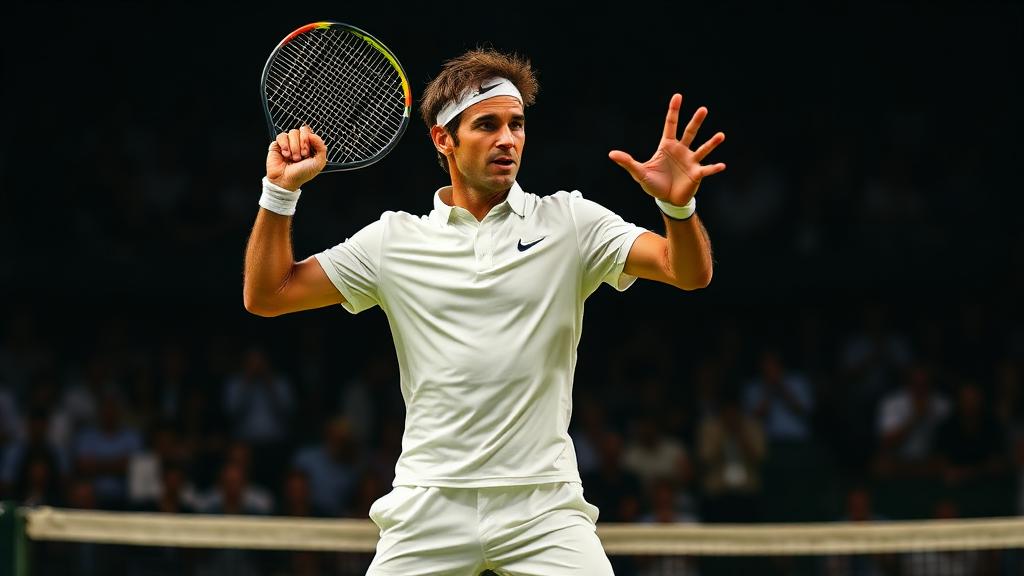
Introduction: The Man Behind the Legend
Roger Federer is widely regarded as one of the greatest tennis players of all time - perhaps the greatest. During his extraordinary career, the Swiss maestro won 20 Grand Slam titles, held the world number one ranking for a record 310 weeks, and became synonymous with grace, elegance, and sportsmanship on and off the court.
When Federer announced his retirement in September 2022 - playing his final match at the Laver Cup in London - the tennis world mourned the end of an era. He had given the sport two decades of brilliance, during which his conduct was almost universally admired.
Almost. Because even Federer - the player most often cited for his on-court composure and off-court diplomacy - had his controversial moments. Some were minor, some were misunderstood, and some were simply human. Together, they offer a more complete portrait of one of sport's most celebrated figures.
Here are five of the most talked-about controversies in Roger Federer's career.
1. Supporting India Over Pakistan at the 2015 Cricket World Cup
What Happened
During the 2015 ICC Cricket World Cup, the India vs Pakistan match was - as always - one of the most watched sporting events on the planet. During this period, Roger Federer was seen holding a Team India cricket jersey and posted a photo on his Facebook page.
The caption on his page read: "Dressing up for a Gentleman's game today. #BleedBlue" - a clear show of support for the Indian team.
The Reaction
The post caused an immediate and strong reaction among Federer's Pakistani fans, who felt hurt that their beloved tennis hero had publicly backed their rivals without any acknowledgement of Pakistan. Social media criticism was swift, with many Pakistani fans expressing their disappointment directly on the post.
Federer's Response
Federer subsequently clarified that the post was part of a Nike marketing campaign and that his intention had never been to take sides in a sporting rivalry or cause offence to any fans. He acknowledged the sensitivity of the India-Pakistan sporting contest and apologised to those who felt hurt by the gesture.
The incident highlighted the global reach of Federer's influence - a social media post about cricket could generate significant controversy across an entire nation - while also demonstrating his willingness to address criticism directly rather than ignore it.
2. The US Open Fine for Swearing at the Umpire (2009)
What Happened
The 2009 US Open final between Roger Federer and Juan Martín del Potro remains one of the most remarkable Grand Slam finals in modern tennis history. Del Potro, then 20 years old, defeated the five-time defending champion in a five-set classic - one of the very few occasions a player outside of the Big Four won a Grand Slam between 2005 and 2013.
During a critical moment in the match, Federer lost his composure and directed a profanity at the chair umpire. The incident occurred when del Potro successfully challenged a line call - overturning an out decision that allowed him to break Federer's serve and take the second set. Federer, visibly frustrated at the reversal and what he felt was excessive time being taken over the challenge, swore loudly enough to be heard.
The Consequence
The outburst earned Federer a fine of $1,500 - a relatively modest sum for a player at his level, but notable given how rarely Federer attracted any form of official sanction. For a player so associated with on-court decorum, even a single incident of this nature generated significant comment.
The Context
Del Potro won the match in five sets - one of the greatest upsets of the era. Federer's frustration was understandable in the context of a tight final, and the incident was widely treated as a rare human moment rather than a pattern of behaviour. It remained, for most observers, a footnote to an otherwise outstanding career.
3. The Orange Shoes Banned at Wimbledon (2013)
What Happened
Wimbledon's all-white clothing rule is one of the most distinctive and rigidly enforced traditions in professional sport. The All England Club requires players to wear predominantly white clothing throughout the Championships - a rule that has generated controversy with various players over the years.
In 2013, Federer arrived at Wimbledon wearing Nike trainer shoes that featured a significant amount of orange colouring - most notably the bright orange sole - which the All England Club deemed to be in violation of the all-white policy.
The Response
Officials from the All England Club asked Federer to change his footwear for subsequent rounds of the Championships. Nike, his equipment sponsor, had apparently pushed the boundaries of the colour rules with the design - the bright orange sole having perhaps not been anticipated as a violation during the approval process.
The Outcome
Federer was not fined for the incident - the All England Club requested the change rather than imposing a financial penalty - and he complied without significant public dispute. The episode became something of a talking point about the rigidity of Wimbledon's dress code and the ongoing tension between the club's traditional standards and modern sportswear marketing.
It remains one of the more lighthearted controversies of Federer's career - more amusing than serious, and quickly resolved.
4. The Boris Becker Book Comments
What Happened
Boris Becker - the former Wimbledon champion and, at the time, the coach of Novak Djokovic - published a book titled "Wimbledon: My Life and Career at the All England Club," in which he made a series of comments about Roger Federer.
Becker wrote that Federer did not express his true feelings openly, suggesting that Federer was careful to protect both his image and the feelings of others - to such an extent that his public persona did not reflect his genuine private views. Becker also included observations about the relationship between Federer and Djokovic - a rivalry that, at the time of publication, was one of the defining dynamics in men's tennis.
Federer's Response
Federer's response was characteristically measured and sharp. "Books are there to be sold," he said - a succinct and pointed dismissal that acknowledged the commercial motivation behind high-profile sports books without engaging directly with the content of the comments.
The incident drew attention both to the Becker-Djokovic-Federer dynamic of that era and to the broader question of how players and coaches use memoirs and books to shape public narratives about rivals.
The Wider Context
Becker's relationship with Djokovic eventually ended, and his subsequent personal legal difficulties overshadowed much of his post-playing career commentary. The Federer comments, in retrospect, say as much about the competitive tensions of that period in men's tennis as they do about either player.
5. Telling the French Crowd to "Shut Up" at the 2012 French Open
What Happened
Roland Garros has never been considered Federer's most natural home - the heavy clay surface of the French Open favoured the physical baseline game of rivals like Rafael Nadal, who dominated the tournament to an unprecedented degree during Federer's career.
In 2012, during a match against Juan Martín del Potro at the French Open, Federer had already lost the first set and was on the verge of dropping the second as well. At a moment of particular frustration - after hitting a ball into the net to halt what had been an excellent rally - Federer turned to the crowd and loudly told them to be quiet. The French crowd, never shy about expressing its opinions during matches, had apparently been adding to the tension of the moment.
The Reaction
The moment generated immediate coverage - the image of the usually composed Federer, visibly frustrated, directing his irritation at a crowd of spectators was unusual enough to attract significant attention.
What Happened Next
Here is the remarkable part of the story: Federer then won the next three sets to advance to the semi-final - his 31st Grand Slam semi-final appearance. Whether the outburst served as a release valve that helped him refocus, or whether he simply rediscovered his form, the result was a demonstration of his extraordinary competitive resilience.
The incident is remembered as much for what followed as for the moment itself - proof that even when Federer's composure cracked, his tennis remained capable of recovering to the highest level.
What These Moments Tell Us
Across all five of these incidents, a consistent picture emerges. These were not the controversies of a difficult personality or a player who brought systematic problems to the sport. They were the human moments of an intensely competitive individual who, for the vast majority of his career, maintained a standard of conduct that other players and commentators openly admired.
The Nike shoe incident was a mild rule infringement quickly resolved. The umpire fine was a single moment of frustration in a career of thousands of matches. The India cricket post was a marketing misstep rather than a deliberate slight. The Becker book response was handled with characteristic dry wit. And the French crowd moment led to one of the most remarkable comebacks of that particular tournament.
In a career defined by excellence, elegance, and longevity, these incidents serve as reminders that even the most composed champions are human - and that part of what made Federer so compelling was the rarity with which these moments occurred.
For fans of racket sports across India and the world, Federer's career remains an inspiration - from the junior club player picking up a racket for the first time to the competitive club player aspiring to their own best tennis. The standards he set - technical, competitive, and behavioural - continue to define what excellence in racket sports looks like.
If Federer's career has inspired you to take your own racket sport seriously, Rackonnect's coaching programmes provide structured development for players at every level across Delhi NCR and North India. And if you are ready to test yourself competitively, Rackonnect tournaments offer the kind of competitive experience that builds the character and composure this sport demands.
A Final Word on the GOAT Debate
Federer retired with 20 Grand Slam titles - a number that has since been surpassed by both Rafael Nadal (22) and Novak Djokovic (24). The numbers ensure that the GOAT debate will continue indefinitely among tennis fans.
But for many who watched him play, the question of titles was always secondary to the question of how he played them. The controversies in this article, minor as they were, are dwarfed by the memory of what Roger Federer gave to tennis across two extraordinary decades.
Stay connected with the world of racket sports through https://rackonnect.com - India's largest platform for racket sports, where the next generation of players is already building their own stories.