1. Introduction
In competitive badminton, the difference between winning and losing often comes down to control rather than power. While smashes often grab attention, it is the advanced drop shot that truly disrupts opponents, breaks their rhythm, and creates winning opportunities. A perfectly executed drop shot forces your opponent to move forward suddenly, opening up the backcourt for your next attacking shot.
Advanced badminton drop shot techniques go far beyond simply “hitting the shuttle softly.” They involve deception, efficient biomechanics, precise contact timing, and intelligent tactical application. At higher levels of play, your drop shot must look like a smash or clear until the very last moment. That disguise is what separates intermediate players from competitive athletes.
In this guide, you will learn what makes a drop shot advanced, the different types of high-level drop shots, and the biomechanics behind an effective and deceptive stroke. Whether you are preparing for tournaments or aiming to dominate club competition, mastering advanced drop shots will elevate your overall game strategy.
2. What is an Advanced Drop Shot? Types and When to Use Them
A drop shot in badminton is a soft stroke played from the rear court that lands close to the opponent’s forecourt. However, an advanced drop shot is defined by deception, sharp placement, and tactical purpose.
At a competitive level, drop shots are not random soft shots. They are strategic weapons used to manipulate court positioning and control rally tempo.
Types of Advanced Drop Shots
1. Fast Drop Shot
A fast drop shot travels flatter and slightly quicker than a slow drop. It lands closer to the short service line rather than tight to the net.
When to use it:
When your opponent is positioned deep in the backcourt
To maintain attacking pressure
In doubles matches where faster tempo is required
2. Slow (Tight) Drop Shot
A slow drop shot is played very softly so that the shuttle falls just over the net.
When to use it:
To force a deep lunge from your opponent
To create weak net returns
To set up a net kill or attacking lift
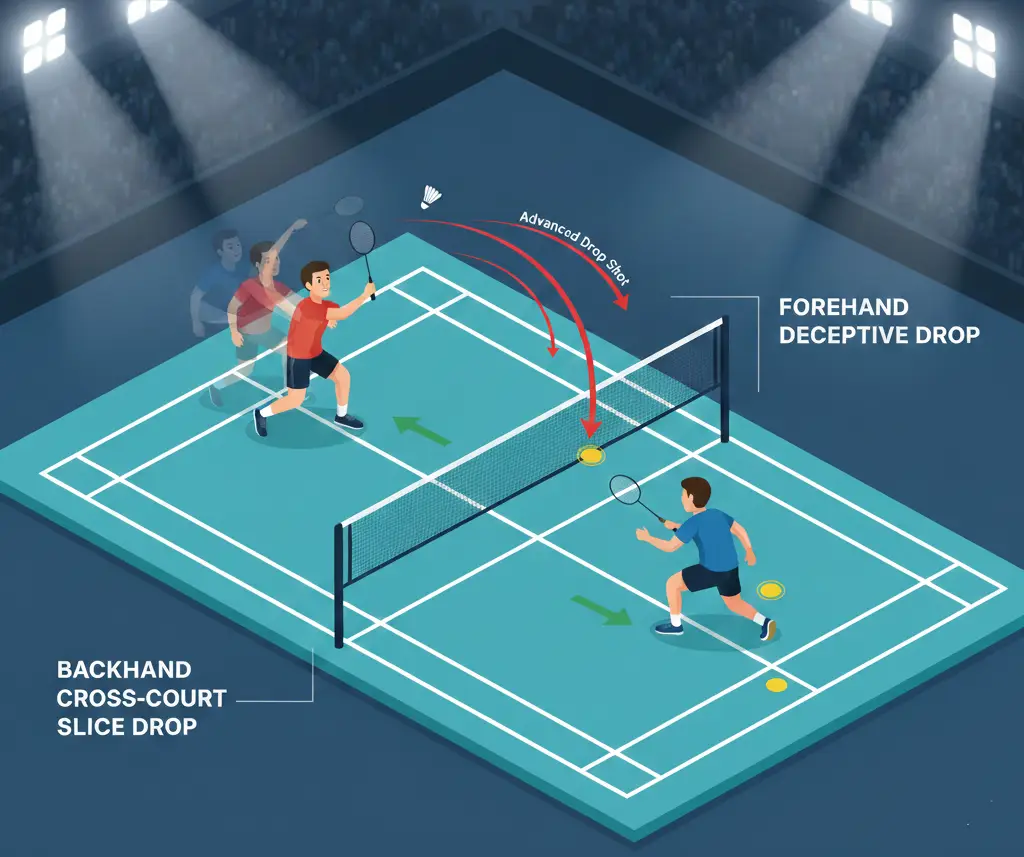
3. Slice Drop Shot
In a slice drop shot, the shuttle is brushed across the racket strings, creating spin and a sharper angle.
When to use it:
To increase deception
To create cross-court angles
Against opponents who anticipate straight drop shots
4. Reverse Slice Drop Shot
The reverse slice drop shot is highly deceptive. The racket moves in one direction, but the shuttle travels in another.
When to use it:
To wrong-foot your opponent
During long rallies to surprise defenders
After a series of smashes to change pace
Tactical Importance of Advanced Drop Shots
Advanced drop shots are used to:
Change the speed of the rally
Force the opponent to move from backcourt to forecourt
Break defensive rhythm
Create space for a winning smash
Top-level players often prepare for a smash but execute a drop shot instead. This identical preparation creates hesitation, and hesitation leads to points.
3. Biomechanics and Stroke Mechanics of an Advanced Drop Shot
Understanding biomechanics is essential for mastering advanced badminton drop shot techniques. Although a drop shot looks gentle, it requires precise body coordination.
Preparation Phase
Your preparation for a drop shot should look identical to a smash or clear. This is critical for deception.
Turn your body sideways
Raise your non-racket arm for balance
Keep your elbow high
Position the racket behind your head
By maintaining the same preparation as a powerful shot, you prevent your opponent from reading your intention early.
Kinetic Chain and Power Control
In a smash, full power is transferred from the legs to the hips, torso, shoulder, arm, and wrist.
In a drop shot:
The lower body still rotates to maintain balance
The swing initially resembles a smash
The wrist and forearm reduce power just before contact
The key is maintaining racket head speed during preparation and slowing slightly at the moment of contact. This creates the illusion of power while producing a soft landing.
Contact Point
Proper contact is crucial for accuracy and control.
Hit the shuttle at the highest reachable point
Make contact slightly in front of your body
Keep your grip relaxed for better touch
For slice drops, brush across the cork instead of hitting it directly
Early contact improves angle and placement. Late contact reduces control and reveals your shot intention.
Follow-Through and Recovery
Unlike a smash, which has a full and aggressive follow-through, a drop shot requires:
A shorter and controlled follow-through
Balanced body positioning
Immediate recovery to base position
Quick recovery is essential because your opponent may lift the shuttle, giving you another attacking opportunity.
4. Grip, Racket Angle and Contact Precision
Mastering advanced badminton drop shot techniques requires precise grip adjustments and refined racket control. Even small changes in finger pressure and racket angle can significantly affect shuttle placement.
Proper Grip for Advanced Drop Shots
For forehand rear-court drops, use a relaxed forehand grip. The grip should not be tight throughout the swing. Instead:
Keep the fingers relaxed during preparation
Tighten slightly at the moment of contact
Relax immediately after contact
This finger power adjustment allows better shuttle control and improves deception.
For backhand drops:
Use a backhand thumb grip
Apply controlled thumb pressure during contact
Avoid excessive wrist snapping
A tight grip throughout the swing reduces control and makes your drop shot predictable.
Racket Angle Control
Racket face angle determines shuttle trajectory:
A slightly open racket face produces a softer, tighter drop
A flatter racket face produces a faster drop
A slicing motion creates spin and sharper angles
Small angle variations create major differences in landing position. Advanced players practice controlling these micro-adjustments.
Contact Precision
Precision at contact is what separates elite players from average players.
Aim to contact the shuttle cleanly at the cork
Maintain a smooth brushing action for slice drops
Keep your wrist stable and controlled
The goal is not just to make the shuttle land in the forecourt, but to make it land where the opponent struggles to return it effectively.
5. Footwork and Body Positioning for Perfect Execution
Even the most technically sound drop shot will fail without proper footwork. Efficient movement allows you to reach the shuttle early and maintain balance for deception.
Rear-Court Positioning
When moving to the rear court:
Perform a split step before your opponent hits
Use quick chasse or crossover steps
Turn your body sideways as you approach the shuttle
Reaching the shuttle early gives you more options — smash, clear, or drop. Late positioning limits your choices and reveals your shot.
Weight Transfer and Balance
Proper body balance ensures control:
Transfer weight from your back foot to your front foot during the stroke
Keep your core engaged for stability
Avoid leaning too far backward
A balanced body allows you to execute deceptive shots without losing recovery speed.
Recovery After the Drop Shot
After playing a drop shot:
Push off immediately toward your base position
Stay light on your feet
Prepare for a lift or net reply
Advanced players recover instantly because opponents often lift tight drops. If you recover slowly, you lose the attacking advantage.
Footwork Drill for Improvement
One effective drill is the “rear-court repetition drill”:
A partner feeds high lifts to your backhand or forehand rear court.
You alternate between smash and drop shots using identical preparation.
Focus on quick recovery after every stroke.
Practicing under speed improves both footwork and deception consistency.
6. Deception Techniques: Fast-Then-Slow Swing and Reverse Slice Mastery
Deception is the defining element of advanced drop shots. Without disguise, even a technically perfect drop becomes easy to defend.
The Fast-Then-Slow Swing Concept
One of the most effective deception techniques is the fast-then-slow swing.
Prepare as if you are going to smash
Accelerate your arm normally
Reduce power only at the final moment of contact
To your opponent, the stroke initially looks aggressive. The delayed softening causes hesitation, forcing them to react late.
Identical Preparation Principle
Your drop shot, smash, and clear should all begin with the same preparation:
Same body rotation
Same racket preparation
Same jump or non-jump approach
If your preparation changes, experienced opponents will anticipate the drop early.
Reverse Slice Deception
The reverse slice drop is an advanced variation used by high-level players.
Swing as if hitting straight
Brush the shuttle across the strings
Send it cross-court instead
Because the racket motion suggests a straight shot, the opponent often moves in the wrong direction.
Balancing Deception and Control
While deception is powerful, excessive slicing can reduce accuracy. Therefore:
Use deception strategically, not every rally
Maintain consistency before adding complexity
Practice both straight and cross variations
The ultimate goal is unpredictability. When your opponent cannot confidently read your intention, you gain full tactical control of the rally.
7. Advanced Variations and Shot Selection Strategy
At a competitive level, executing the drop shot correctly is only half the battle. The real advantage comes from knowing when and where to use each variation.
Straight vs Cross-Court Drop
Straight Drop Shot
Safer option
Shorter travel distance
Faster recovery
Best used when you are under mild pressure or want to maintain control.
Cross-Court Drop Shot
Creates wider angles
Forces extreme lateral movement
Higher risk due to longer shuttle travel
Best used when your opponent is positioned toward one side of the court.
Singles vs Doubles Application
In Singles:
Drops are used to move opponents continuously
Tight drops can exhaust opponents
Combining drop and clear increases rally control
In Doubles:
Fast drops are more effective than slow ones
Tight net drops can be punished quickly
Use drops to disrupt defensive formations
Reading Your Opponent
Before selecting your drop variation, observe:
Is your opponent standing deep? Use a tight drop.
Are they rushing forward? Use a fast drop or punch clear.
Are they anticipating straight shots? Use cross or reverse slice.
Advanced shot selection is about exploiting positioning, not just executing technique.
8. Progressive Practice Plan for Competitive Players
To truly master advanced badminton drop shot techniques, structured practice is essential. Below is a four-week progressive training framework.
Week 1: Technique Refinement
Focus on:
High contact point
Relaxed grip
Clean shuttle contact
Drill:
50 straight forehand drops
50 backhand drops
Focus on consistency, not deception
Goal: 80% of shots landing within 1 meter of the net.
Week 2: Adding Movement
Focus on:
Rear-court footwork
Quick recovery
Balanced body positioning
Drill:
Partner feeds lifts randomly to forehand/backhand rear court
Alternate between drop and clear
Recover immediately to base
Goal: Maintain technique under movement pressure.
Week 3: Introducing Deception
Focus on:
Identical preparation for smash and drop
Fast-then-slow swing control
Slice variations
Drill:
Multi-shuttle feeding
Coach calls “smash” or “drop” at the last second
Maintain same preparation every time
Goal: Opponent cannot read your shot early.
Week 4: Match Simulation
Focus on:
Tactical use
Decision-making under pressure
Variation timing
Drill:
Play practice games where at least 30% of rear-court shots must be drops
Analyze effectiveness
Goal: Integrate drop shots naturally into match play.
Consistency and repetition build confidence. Advanced techniques only become reliable when practiced under realistic match conditions.
9. Common Mistakes and How to Fix Them
Even experienced players make technical errors when attempting advanced drop shots.
Mistake 1: Hitting Too Hard
Problem: Shuttle lands mid-court and becomes easy to attack.
Fix: Relax grip pressure and reduce wrist acceleration at contact.
Mistake 2: Telegraphing the Shot
Problem: Opponent moves early because preparation looks different.
Fix: Practice identical preparation for smash and drop.
Mistake 3: Late Contact
Problem: Shuttle lacks angle and control.
Fix: Improve rear-court footwork and reach the shuttle earlier.
Mistake 4: Poor Recovery
Problem: Slow return to base position.
Fix: Focus on balanced landing and immediate push-off after contact.
Eliminating these errors improves consistency and unpredictability.
10. Equipment and Shuttle Considerations
Your equipment can influence drop shot performance.
Higher string tension provides better control but requires precise timing.
Slightly head-light rackets improve maneuverability for deceptive strokes.
Shuttle speed and hall conditions affect drop accuracy.
Players should test different string tensions and shuttles during training to find optimal control settings.
11. Match Tactics and Winning Combinations
Advanced drop shots become lethal when combined with other attacking strokes.
Effective Combinations
Smash → Tight Drop → Net Kill
Clear → Slice Drop → Cross Net Shot
Fast Drop → Lift → Jump Smash
These combinations force constant forward and backward movement, exhausting opponents physically and mentally.
Creating Pressure
Repeatedly alternating between powerful and soft shots creates uncertainty. Once hesitation appears, capitalize with a decisive attack.
Drop shots are not finishing shots alone — they are rally constructors that create scoring opportunities.
12. Mental Focus and Decision-Making
Advanced badminton is as much mental as physical.
To maximize drop shot effectiveness:
Stay patient during long rallies
Observe opponent positioning continuously
Commit fully to deception
Avoid overusing complex variations
Confidence in execution prevents hesitation. A committed drop shot is far more effective than a doubtful one.
13. Frequently Asked Questions (FAQ)
What is the difference between a net shot and a drop shot?
A drop shot is played from the rear court to the opponent’s forecourt. A net shot is played near the net area. Drop shots travel longer distances and require greater control and deception.
How can I improve deception in my drop shot?
Use identical preparation for smash, clear, and drop. Maintain racket head speed and reduce power only at the final moment of contact.
Is the slice drop shot necessary for competitive play?
While not mandatory, slice drops increase unpredictability and create sharper angles, making them valuable at advanced levels.
How often should I practice drop shots?
Competitive players should practice drop shots at least 2–3 times per week, incorporating them into multi-shuttle and match-simulation drills.
Why does my drop shot go too high?
This usually happens due to an open racket face or excessive wrist motion. Focus on controlled contact and proper angle alignment.
14. Conclusion
Advanced badminton drop shot techniques are essential for competitive success. By mastering grip control, precise biomechanics, deceptive swing patterns, and tactical decision-making, you transform the drop shot into a strategic weapon.
Remember, the goal is not just softness — it is unpredictability, precision, and timing. Practice consistently, refine your deception, and integrate drops naturally into match play. Over time, your drop shot will become one of your most reliable tools for controlling rallies and winning points.