Organising a badminton tournament means managing registrations, match schedules, courts, officials and equipment. Among these responsibilities, one small but essential item can easily disrupt a well-planned event: running out of shuttlecocks before the final match.
Unlike many other racket sports, competitive badminton uses feather shuttlecocks that can wear out during play. A shuttlecock may need replacing because of damaged feathers, unstable flight or changes in playing performance.
So, how many shuttlecocks are needed for a badminton tournament? The answer depends on the total number of matches, player level, scoring format, shuttlecock durability and competition conditions.
For many local and regional tournaments, the Badminton World Federation's Referees' Manual provides a useful planning estimate of three to four shuttlecocks per match. Actual consumption can vary, so tournament organisers should adjust this estimate according to previous event records and the shuttlecock model being used.
This guide explains how to calculate your tournament's shuttlecock requirements, estimate the number of tubes to order, prepare a practical equipment budget and avoid unnecessary stock shortages.
How Many Shuttlecocks Are Used in One Badminton Match?
A useful starting estimate for many local and regional badminton tournaments is 3–4 shuttlecocks per match.
The BWF Referees' Manual, Level 1, Section 4.4, identifies this range for tournament planning while noting that the appropriate quantity depends on the players' age, proficiency, shuttlecock quality and durability.
It is a planning recommendation, not a rule requiring every match to use exactly three or four shuttlecocks.
For example, a short junior match may use fewer shuttles than a physically demanding match between advanced players. Some matches require frequent replacements, while others can be completed with relatively few.
For initial planning, organisers can consider the following approach:
Three shuttlecocks per match: A reasonable starting estimate for a local event when previous experience supports that level of consumption.
Four shuttlecocks per match: A more cautious starting estimate for local and regional competition, especially when usage data is limited.
More than four: May be appropriate for demanding matches, less durable products or event conditions associated with higher replacement rates.
The final decision should reflect real playing conditions rather than assuming that the same quantity will work for every tournament.
Official planning reference: BWF Referees' Manual, Level 1 — Section 4.4, Estimation of Playing Hours and Shuttles Required.
How to Calculate Shuttlecock Requirements for a Badminton Tournament
The basic calculation is straightforward. First, determine how many matches your tournament will include. Then multiply that number by your estimated shuttlecock consumption per match.
Base shuttlecock requirement = Total scheduled matches × Estimated new shuttlecocks per match
For example, suppose your tournament has 100 scheduled matches and you estimate four shuttlecocks per match.
100 matches × 4 shuttlecocks = 400 shuttlecocks.
That is your estimated match-play consumption before adding any allowance for unexpected demand, testing or other separately budgeted requirements.
How to Add Reserve Stock
Tournament organisers may want additional inventory in case match consumption exceeds their estimates or replacement stock cannot be delivered quickly.
For illustration, consider a 15% allowance:
Planned quantity = Base shuttlecock requirement × 1.15
Using the previous example:
400 × 1.15 = 460 shuttlecocks.
This 15% is an illustrative purchasing allowance, not a fixed BWF requirement. Organisers with reliable historical consumption records may choose a different allowance.
How to Convert Shuttlecock Quantity Into Tubes
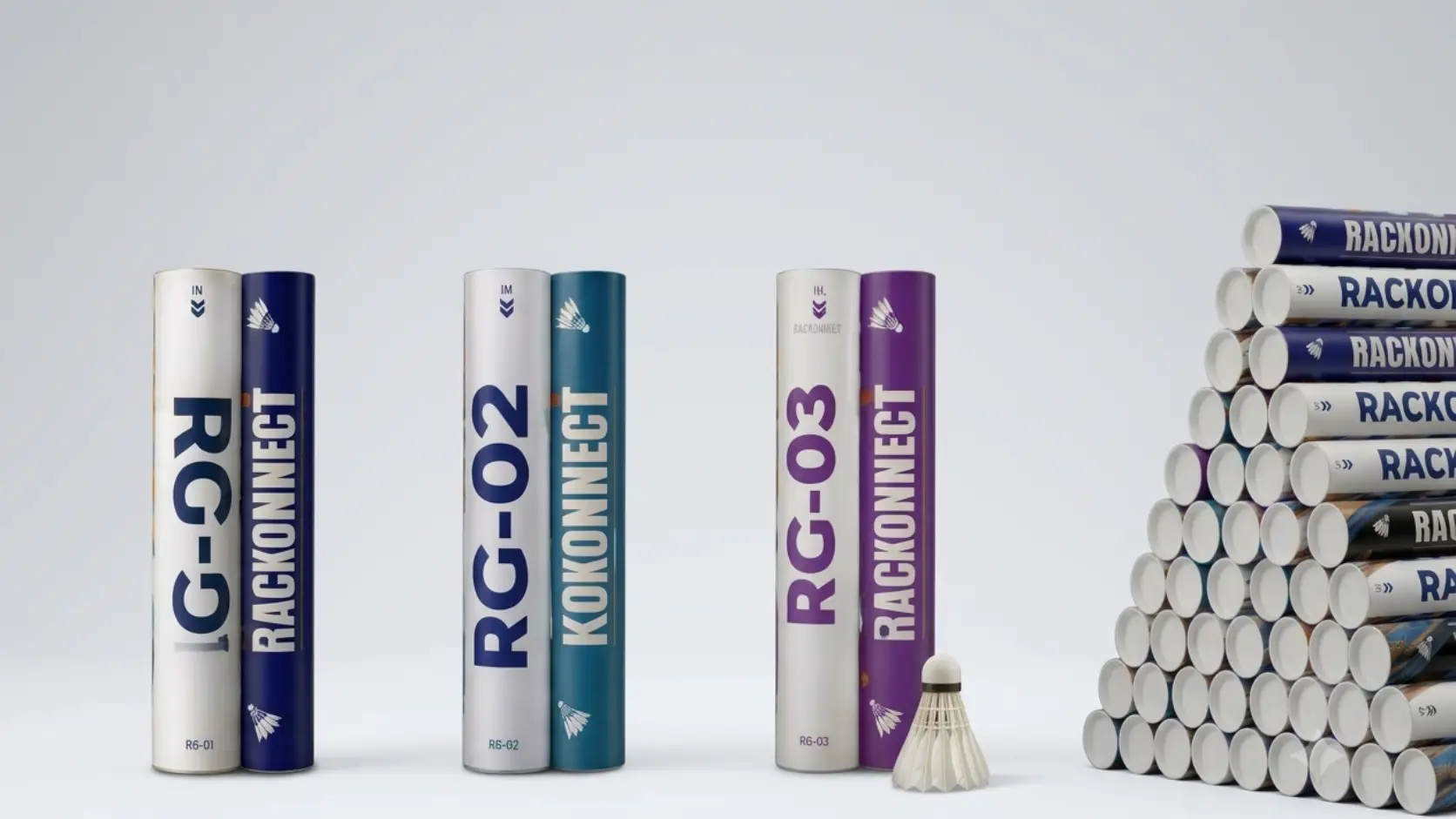
Rackonnect's feather shuttlecock range contains 12 pieces per tube.
To calculate the number of tubes:
Tubes required = Planned shuttlecock quantity ÷ 12
Always round up to a whole tube.
For 460 shuttlecocks:
460 ÷ 12 = 38.33, rounded up to 39 tubes.
Therefore, a tournament with 100 matches, an assumed four shuttlecocks per match and a 15% inventory allowance would require approximately 39 tubes containing 468 shuttlecocks.
The remaining eight shuttlecocks are the additional quantity created by purchasing complete tubes.
Step 1: Calculate the Number of Matches in Your Tournament
Before estimating equipment quantities, confirm your competition format. The number of registrations does not always equal the number of matches.
Single-Elimination or Knockout Tournament
In a standard single-elimination tournament with one champion and no additional classification matches, each completed match eliminates one competitor or team.
The formula is:
Total matches = Number of entries − 1
For example:
Entries | Total Matches | Estimated Shuttles at 3 per Match | Estimated Shuttles at 4 per Match |
16 | 15 | 45 | 60 |
32 | 31 | 93 | 124 |
64 | 63 | 189 | 252 |
128 | 127 | 381 | 508 |
These figures exclude reserve stock, warm-up or testing use, and additional classification matches.
In doubles events, each pair counts as one entry for this formula. A 32-pair doubles knockout event normally requires 31 matches, not 63 or 64.
If your tournament includes third-place playoffs, consolation rounds or other classification matches, add those matches separately.
Round-Robin Badminton Tournament
In a single round-robin competition, every entrant plays each other entrant once.
The formula is:
Total matches = N × (N − 1) ÷ 2
Here, N represents the number of players or doubles pairs in the group.
For example, with eight entries:
8 × 7 ÷ 2 = 28 matches.
At four shuttlecocks per match, that means 112 shuttlecocks before adding reserve stock.
Entries in One Group | Matches |
4 | 6 |
5 | 10 |
6 | 15 |
8 | 28 |
A double round-robin, where every entrant meets each other twice, requires twice the number of matches shown above.
Group Stage Followed by Knockouts
Some tournaments combine round-robin groups with knockout playoffs.
Suppose an event has four groups of four players, with every player facing the other three competitors in their group.
Each group has six round-robin matches.
Four groups therefore produce 24 matches.
If the winner of each group progresses to a four-player knockout stage, three more matches are required.
The total is 27 matches.
If the top two players from each group advance to an eight-player knockout stage, the playoff stage requires seven matches instead, producing 31 matches overall.
These examples show why organisers should finalise the format and qualification rules before placing their main shuttlecock order.
Step 2: Estimate Shuttlecock Quantity for 50, 100 or 200 Matches
The following table uses four new shuttlecocks per match, a 15% illustrative inventory allowance and 12 shuttlecocks per tube.
Scheduled Matches | Base Shuttlecocks | Quantity with 15% Allowance | Whole Tubes to Order |
50 | 200 | 230 | 20 |
100 | 400 | 460 | 39 |
200 | 800 | 920 | 77 |
These are planning examples rather than fixed tournament equipment standards. Shuttlecock consumption may be different if matches use shorter scoring formats, player levels vary significantly or the selected product has different durability characteristics.
For a multi-category tournament, add the match counts from men's singles, women's singles, men's doubles, women's doubles, mixed doubles and any age-group competitions before applying the quantity formula.
Step 3: Calculate Your Tournament Shuttlecock Budget in India
Once you know the number of tubes required, calculating the equipment budget becomes much easier.
The actual feather shuttlecock price depends on product grade, brand, order quantity, supplier and delivery terms.
For the following examples, assume a hypothetical price of ₹900 per tube containing 12 shuttlecocks.
Cost per shuttlecock = ₹900 ÷ 12 = ₹75.
These figures are for explaining the calculation. They are not confirmed Rackonnect prices or an Indian market average.
Example Tournament Shuttlecock Budget
Matches | Tubes Including Allowance | Assumed Price per Tube | Illustrative Budget |
50 | 20 | ₹900 | ₹18,000 |
100 | 39 | ₹900 | ₹35,100 |
200 | 77 | ₹900 | ₹69,300 |
Important: These are hypothetical purchase budgets based on the assumptions in this guide. Actual quotations may include different product prices, taxes, shipping charges and minimum order quantities.
If the supplier offers bulk pricing, replace the hypothetical ₹900 figure with your confirmed quote.
Use the formula:
Tournament shuttlecock budget = Whole tubes required × Quoted price per tube
Then add any delivery, tax or handling charges not already included in the quotation.
For actual feather shuttlecock prices, organisers can request a bulk tournament supply quotation from Rackonnect.
Step 4: Choose the Right Feather Shuttlecocks for Tournament Matches
The cheapest shuttlecock is not necessarily the most economical option for a competitive badminton tournament.
A suitable tournament shuttlecock should offer consistent flight, appropriate speed and reasonable durability under the intended playing conditions.
Before selecting a product, evaluate these factors:
Flight Consistency
Players should be able to anticipate how the shuttlecock travels during clears, drops, drives and defensive shots.
If different shuttlecocks from the same order behave unpredictably, players may find it difficult to maintain consistent match performance.
Shuttlecock Speed
Temperature, altitude and playing conditions affect shuttle flight. A product that performs appropriately at one venue may need reassessment at another.
Organisers should test the selected shuttlecock speed on the actual tournament courts before play begins.
Avoid deciding which speed to buy solely on the basis of a city, season or number printed on the tube.
Durability
A more durable shuttlecock may reduce the number of replacements needed during an event.
However, durability needs to be measured under actual playing conditions rather than accepted as an unsupported product claim.
Organisers can run trial matches and record how many new shuttlecocks are used per match for different models.
Product and Batch Consistency
For large events, test samples from different tubes or cartons before distributing stock across courts.
This helps identify obvious differences in feather condition, assembly, flight and speed.
For a more detailed explanation of shuttle materials and speed selection, refer to Rackonnect's Badminton Shuttle Selection Guide.
Step 5: Plan Reserve Stock and Prevent Shortages
Even a carefully prepared forecast can change once a tournament begins.
Longer matches, damaged stock and different playing conditions may cause actual usage to exceed the original estimate.
Rather than keeping all tubes in one open pile, establish a simple distribution and stock-control process.
Keep a Central Shuttlecock Inventory
Assign one equipment coordinator to maintain the main stock and distribute shuttlecocks to individual courts or officials.
Keep unopened tubes separated by product model and marked speed to reduce accidental mixing.
Track New Shuttlecocks Used per Match
Ask court officials to record how many new shuttlecocks are issued for each completed match.
Record this separately from the number of shuttlecock changes requested, since a change does not always mean that a previously unused shuttlecock is introduced.
At the end of a playing session, compare actual consumption with the expected quantity.
Protect Inventory During the Event
Store tubes according to the manufacturer's recommendations, away from direct sunlight, excessive heat and damaging moisture exposure.
Keep packaging intact until the shuttlecocks are needed and inspect any visibly damaged stock.
Arrange Additional Supply if Necessary
For larger or multi-day tournaments, discuss possible replenishment arrangements with the supplier before the event.
Ask about realistic dispatch timelines, stock availability and the last practical date for placing an additional order.
Do not assume urgent same-day delivery will be available unless it has been specifically confirmed.
How to Estimate Shuttlecock Needs for a Multi-Day Tournament
For a two-day or three-day competition, divide your total match schedule by day and category.
For example, suppose a tournament has 120 matches scheduled across two days:
Day 1: 80 matches
Day 2: 40 matches
At an estimated four shuttlecocks per match:
Day 1 base requirement: 320 shuttlecocks.
Day 2 base requirement: 160 shuttlecocks.
Total base requirement: 480 shuttlecocks.
With a 15% illustrative stock allowance, the total becomes 552 shuttlecocks, or 46 tubes containing 12 pieces each.
Keep the planned reserve centrally managed rather than treating it as stock that must be consumed.
After Day 1, check the actual number of shuttles issued and compare it with the remaining schedule. This helps determine whether adjustments are needed before the following day's matches.
Remember that the number of courts affects scheduling and distribution, but not the total shuttlecock requirement independently of the number and type of matches.
Which Rackonnect Feather Shuttlecocks Can Tournament Organisers Consider?
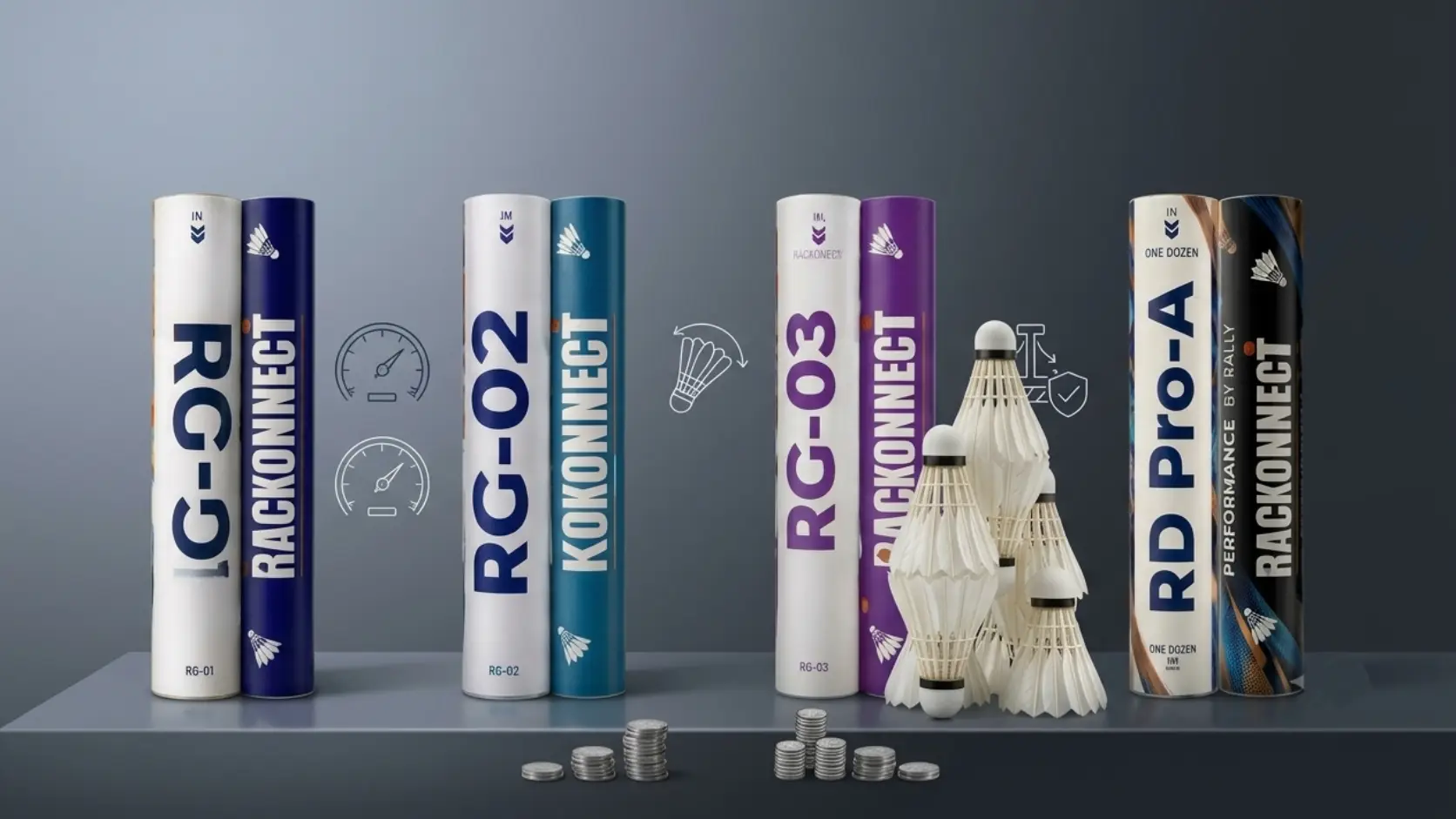
Rackonnect offers four feather shuttlecock products for different badminton playing requirements, including training, club matches and competitive use.
Its official product range includes:
RG-01: Positioned for dependable durability during regular training.
RG-02: Positioned for tournament-grade flight and serious badminton play.
RG-03: Positioned as an affordable feather shuttlecock option.
RD Pro-A: A premium goose-feather shuttlecock option.
Each product is listed in a tube containing 12 shuttlecocks.
These descriptions reflect the product positioning published by Rackonnect. They do not establish that a particular model has official tournament approval or independently verified superiority over competing products.
Tournament organisers should confirm the required specifications with their competition authority, referee or technical organiser before making a purchasing decision.
For competitions requiring a particular approved product or supplier, follow the relevant event regulations rather than substituting an alternative solely because it is available.
For suitable events, explore Rackonnect's RG-01, RG-02, RG-03 and RD Pro-A feather shuttlecock range and enquire about bulk availability, product suitability and delivery terms.
Bulk Buying Checklist for Badminton Tournament Organisers
Before confirming a large order, make sure the supplier understands your competition requirements.
Requirement | What to Confirm |
Tournament size | Final or maximum estimated number of matches |
Shuttlecock specification | Product model, grade and any competition approval requirements |
Shuttle speed | Appropriate speed based on actual court testing |
Quantity | Required pieces, tubes and any reserve |
Packaging | Pieces per tube and tubes per carton or box |
Price | Unit price, applicable bulk rates, taxes and delivery charges |
Delivery | Confirmed dispatch date and destination |
Quality checks | Sample testing and procedures for damaged or incorrect stock |
Emergency stock | Availability of additional supply if actual consumption exceeds forecast |
Where possible, finalise the product specification and quantity before publishing the last version of your tournament schedule.
If you're also managing registrations, fixtures and match coordination, Rackonnect's Tournaments & Events Hub provides information about its wider tournament activities.
Common Mistakes When Ordering Shuttlecocks for Tournaments
Estimating Quantity From Player Registrations Alone
Thirty-two participants do not always mean thirty-two matches. The actual match count depends on whether you're using knockout, round-robin or group-stage formats.
Always calculate scheduled matches first.
Ignoring Third Games and Match Intensity
Competitive badminton matches can vary in duration and intensity. A demanding three-game match may require more shuttlecock replacements than a short two-game contest.
Use previous event records to adjust your estimate where available.
Buying Solely on the Lowest Tube Price
Price is important, but poor flight consistency or frequent replacements can make a low-priced shuttlecock more expensive in practice.
Evaluate cost alongside usable performance and durability.
Forgetting Reserve Stock
Ordering only the expected match-play quantity leaves little room for unexpected demand.
Include a suitable reserve based on event size, consumption uncertainty and replenishment lead time.
Not Checking the Actual Shuttlecock Speed
Incorrect speed can affect match consistency. Test the chosen product at the venue and confirm any relevant competition requirements.
Waiting Until the Last Moment to Order
Bulk procurement may involve stock confirmation, packaging, dispatch and transport.
Agree on delivery terms early enough to inspect the shipment and address problems before the first scheduled match.
Frequently Asked Questions About Badminton Tournament Shuttlecocks
How many shuttlecocks are needed for one badminton match?
For many local and regional tournaments, the BWF Referees' Manual suggests estimating three to four shuttlecocks per match for planning. Actual usage varies with player level, match duration, shuttlecock durability and playing conditions.
How many shuttlecocks are needed for a 32-player knockout tournament?
A standard 32-entry single-elimination competition requires 31 matches. At four shuttlecocks per match, the base estimate is 124 shuttlecocks. With an illustrative 15% allowance, this becomes 143 pieces, rounded up to 12 tubes of 12 shuttlecocks each.
How many tubes of shuttlecocks are required for 100 badminton matches?
At four shuttlecocks per match, 100 matches require 400 shuttlecocks before reserve stock. Adding a 15% allowance gives 460 pieces, or 39 complete tubes containing 12 shuttlecocks each.
How many shuttlecocks are in one tube?
Rackonnect's RG-01, RG-02, RG-03 and RD Pro-A feather shuttlecock products are listed in tubes of 12 pieces. Other suppliers may use different pack formats, so always verify the quantity.
What is the feather shuttlecock price for a tournament in India?
The price depends on brand, grade, order size, supplier and delivery terms. Ask for a confirmed per-tube quotation, including any applicable taxes and shipping charges, before calculating the tournament budget.
Is a shuttlecock box the same as a tube?
Not necessarily. A tube usually refers to a retail or playing pack containing a set number of shuttlecocks. A carton or larger box may contain several tubes. Ask the supplier to specify both pieces per tube and tubes per box when discussing shuttlecock box prices.
Do singles and doubles matches need the same number of shuttlecocks?
Not always. Playing intensity, rally patterns and match duration can affect shuttlecock replacement rates. Use recorded consumption from comparable singles and doubles matches when available rather than assuming both categories use identical quantities.
How much extra shuttlecock stock should a tournament organiser keep?
There is no universal reserve percentage. A 15% allowance can be used as an illustrative starting point, but the right quantity depends on the reliability of your consumption estimate, supplier lead time and event requirements.
Should tournament organisers buy feather or nylon shuttlecocks?
Choose the shuttlecock type required by the competition regulations. Feather shuttlecocks are standard in high-level competitive badminton, while other formats may have different permitted equipment. Always verify the relevant rules before ordering.
Where can organisers request bulk feather shuttlecock supply in India?
Organisers can visit Rackonnect's official feather shuttlecock supply page to review the RG-01, RG-02, RG-03 and RD Pro-A range and enquire about quantities, applicable pricing and delivery availability.
Final Thoughts: Plan Your Matches Before Ordering Shuttlecocks
A successful badminton tournament depends on thoughtful planning, and shuttlecock inventory deserves the same attention as fixtures, courts and match officials.
Start by calculating the number of matches in each category. Use a suitable shuttlecock consumption estimate, convert the total into complete tubes and maintain enough reserve stock to handle unexpected demand.
For many local and regional events, three to four shuttlecocks per match provides a useful initial estimate. Historical tournament records and actual product testing should guide the final purchase quantity.
When comparing suppliers, consider flight consistency, durability, product specifications, availability and the full purchase cost rather than looking only at the lowest advertised price.
Organising an upcoming badminton tournament? Explore Rackonnect feather shuttlecocks and request bulk pricing for your estimated quantity, preferred product and tournament location.