Introduction: Everything You Need to Know About Badminton
Badminton is one of the fastest racket sports in the world — and one of the most widely played. From school playgrounds in India to Olympic arenas in Paris, the sport is loved for its combination of speed, strategy, explosive athleticism, and accessibility to players of every age and skill level.
Whether you are picking up a racket for the first time, returning to the sport after years away, or looking to take your competitive game to the next level, this complete guide covers everything you need to know about badminton — its history, court layout and measurements, official rules, essential equipment, key shots and strategies, fitness requirements, nutrition principles, and training fundamentals.
Quick Overview: What This Guide Covers
1. History of badminton → From ancient origins to Olympic sport
2. Court layout and measurements → Full dimensions, zones, and net specifications
3. Official rules of the game → Scoring system, serving rules, faults, and line calls
4. Essential equipment → Rackets, shuttlecocks, shoes, grips — what to choose and why
5. Key shots and strategies → Smash, drop, clear, net shot, drive — when and how to use each
6. Footwork fundamentals → Why movement is as important as stroke technique
7. Fitness for badminton players → Stamina, agility, strength, and injury prevention
8. Nutrition for performance → Pre-match, during-match, and recovery fuelling
9. Training tips for all levels → How to structure your practice for consistent improvement
1. The History of Badminton
Ancient Origins
Long before badminton became an Olympic sport, games involving a feathered shuttlecock were played across ancient civilisations. Early versions of the game — using paddles or bats to keep a feathered object airborne — have been traced back to ancient China, Greece, Japan, and India.
In India, a game called "Poona" — named after the city of Pune (then Poona) — was widely played by British army officers stationed there during the 19th century. When these officers returned to England, they brought the game with them.
From Poona to Badminton House
In 1873, the Duke of Beaufort introduced the game at his country estate, Badminton House, in Gloucestershire, England. The sport quickly became popular among the British aristocracy and took its modern name from the estate.
By the 1870s, the Bath Badminton Club had standardised a formal set of rules — establishing the court dimensions, scoring principles, and serving rules that form the foundation of the modern game.
The Badminton World Federation and Olympic Recognition
In 1934, the Badminton World Federation (BWF) was established to govern the sport internationally. Today the BWF oversees rules, rankings, tournaments, and international competition across more than 170 member nations.
Badminton made its Olympic debut at the 1992 Barcelona Games — a milestone that transformed it into a globally recognised competitive sport. Since then, Asian nations — particularly China, Indonesia, South Korea, India, Malaysia, and Japan — have dominated international play, with Europe led by Denmark producing consistently elite players.
In India, the sport has grown dramatically in popularity over the past two decades, with players like Saina Nehwal, P.V. Sindhu, Kidambi Srikanth, and H.S. Prannoy inspiring a generation of competitive players across the country.
2. Court Layout and Measurements
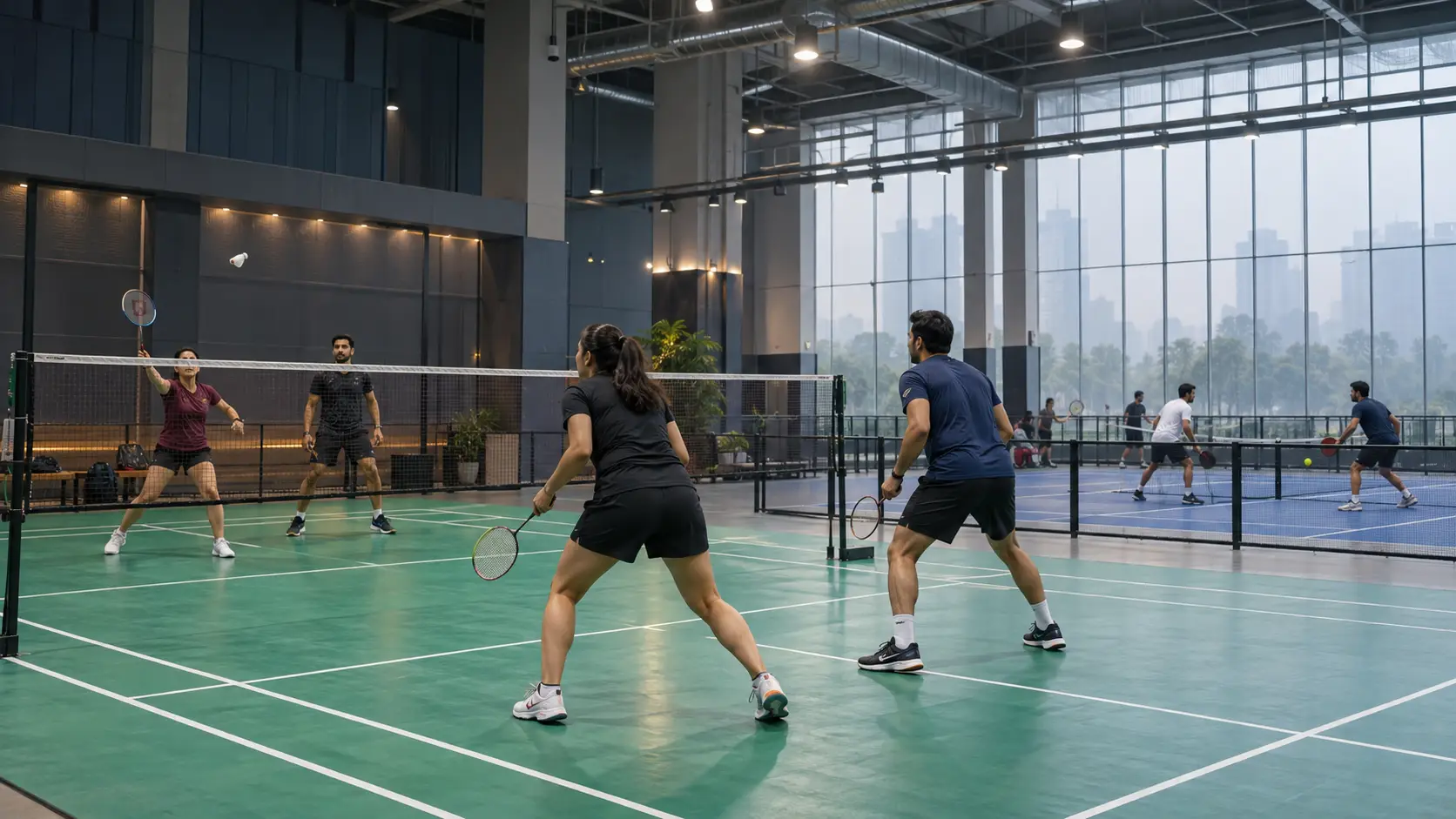
A standard badminton court is rectangular and divided by a central net. Understanding court dimensions and zones is essential for positioning, tactical awareness, and applying rules correctly.
Court Dimensions
Total length: 13.4 metres
Width (doubles): 6.1 metres
Width (singles): 5.18 metres — the doubles sidelines are not in play for singles
Net height at posts: 1.55 metres
Net height at centre: 1.524 metres — the net dips slightly at the middle
Court Zones
Service courts: The court is divided into right and left service courts by the centre line. Serves must land diagonally in the opponent's corresponding service court.
Short service line: Located 1.98 metres from the net. Serves must clear this line to be valid.
Long service line (doubles): Located 0.76 metres inside the back boundary. Long serves in doubles must land between the back boundary and this line.
Long service line (singles): The full back boundary line is used for singles serving.
Mid-court and rear court zones: Tactical positioning and shot selection — net play, mid-court drives, and rear-court smashes — are all defined by these zones in relation to the net.
Movement and positioning within these zones are as important as stroke technique. Footwork efficiency and base position recovery after every shot often determine rally outcomes more than shot quality alone.
3. Official Rules of the Game
Scoring System
Badminton uses a rally-point scoring system — a point is scored on every rally regardless of which player served.
Each game is played to 21 points
Matches are best of three games
A game must be won by a minimum two-point margin — if the score reaches 20-20, play continues until one player leads by two points
At 29-29, the player who scores the 30th point wins — regardless of margin
The player or pair who wins two games wins the match
Serving Rules
Serves must be played underhand — the racket head must be pointing downward at the moment of contact and contact must be made below the server's waist
Serves must be played diagonally into the opponent's service court
In singles: Server starts from the right service court when their score is even; left service court when odd
In doubles: Service court alternates based on score as in singles; only the server's partner may receive
Service faults: Overarm serve, serve above the waist, feinting during the service action, or shuttle landing outside the correct service court
In and Out
A shuttle landing on any boundary line is considered in
In singles, the wider doubles sidelines are out — only the narrower singles court is in play
In doubles, the short service line rear extension applies only to serves — during general play, the full doubles court including the back tramlines is in play
Common Faults
Double hit: Hitting the shuttle twice in a single stroke
Carry: The shuttle resting on the racket strings rather than being struck cleanly
Net fault: Touching the net or posts with racket or body during play
Foot fault: Stepping on or across the centre line or service court boundary during a serve
Shuttle fails to cross the net: Results in a point to the opponent
Out of bounds: Shuttle landing outside the court boundary
4. Essential Equipment for Badminton
Rackets
Badminton rackets are lightweight — typically 80–100 grams — and are constructed from carbon fibre, graphite, or aluminium alloy depending on price and performance level.
Balance types and their uses:
Head-heavy rackets — More weight in the racket head generates more power in smashes and clears. Best suited for aggressive baseline players who prioritise attacking shots.
Head-light rackets — More weight in the handle improves maneuverability and reaction speed. Ideal for doubles players and those who prioritise net play and fast exchanges.
Even-balance rackets — Balanced weight distribution provides a compromise between power and control. Best choice for beginners and all-round players.
String tension affects both power and control. Lower tension (20–23 lbs) provides more power and is better for beginners. Higher tension (24–28 lbs) provides greater control and is preferred by advanced players with established technique.
Shuttlecocks
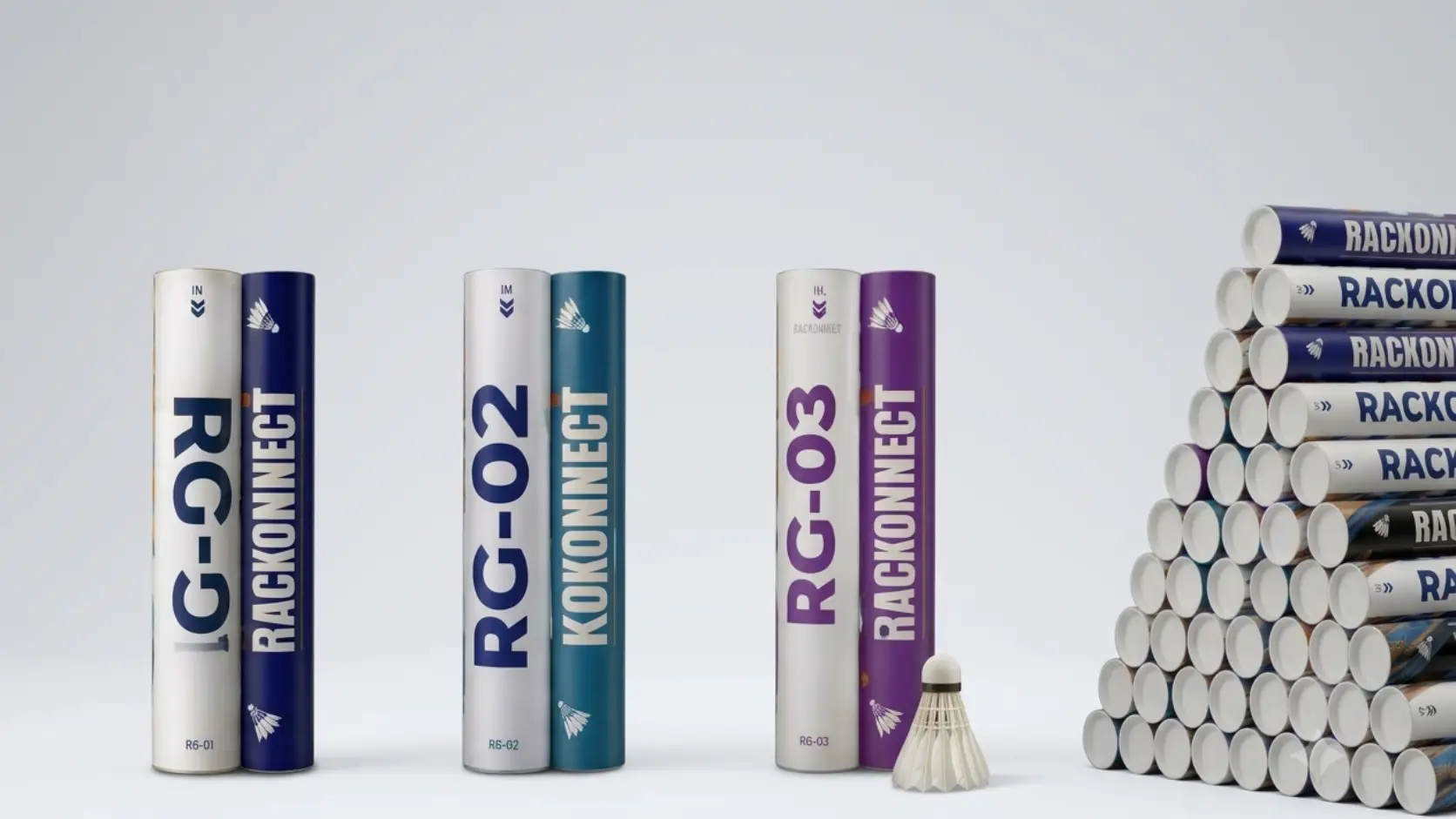
Feather shuttles — Used in professional and competitive play. Made from 16 goose or duck feathers attached to a cork base. They fly more accurately and provide better feel than synthetic options, but are more expensive and less durable.
Synthetic (nylon) shuttles — Used for practice and recreational play. More durable and consistent across temperature and humidity variations. Recommended for beginners and for outdoor or practice use.
Shuttle speed is rated by number (typically 75–78) and must be matched to temperature and altitude conditions. Faster shuttles (higher numbers) are used in cold or high-altitude conditions; slower ones in warm conditions.
Shoes
Badminton shoes are one of the most important pieces of equipment — and the most underestimated. Running shoes are not appropriate for badminton.
What to look for in badminton shoes:
Non-marking rubber soles — required on all indoor court surfaces
Good lateral support — protects the ankle during explosive side lunges
Cushioning in the forefoot and heel — absorbs repeated landing impact
Low profile — keeps your centre of gravity close to the ground for faster directional changes
Lightweight construction — reduces foot fatigue across long sessions
Investing in proper badminton shoes is the single most effective injury prevention measure available to any player at any level.
Grips
Original grip — The factory grip on the racket handle. Often too thick or too thin for individual preference.
Overgrip — A thin grip tape wrapped over the existing grip. Absorbs sweat, improves feel, and can be replaced inexpensively when worn.
Towel grip — Absorbs sweat more effectively than synthetic overgrips. Preferred by players with sweaty hands. Requires more frequent replacement.
Grip size directly affects racket control and injury prevention. A grip that is too thick or too thin increases the risk of wrist and elbow strain.
5. Key Shots and Strategies
Mastering a variety of shots makes your game unpredictable and forces opponents into errors. Here are the six essential badminton strokes every player must develop.
Smash
The smash is the primary attacking shot in badminton — a fast, steep downward stroke aimed at finishing the rally. Contact is made at the highest possible point above the head, with maximum arm extension and full body rotation.
When to use it: When the shuttle is high and you are well-balanced. A smash from a poor position produces a weak or inaccurate result that is easily defended.
Key technique: Full shoulder rotation, high contact point, forearm pronation at impact, controlled follow-through.
Drop Shot
The drop shot is a controlled, deceptive stroke that sends the shuttle gently over the net to land close to the net tape on the opponent's side. When disguised to look like a smash preparation, it is one of the most effective rally-winning shots in the game.
When to use it: To draw the opponent forward and create space in the rear court. Most effective when alternated with smashes from the same preparation.
Key technique: Identical preparation to the smash — slow the racket head just before contact to reduce power.
Clear (Lift)
A clear sends the shuttle high and deep toward the opponent's rear baseline. Used defensively to reset the rally and buy recovery time, or aggressively (flatter and faster) to rush an opponent positioned near the net.
When to use it: When under pressure and needing recovery time (defensive clear), or when opponent is at the net (attacking clear).
Key technique: Full arm extension at contact, deep trajectory, aim for the backhand rear corner.
Net Shot
The net shot is a delicate stroke played close to the net — the shuttle barely clears the tape and drops steeply on the opponent's side. When executed with spin (spinning or tumbling net shot), it creates enormous difficulty for the opponent.
When to use it: When the opponent plays a loose net shot or short drop. Used to force a weak lift and regain the attack.
Key technique: Relaxed grip, gentle brushing motion, contact just above tape height.
Drive
The drive is a flat, fast stroke played at mid-court height, directed straight or cross-court. Used primarily in doubles to maintain pressure and prevent the opponent from setting up an attack.
When to use it: When the shuttle arrives at body or shoulder height in mid-court. Used to break rhythm and force mid-court errors.
Key technique: Compact backswing, flat contact point, wrist snap through impact.
Service
The serve starts every rally and sets its tactical tone. Two primary serve types:
Short backhand serve (doubles): Low over the net, landing just past the short service line. Forces the receiver to lift, maintaining your attacking initiative.
High serve (singles): Hit high and deep to the opponent's rear baseline, pushing them to the back of the court and opening the front court.
6. Footwork Fundamentals
Strong footwork is the foundation of all badminton technique. Even the most technically gifted players struggle without efficient movement — arriving late to the shuttle forces rushed, off-balance shots that reduce both power and precision.
The Split Step
The split step — a small hop performed as your opponent makes contact with the shuttle — is the single most important footwork habit in badminton. It loads your muscles for explosive movement in any direction and ensures you are never caught flat-footed between shots.
Base Position
The base position is the center of your court — slightly behind the midline in singles — where you recover after every shot. Returning to base after every stroke gives you equal coverage of all six court zones for the next rally exchange.
Six-Corner Coverage
Every player must be able to move efficiently to all six court corners: front-left, front-right, mid-left, mid-right, rear-left, and rear-right. Shadow footwork drills — moving to each corner and returning to base without a shuttle — are the most effective way to build automatic movement patterns.
💡 Want to develop your footwork with expert coaching? Rackonnect's certified coaches at venues across Delhi NCR design structured footwork programmes for all skill levels. Explore coaching programmes
7. Fitness for Badminton Players
Badminton demands a unique combination of explosive power, multi-directional speed, cardiovascular endurance, and muscular resilience. A structured fitness routine is essential for both performance and injury prevention.
Cardiovascular Stamina
Competitive matches last 40–75 minutes at high intensity. Building aerobic endurance through interval running, skipping, and cycling provides the fitness base to maintain performance quality across all three games.
Agility and Explosive Speed
Badminton movement is multi-directional and explosive. Agility ladder drills, shuttle sprint runs, plyometric lateral bounds, and split step practice directly improve the first-step speed and directional change ability that determine court coverage quality.
Strength Training
Legs and glutes — Squats, lunges, and Bulgarian split squats build the lower body power for explosive lunges and jumps
Core — Plank variations and rotational exercises stabilise the body during smashes and overhead strokes
Shoulders and forearms — Resistance band rotator cuff exercises and wrist strengthening protect the most injury-prone areas
Injury Prevention
Common badminton injuries — ankle sprains, knee strain, shoulder impingement, and Achilles tendon issues — are largely preventable through proper warm-up, correct footwear, strength training, and adequate recovery between sessions.
Dynamic warm-up before every session (10–15 minutes) and static stretching cool-down after every session (10 minutes) are non-negotiable components of safe, sustainable badminton training.
8. Nutrition for Badminton Performance
Before Play (2–3 Hours Before)
Complex carbohydrates — rice, roti, oats, or whole-grain bread — for sustained energy
Moderate protein — eggs, dal, lean chicken, or yogurt — for muscle support
Avoid heavy, oily, or spicy food close to match time
Small pre-match snack (30–60 minutes before): banana, dates, or light energy bar
During Play
Sip water consistently at every changeover — do not wait until thirsty
For matches longer than 45 minutes, consider electrolyte drinks to replace lost sodium and potassium
Avoid carbonated drinks or large volumes of fluid at once
After Play
Protein within 30–45 minutes — eggs, paneer, lentils, or lean meat — for muscle repair
Carbohydrates to replenish glycogen — rice, roti, or fruit
Full rehydration — continue drinking water in the hours after play
Balanced, consistent nutrition keeps energy levels high across long rallies, supports faster recovery between sessions, and reduces injury risk over a sustained training period.
9. Training Tips for All Levels
For Beginners
Focus on fundamentals first — correct grip, basic footwork, and consistent rally ability are more valuable at this stage than power or advanced shots. Spending time on these foundations pays dividends for years.
Get proper coaching early — developing correct habits from the start is far easier than correcting ingrained errors later. Even a few sessions with a qualified coach early on can save months of self-correction.
Play regularly, not intensively — two to three sessions per week with adequate recovery is better than daily play that leads to fatigue and overuse injuries.
For Intermediate Players
Add structured drills to match play — shadow footwork, multi-shuttle feeding, and conditioned rally practice develop skills that free play alone cannot build.
Study your own game — even brief phone video recordings of your matches reveal technical errors and tactical patterns you cannot see in the moment.
Enter local tournaments — competitive match experience accelerates development faster than any training drill. The pressure, intensity, and unpredictability of real competition cannot be replicated in practice.
View Rackonnect tournaments near you
For Advanced Players
Specialise your tactical game — develop a defined playing style with specific patterns and strengths, rather than trying to be strong at everything.
Manage training load — balance court sessions with conditioning, recovery, and planned rest weeks. Overtraining at advanced level is one of the most common causes of performance plateau.
Use technology to optimise — track sessions, manage schedules, and analyse performance data. The Rackonnect technology platform provides tools to manage your entire badminton development — from court booking to training tracking.
Where to Play Badminton in India
Rackonnect operates India's largest network of premium badminton facilities across Delhi NCR and North India — with professional-grade courts, certified coaching, and structured tournaments available year-round.
Find a venue near you:
Frequently Asked Questions (FAQ)
Q: What is the basic rule of badminton? The fundamental rule is that you must hit the shuttlecock over the net and land it within the opponent's court boundaries before it touches the ground on your side. Badminton uses a rally-point scoring system — every rally produces a point. Matches are the best of three games, each played to 21 points with a minimum two-point winning margin.
Q: What equipment do I need to start playing badminton? To begin, you need a badminton racket (head-light or even balance for beginners), shuttlecocks appropriate for indoor play, non-marking badminton shoes, and comfortable sportswear. For regular play, adding an overgrip and a bag to protect your racket is recommended. Badminton shoes are the most important investment — never play in running shoes.
Q: What is the difference between singles and doubles badminton? In singles, one player plays against one opponent across the narrower court (5.18m wide). In doubles, two players play against two, using the full court width (6.1m). Tactical principles differ significantly — singles is more patient and positional, doubles is faster, more aggressive, and relies heavily on rotational formation and net play.
Q: How long does a badminton match last? A typical competitive badminton match lasts between 30 and 75 minutes. Short two-game matches can finish in 30–40 minutes. Close three-game encounters — particularly at competitive and club level — regularly extend to 60–75 minutes of high-intensity play.
Q: What is the best racket for a badminton beginner? An even-balance racket in the 85–90g range is the best starting point for most beginners. It provides a comfortable combination of maneuverability and power without the demands of head-heavy or head-light extremes. String tension should be kept at 20–22 lbs for easier power generation while developing technique.
Q: How can I improve at badminton quickly? The fastest improvements come from: getting proper coaching to correct technique fundamentals early, practising shadow footwork daily (even without a shuttle), playing regularly with partners at or slightly above your level, and entering beginner-level competition to experience match pressure. Technical improvement without match experience plateaus quickly.
Q: Where can I play badminton in Delhi NCR? Rackonnect operates multiple premium badminton venues across Delhi, Noida, Gurugram, Faridabad, and Ghaziabad. Courts can be booked online through rackonnect.com/venues — with flexible hourly booking, no long-term membership required.
Conclusion: Badminton — A Sport for Every Level and Every Age
Badminton is uniquely accessible. It can be enjoyed casually in a park, played recreationally at a local sports hall, or pursued seriously through structured coaching and competitive tournaments. The barrier to entry is low, the physical and mental benefits are exceptional, and the ceiling for development is virtually unlimited.
Whether you are picking up a racket for the first time or looking to compete at a higher level, the fundamentals in this guide give you the knowledge foundation to play better, train smarter, and enjoy the sport more — at every stage.
Start your badminton journey or take it to the next level with Rackonnect: