1. Why Conditioning Matters in Badminton
Badminton is one of the fastest racket sports in the world. A single rally can involve explosive jumps, deep lunges, rapid direction changes, and high-intensity sprints—all within seconds. Without proper conditioning, even technically skilled players struggle to maintain speed, power, and precision throughout a match.
Effective badminton conditioning workouts improve:
Explosive power for stronger smashes and jump shots
Agility and footwork speed for quicker court coverage
Anaerobic endurance to sustain high-intensity rallies
Muscular endurance for longer matches
Injury resistance in knees, ankles, and shoulders
Unlike general gym workouts, badminton conditioning must be sport-specific. It should mimic real match demands—short bursts of maximum effort followed by brief recovery periods. Players who combine strength, plyometrics, agility drills, and on-court conditioning consistently outperform those who rely only on technical training.
If your goal is to move faster, recover quicker between rallies, and hit harder without fatigue, structured conditioning is essential.
2. What the Research Says: Key Principles for Badminton Conditioning

Modern sports science strongly supports combining strength training, plyometrics, and high-intensity interval conditioning for badminton players.
A recent review published in PubMed Central analyzed the effects of plyometric training in badminton athletes and found significant improvements in:
Vertical jump height
Agility performance
Explosive leg power
Speed and reaction ability
These improvements directly translate to better on-court performance—particularly during jump smashes, quick defensive transitions, and rapid direction changes.
Key Research-Based Principles
1. Train for Explosive Power
Badminton movements are short and explosive. Plyometric exercises such as lateral bounds and box jumps enhance fast-twitch muscle recruitment, improving jump height and court speed.
2. Build Lower-Body Strength
Strong quadriceps, hamstrings, glutes, and calves improve lunge stability and reduce injury risk. Strength training also enhances power output during push-offs and jumps.
3. Prioritize Agility and Change of Direction
Unlike linear sprint sports, badminton requires multidirectional movement. Agility drills that mimic court patterns are essential for improving reaction time and foot placement.
4. Develop Anaerobic Conditioning
Badminton relies heavily on the anaerobic energy system. Short, high-intensity shuttle runs with brief rest intervals simulate match conditions better than long-distance cardio.
5. Apply Progressive Overload
Gradually increasing intensity, volume, or complexity ensures continuous improvement while minimizing the risk of overtraining.
Scientific evidence clearly shows that combining strength, plyometrics, agility, and high-intensity intervals produces the greatest performance gains in badminton athletes.
3. Assess Your Starting Point Before Training
Before starting any badminton conditioning program, you should measure your baseline fitness. Testing allows you to:
Track progress objectively
Identify weaknesses in power, endurance, or balance
Personalize your training intensity
Reduce injury risk
Here are four simple performance tests you can perform:
1. Vertical Jump Test (Power)
Stand beside a wall and mark your standing reach.
Jump as high as possible and mark your highest touch.
Measure the difference in centimeters.
Purpose: Measures lower-body explosive power.
2. 6 × 30-Meter Shuttle Sprint Test (Speed and Anaerobic Capacity)
Sprint 30 meters and return.
Repeat six times with 20 to 30 seconds of rest between efforts.
Record your total time.
Purpose: Simulates repeated high-intensity court efforts.
3. Single-Leg Balance Test (Stability)
Stand on one leg for 30 to 60 seconds.
First perform with eyes open, then with eyes closed.
Note any imbalance or difficulty.
Purpose: Assesses ankle and knee stability, which is critical for lunges and landing mechanics.
4. Court Movement Drill Timing (Agility)
Place cones in six court directions.
Move from the center base position to each cone and return.
Record your total time.
Purpose: Evaluates badminton-specific agility and movement efficiency.
How to Use Your Results
Low jump height → Focus more on plyometrics
Slow shuttle sprint time → Increase anaerobic interval training
Poor balance → Add stability and mobility drills
Slow directional movement → Emphasize agility training
Re-test every four weeks to measure improvement and adjust your program accordingly.
4. Core Components of an Effective Badminton Conditioning Program
A well-structured badminton conditioning program should address every physical demand of the sport. Simply running or lifting weights is not enough. Your training must replicate match intensity, movement patterns, and energy system demands.
Below are the six essential components of an effective program:
1. Dynamic Warm-Up and Mobility
A proper warm-up prepares the muscles, joints, and nervous system for explosive movement. Skipping this step increases injury risk and reduces performance output.
Example Warm-Up Routine (8–10 minutes):
Light jogging or skipping (2 minutes)
High knees and butt kicks (30 seconds each)
Dynamic lunges with rotation (10 reps per side)
Lateral shuffles (2 × 20 meters)
Arm circles and shoulder mobility drills
Purpose: Increase blood flow, activate muscles, and improve joint mobility before high-intensity work.
2. Strength Training
Strength forms the foundation for power and injury prevention. Focus primarily on lower-body strength and core stability.
Key Exercises:
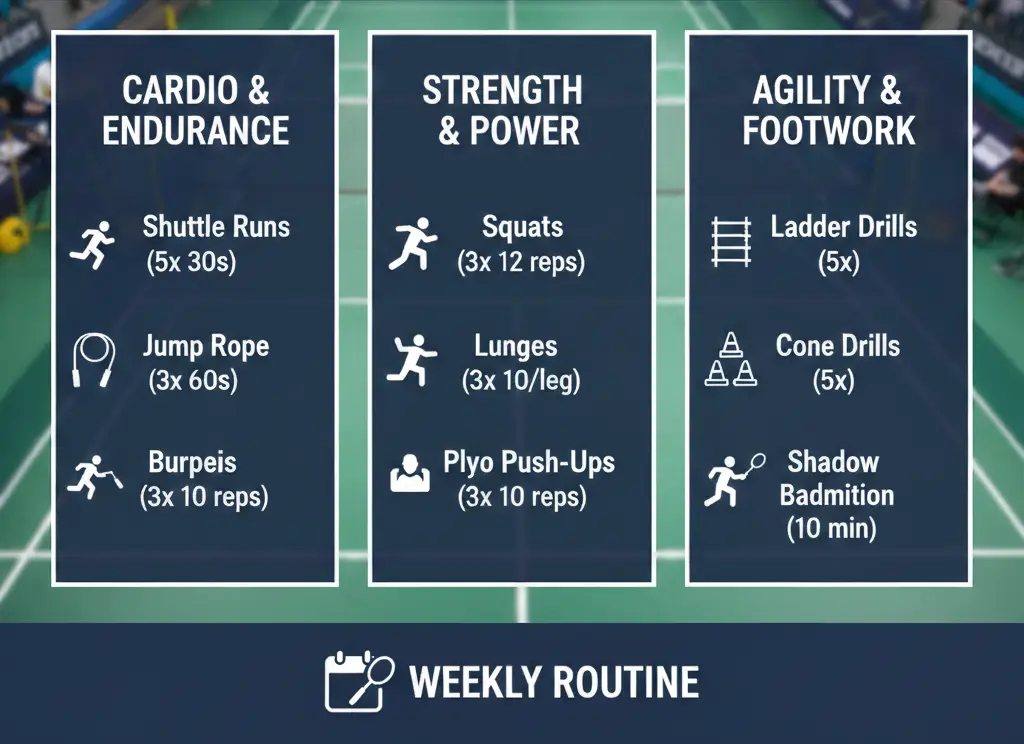
Squats (3–4 sets × 6–8 reps)
Romanian deadlifts (3 × 8 reps)
Walking lunges (3 × 10 per leg)
Planks and side planks (3 × 30–60 seconds)
Strong glutes, hamstrings, and quadriceps improve push-off speed and lunge stability. Core strength enhances balance during rapid directional changes.
Train strength 2–3 times per week.
3. Plyometrics and Power Training
Plyometric training improves explosive strength and jump performance—critical for smashes and fast recoveries.
Example Exercises:
Box jumps (3 × 5 reps)
Lateral bounds (3 × 8 per side)
Split squat jumps (3 × 6 per leg)
Skater hops (3 × 10 reps)
Focus on quick ground contact and proper landing mechanics (soft knees, controlled balance).
Perform plyometrics 1–2 times per week after warm-up.
4. Speed and Agility Drills
Badminton requires rapid acceleration and quick directional changes.
Example Drills:
Agility ladder drills (3–4 variations)
T-drill cone pattern (4–6 rounds)
Reaction-based shuttle sprints (5–8 reps)
Multi-directional court movement drills
Keep repetitions short and explosive with full recovery between sets.
5. Anaerobic Conditioning
Badminton relies heavily on short bursts of intense effort. Traditional long-distance cardio does not replicate match demands.
Example Conditioning Sets:
6 × 20-meter shuttle sprints (20 seconds rest)
30 seconds high-intensity rally simulation + 30 seconds rest (8 rounds)
Court suicide runs (4–6 rounds)
Focus on maintaining maximum intensity during each repetition.
6. Recovery and Injury Prevention
Recovery is where adaptation happens. Without proper rest, performance declines.
Key recovery strategies:
Foam rolling (10 minutes post-training)
Static stretching after workouts
At least 1–2 rest days per week
Adequate sleep (7–9 hours nightly)
Strong ankles, knees, and hips reduce common badminton injuries such as sprains and patellar stress.
5. Sample Badminton Conditioning Workouts
Below are three structured session examples based on skill level.
Beginner Workout (2–3 Sessions per Week)
Warm-Up (10 minutes)
Light jog (2 minutes)
Dynamic lunges (10 per leg)
Lateral shuffles (2 × 20 meters)
Main Set
Bodyweight squats (3 × 12)
Walking lunges (3 × 10 per leg)
Agility ladder basic drills (5 minutes)
4 × 20-meter shuttle sprints (30 seconds rest)
Cool Down
Light stretching (5 minutes)
Focus: Building basic strength and movement coordination.
Intermediate Workout (3–4 Sessions per Week)
Warm-Up (10 minutes)
Skipping rope (3 minutes)
Dynamic mobility drills
Lateral shuffle + sprint combo
Main Set
Squats (4 × 6–8 reps)
Romanian deadlifts (3 × 8 reps)
Box jumps (3 × 5 reps)
T-drill agility (5 rounds)
6 × 30-meter shuttle sprints (20 seconds rest)
Cool Down
Foam rolling + static stretching
Focus: Improving power, agility, and repeated sprint ability.
Advanced Workout (4–5 Sessions per Week)
Warm-Up (12 minutes)
Skipping + reaction drills
Explosive movement prep
Main Set
Barbell squats (4 × 5 reps)
Bulgarian split squats (3 × 6 per leg)
Depth jumps (3 × 5 reps)
Multi-directional cone drill (6 rounds)
8 rounds of 30-second high-intensity rally simulation + 30-second rest
Cool Down
Mobility work + recovery protocol
Focus: Maximum power output and match-intensity conditioning.
6. 8-Week Progressive Conditioning Plan
A structured progression ensures continuous improvement while minimizing injury risk.
Weeks 1–2: Foundation Phase
Goal: Build movement quality and base strength.
Strength training: 2 sessions per week
Light plyometrics
Basic agility drills
Moderate shuttle intervals
Focus on mastering proper technique.
Weeks 3–4: Strength and Stability Phase
Goal: Increase strength and improve balance.
Increase resistance in squats and lunges
Add more challenging plyometrics
Increase shuttle sprint volume
Re-test baseline performance at end of Week 4
You should notice improved jump height and faster recovery.
Weeks 5–6: Power Development Phase
Goal: Improve explosiveness and acceleration.
Reduce reps, increase intensity
Add depth jumps and reactive drills
Shorten rest periods slightly
Increase court simulation drills
Intensity becomes higher, but recovery remains essential.
Weeks 7–8: Match-Specific Conditioning Phase
Goal: Peak performance.
High-intensity rally simulations
Maximum-effort shuttle sprints
Multi-directional court drills
Maintain strength training (lower volume, high intensity)
Re-test performance at the end of Week 8 and compare with baseline results.
Expected Results After 8 Weeks
Increased vertical jump height
Faster directional movement
Improved anaerobic endurance
Better recovery between rallies
Consistency, progressive overload, and proper recovery are the keys to success.
7. Nutrition, Hydration, and Sleep for Optimal Performance
Training hard without proper recovery and nutrition limits your progress. Conditioning improvements occur when your body repairs and adapts after workouts.
1. Nutrition for Badminton Conditioning
Badminton is a high-intensity sport that relies heavily on carbohydrates for quick energy.
Key Guidelines:
Carbohydrates: 4–6 g per kg of body weight daily for active players
Protein: 1.4–1.8 g per kg of body weight to support muscle repair
Healthy fats: Essential for joint health and hormonal balance
Pre-training snack: Banana, yogurt, or whole-grain toast 60–90 minutes before training
Post-training meal: Protein + carbohydrates within 60 minutes
Proper fueling improves energy levels, reaction speed, and recovery.
2. Hydration
Even mild dehydration reduces reaction time and endurance.
Hydration Tips:
Drink 400–600 ml of water 2 hours before training
Sip water during sessions (every 10–15 minutes)
Replace electrolytes during intense or long sessions
Monitor urine color (light yellow indicates good hydration)
3. Sleep and Recovery
Sleep is critical for muscle repair and nervous system recovery.
Aim for 7–9 hours of quality sleep
Maintain a consistent sleep schedule
Limit screen exposure before bedtime
Include at least 1–2 full rest days per week
Without adequate recovery, performance plateaus and injury risk increases.
8. Common Mistakes and How to Avoid Injury
Even well-designed conditioning programs can fail if common mistakes are made.
1. Skipping the Warm-Up
Starting intense drills without preparing muscles increases the risk of strains and sprains.
2. Overtraining
Training too frequently without recovery leads to fatigue, poor performance, and injury. Follow progressive overload principles and schedule rest days.
3. Poor Landing Mechanics
Incorrect landing during jumps places excessive stress on knees and ankles. Always land softly with knees slightly bent and hips engaged.
4. Ignoring Mobility
Tight hips and ankles restrict movement efficiency. Include mobility drills weekly.
5. Too Much Long-Distance Cardio
Badminton requires short explosive efforts, not marathon endurance. Prioritize interval-based conditioning.
Injury Prevention Tips
Strengthen ankles and knees
Include balance training
Increase intensity gradually
Listen to early signs of pain
Proper technique and progression are more important than intensity alone.
9. Equipment and Space Needed
You do not need expensive equipment to perform effective badminton conditioning workouts.
Basic Equipment:
Badminton court or open space
Cones or markers
Agility ladder
Resistance bands
Plyometric box or sturdy platform
Foam roller
Minimal equipment can still deliver professional-level results when structured correctly.
10. Frequently Asked Questions (FAQ)
How often should I do badminton conditioning workouts?
Beginner players should train 2–3 times per week. Intermediate and advanced players can train 3–5 times weekly, depending on recovery and match schedule.
How long before I see improvement?
Most players notice improvements in agility and endurance within 4 weeks. Significant power and performance gains typically occur within 6–8 weeks.
Are plyometrics safe for beginners?
Yes, when performed at low intensity with proper supervision and technique. Start with basic hops before progressing to advanced jumps.
Should conditioning replace technical training?
No. Conditioning enhances technical performance but does not replace skill practice. Both should be integrated into a balanced program.
Can I do conditioning during the competitive season?
Yes, but reduce volume. Maintain strength and power while prioritizing match performance and recovery.
11. Conclusion: Build a Stronger, Faster Badminton Game
Badminton conditioning workouts are essential for players who want to improve speed, power, agility, and endurance. A structured program that combines strength training, plyometrics, agility drills, and anaerobic conditioning produces measurable performance improvements within weeks.
The key principles are:
Train explosively
Move in multiple directions
Progress gradually
Recover properly
Start with baseline testing, follow the 8-week progressive plan, and monitor improvements consistently.
If you apply these methods with discipline and consistency, you will notice stronger smashes, faster court coverage, and improved recovery between rallies.
Now it’s time to step onto the court and train with purpose.