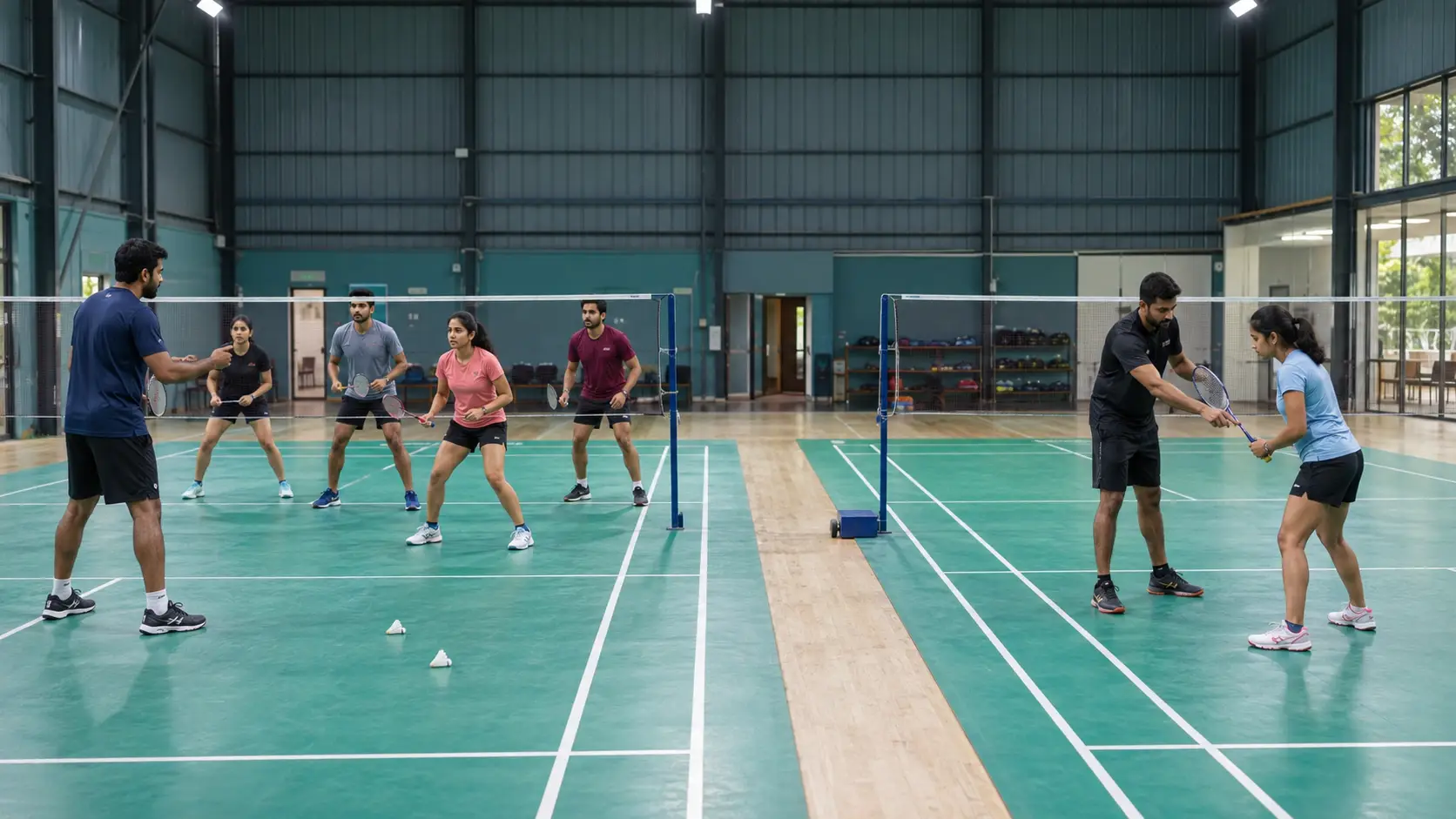

Once badminton becomes part of your weekly routine, paying for individual court bookings every time may start to feel expensive. An academy or club membership can appear more economical, but it may also involve fixed timings, limited access or services you do not need.
The better option depends on how frequently you play, whether you need coaching, how predictable your schedule is and whether you already have regular playing partners.
This guide compares badminton court booking vs academy membership across cost, flexibility, coaching, match access and long-term value. It will help you choose a practical arrangement for the way you actually play, rather than the way you optimistically imagine you will play every Monday morning.
What Is Pay-and-Play Badminton Court Booking?
Pay-and-play booking allows you to reserve a badminton court for a particular date and time. You pay for the selected slot without committing to a monthly or annual plan.
Depending on the venue, a standard reservation may provide access to the full court for 45, 60 or 90 minutes. The booking is normally shared by the players using that slot, so four doubles players can divide the cost.
Individual court booking is generally suitable for:
Players with changing work schedules
Friends who play occasionally
Groups that prefer different venues
Players who already know the game and do not need coaching
Visitors who do not want a long-term commitment
Teams preparing for a specific match or tournament
If this format suits you, you can browse sports venues on Rackonnect and compare available places to play.
What Is an Academy Membership?
An academy membership usually provides access to a defined training programme, playing schedule or set of monthly benefits. The exact structure differs between facilities.
Some memberships focus on coaching and include a fixed number of supervised sessions. Others provide regular court access, practice groups, fitness training or discounts on additional bookings.
An academy membership may include:
Scheduled group coaching sessions
Regular access to an assigned batch
Technical and footwork training
Practice games with other members
Fitness or conditioning exercises
Progress feedback from a coach
Preferential rates for extra court time
Access to internal matches or competitions
These benefits are not standard across every academy. Before enrolling, confirm what the quoted fee covers and whether independent court use is included.
Court Booking vs Academy Membership at a Glance
Factor | Individual Court Booking | Academy Membership |
Payment | Pay for each selected slot | Usually paid monthly, quarterly or annually |
Commitment | Low | Medium to long term |
Schedule | Choose from available slots | Often linked to fixed batch timings |
Coaching | Normally not included | May be included in training memberships |
Playing partners | You generally arrange your own group | Other members may provide regular partners |
Venue choice | You can use different facilities | Usually limited to the selected academy |
Best for | Flexible and independent players | Consistent players seeking structure |
Which Option Costs Less?
The answer depends on how often you play and how many people share the booking.
Suppose a court costs ₹600 for one hour. If four doubles players divide the amount equally, each player pays ₹150. Playing twice a week would cost each person approximately ₹1,200 over four weeks, assuming the same price and complete attendance.
If you regularly book a court alone or with only one partner, your share rises considerably. Peak evening and weekend slots may also cost more than quieter daytime periods.
A membership may offer better value when you attend several times every week and use most of its included benefits. It becomes poor value when you frequently miss fixed sessions or pay separately for the court access you expected to receive.
Use this simple calculation before deciding:
Monthly court-booking cost = cost per slot × your share × expected monthly sessions
Compare that figure with the complete membership fee, including registration, equipment and additional court charges. Marketing brochures have a charming habit of placing the smallest number in the largest font.
When Individual Court Booking Offers Better Value
Pay-and-play booking may be the better choice when you play fewer than once or twice per week, although the exact break-even point depends on local prices and membership terms.
It is especially useful if:
Your office schedule changes every week
You travel frequently
You already have reliable playing partners
You prefer casual games over structured training
You want to compare different court surfaces and locations
You play more than one racket sport
You pay only when you play, but popular time slots can fill quickly. Regular players may need to book several days in advance, particularly during weekday evenings and weekends.
Read Rackonnect’s guide to pay-and-play badminton courts in Delhi NCR to understand how this model works across the region.
When an Academy Membership Offers Better Value
A membership makes more sense when badminton is a fixed part of your weekly routine. It can also provide value beyond the cost of court access.
Consider a membership if:
You want to train at least two or three times per week
You need structured coaching
You do not have dependable playing partners
You want to improve technique rather than only play matches
You can attend fixed batch timings consistently
You are preparing for amateur or corporate tournaments
You prefer one familiar facility and playing community
Consistency is the main advantage. Your sessions are already part of a schedule, and the coach can plan progress over time. You also avoid arranging a new group for every game.
Which Is Better for Improving Your Game?
An academy membership with proper coaching is usually better for technical improvement. A coach can identify errors in your grip, movement, contact point and recovery position that casual opponents may never mention.
Regular court booking still helps you gain match experience. You learn to respond to different opponents, make decisions under pressure and manage the score. The limitation is that playing more games does not automatically correct poor technique.
The ideal arrangement for a developing player may combine both:
Attend structured coaching sessions for technique and footwork
Book an additional court for unsupervised match practice
Use match difficulties to guide the next coaching session
Players looking for organised instruction can review badminton coaching options on Rackonnect.
Which Offers More Scheduling Flexibility?
Individual booking offers more theoretical flexibility because you select the day and time. In practice, your preferred slot still depends on venue availability and whether your partners can attend.
Academy memberships often use fixed batches. This removes the weekly planning problem but gives you less freedom to change the schedule. Some academies allow members to attend an alternative batch or make up a missed session, while others do not.
Ask about rescheduling before paying. A membership with twelve monthly sessions is not good value if your work schedule allows you to attend only seven.
What About Playing Partners?
Court booking works best when you already have a reliable group. Cancellations can increase everyone’s share of the cost or leave the remaining players without a proper game.
An academy or club environment may make it easier to meet players of a similar standard. Regular batches also help you understand how different opponents serve, defend and construct rallies.
Before joining, ask whether membership includes organised match play or only technical drills. A room full of members does not guarantee that anyone will actually play against you.
Does Membership Guarantee Court Access?
Not always. Some memberships cover only scheduled coaching sessions. Independent practice may require a separate reservation and payment.
Confirm the following points:
How many weekly sessions are included?
Does membership include unsupervised court time?
Can members reserve peak-hour slots?
Are additional bookings discounted?
Are shuttlecocks included during coaching?
Can unused sessions carry forward?
What happens when the academy closes for an event?
Is there a cancellation or refund policy?
Monthly, Quarterly or Annual Membership?
A monthly plan is generally safer when joining a new academy. It gives you time to assess coaching quality, attendance, travel time and batch compatibility.
A quarterly plan may offer a modest discount while keeping the commitment manageable. Annual membership can provide the lowest average monthly cost, but only if you remain consistent throughout the year.
Attend a trial session before choosing a long-term package. Check the actual batch during your preferred time rather than visiting an empty court in the afternoon and assuming Monday evening will look equally peaceful.
How to Decide Based on Your Playing Profile
Occasional Player
If you play a few times per month and value flexibility, individual court booking is usually more practical. You avoid paying for unused sessions.
Regular Recreational Player
If you play once or twice per week with a dependable group, compare your monthly share of court costs with a basic membership. Either option may work depending on local prices.
Beginner Who Wants to Improve
An academy membership with structured coaching is likely to provide more value than booking a court and attempting to learn entirely through matches.
Competitive Amateur Player
A coaching membership combined with additional match bookings may be the strongest option. Technical training and competitive practice serve different purposes.
Busy Professional
Choose the arrangement you can attend consistently. Flexible bookings may suit an unpredictable calendar, while a fixed membership batch may help someone who benefits from a committed routine.
How to Compare Badminton Options Near You
Distance and travel time affect the real cost of playing. A cheaper facility far from home may consume more time and fuel than a slightly more expensive nearby court.
Rackonnect lets you explore available sports venues. Players can also review badminton courts in Delhi before selecting a convenient place to play.
If you decide that regular access suits your routine, review the available Rackonnect membership options and confirm the current inclusions directly before purchasing.
Frequently Asked Questions
Is a badminton membership cheaper than booking a court?
It can be cheaper for frequent players who use most included sessions. Occasional players may save more by paying only when they book a court.
Does an academy membership include badminton coaching?
Some memberships include coaching, while others provide only court or club access. Check the programme details before paying.
Can I book a badminton court without becoming a member?
Many pay-and-play venues allow individual reservations without membership. Availability and booking terms vary by facility.
How many times per week should a regular player practise?
Two or three sessions per week can provide a workable balance for many recreational players. Your fitness, recovery and goals should determine the final schedule.
Can I use both court booking and academy coaching?
Yes. Coaching can develop technique, while separate court bookings provide additional match practice with friends or other players.
Final Verdict
Choose individual badminton court booking if flexibility, venue choice and low commitment matter most. Choose an academy membership if you want a regular schedule, coaching, familiar partners and structured improvement.
Calculate how often you genuinely play, examine every included benefit and account for missed sessions. The best choice is the one you will use consistently.
When you are ready, find a badminton venue with Rackonnect, explore coaching options or review the available membership plans.