
Understanding Badminton Court Dimensions and Lines
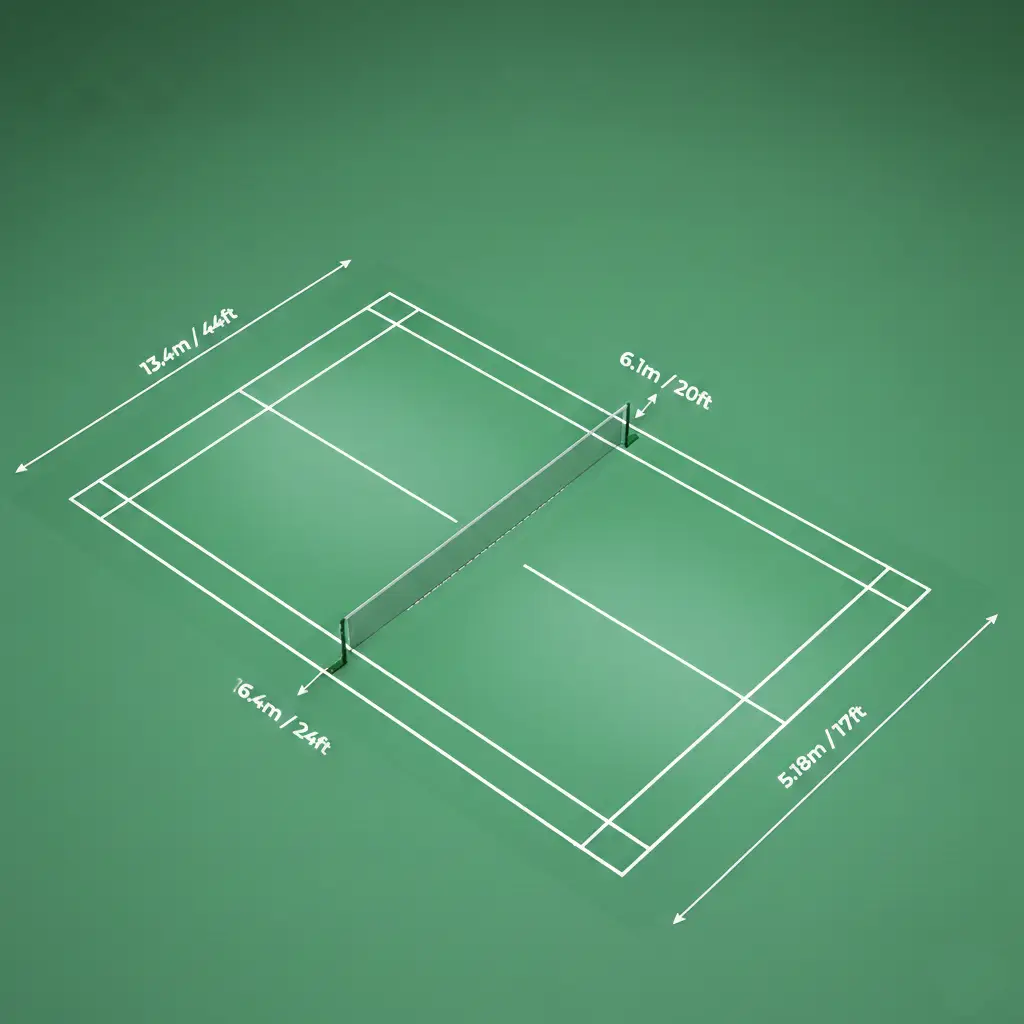
The official badminton court measures 13.40 meters (44 feet) in length, with different widths for singles and doubles matches. Understanding these measurements is essential for players, coaches, and facility planners to ensure proper gameplay according to the rules set by the Badminton World Federation (BWF).
Badminton courts follow strict international standards. Every line, marking, and measurement serves a specific purpose during play. In this guide, we will explain the official dimensions, what each line means, and how singles and doubles courts differ.
Official Badminton Court Dimensions (Quick Facts)
A badminton court is rectangular and divided into two equal halves by a net placed at the center. The court dimensions remain the same worldwide for competitive matches.
Standard Measurements
Total Court Length: 13.40 meters (44 feet)
Doubles Court Width: 6.10 meters (20 feet)
Singles Court Width: 5.18 meters (17 feet)
Net Height at Center: 1.524 meters (5 feet)
Net Height at Posts: 1.55 meters (5 feet 1 inch)
Distance from Net to Short Service Line: 1.98 meters (6.5 feet)
Line Width: 40 millimeters (1.57 inches)
Important Notes
The length of the court remains the same for both singles and doubles matches.
The width changes depending on whether the match is singles or doubles.
All lines are 40 mm wide and must be clearly visible.
The net is slightly higher at the posts than at the center.
These measurements ensure uniformity across tournaments, from school-level competitions to international championships.
Court Layout Explained: Lines and What They Mean
Each line on a badminton court has a specific role in defining play areas and service zones. Understanding these markings helps avoid faults and ensures correct gameplay.
1. Baselines (Back Boundary Lines)
The baselines run along the back edge of each side of the court.
They mark the full court length of 13.40 meters.
If the shuttle lands on the baseline, it is considered in.
In singles matches, the baseline is used during both rallies and serves.
In doubles matches, the baseline is used during rallies but not for long serves.
2. Side Lines: Singles vs Doubles
The side lines define the width of the court, and this is where singles and doubles differ.
Doubles matches use the full width of 6.10 meters.
Singles matches use the inner side lines, reducing the width to 5.18 meters.
This narrower width in singles ensures balanced play and better movement control since only one player covers the court.
Important:
If the shuttle lands between the singles sideline and doubles sideline during a singles match, it is considered out.
3. Short Service Line
The short service line is located 1.98 meters (6.5 feet) from the net.
A legal serve must cross this line.
If the shuttle lands before crossing the short service line, it is a fault.
4. Center Line
The center line divides each side of the court into two equal service courts:
Left service court
Right service court
Players must serve diagonally into the opponent’s correct service box.
5. Doubles Long Service Line
The doubles long service line is located 0.76 meters (2.5 feet) inside the baseline.
This line applies only during doubles serves.
A serve in doubles must not cross this line.
During rallies, the baseline becomes active again.
Net and Post Specifications
The badminton net plays a crucial role in defining the two halves of the court. Its height and placement are strictly regulated to maintain fairness and consistency in gameplay.
Official Net Height
Height at the center: 1.524 meters (5 feet)
Height at the posts: 1.55 meters (5 feet 1 inch)
The slight difference in height ensures the net remains properly tensioned across the width of the court.
Net Placement
The net is placed exactly at the center of the 13.40-meter court length.
It extends across the full width of the doubles court (6.10 meters).
The posts are positioned directly over the doubles sidelines, even in singles matches.
Net Dimensions and Material
The net should be made of fine cord of dark color.
Mesh size should not be less than 15 mm and not more than 20 mm.
The top of the net must have a 75 mm white tape running along its full length.
Practical Tip
When setting up a court:
Always measure the center height first.
Ensure the net is tight but not overstretched.
Check that the net touches the posts without gaps.
Correct net installation is essential for tournament-level matches and ensures compliance with international standards.
Singles vs Doubles Court: Practical Differences Explained
Although the overall court length remains the same, singles and doubles matches differ significantly in width and service areas.
Court Width Comparison
Singles Width: 5.18 meters
Doubles Width: 6.10 meters
In singles, the inner sidelines are used, reducing the total playable width. In doubles, the outer sidelines define the boundaries.
Service Area Differences
This is where many beginners get confused.
In Singles:
Full court length (baseline included) is used for serving.
Narrow width (singles sidelines) applies.
In Doubles:
Full court width (outer sidelines) is used.
The serve must not go beyond the doubles long service line.
The baseline is used only during rallies, not for long serves.
Why These Differences Exist
Singles matches focus more on endurance and precision.
Doubles matches emphasize teamwork and faster net play.
The shorter service area in doubles prevents overly defensive, high serves.
Quick Comparison Summary
Singles:
Narrower court
Full-length serves allowed
More movement per player
Doubles:
Wider court
Shorter service depth
Faster rallies and more attacking play
Understanding these distinctions helps players adapt strategies based on match type.
How to Measure and Mark a Badminton Court (Step-by-Step Guide)
If you are setting up a badminton court in a sports hall, school, or private facility, accurate measurement is critical.
Tools Required
Measuring tape (minimum 15 meters)
Chalk or court marking tape
String line for straight alignment
Right-angle measuring tool or carpenter’s square
Step 1: Mark the Outer Boundary (Doubles Court)
Measure and mark a 13.40-meter straight line for one baseline.
From each end, measure 6.10 meters outward to form the width.
Connect the lines to form a rectangle.
This creates the full doubles court.
Step 2: Mark the Singles Side Lines
Measure inward 0.46 meters (18 inches) from each doubles sideline.
Draw parallel lines across the full court length.
This creates the singles playing area.
Step 3: Mark the Short Service Line
Measure 1.98 meters from the net line on both sides.
Draw a line parallel to the net.
Step 4: Mark the Center Line
Draw a straight line from the short service line to the baseline.
This divides each half into left and right service courts.
Step 5: Mark the Doubles Long Service Line
Measure 0.76 meters inside the baseline.
Draw a line parallel to the baseline.
Step 6: Ensure Line Width
All lines must be 40 millimeters wide and clearly visible. Use a contrasting color (commonly white or yellow).
Final Checklist
Court length confirmed at 13.40 meters
Correct singles and doubles widths marked
Service lines accurately measured
Net installed at correct height
Lines evenly spaced and clearly visible
Accurate court marking ensures proper gameplay and prevents disputes during matches.
Frequently Asked Questions (FAQs)
1. What are the official badminton court dimensions?
The official badminton court measures 13.40 meters (44 feet) in length. The width differs depending on the match type:
Singles: 5.18 meters (17 feet)
Doubles: 6.10 meters (20 feet)
These dimensions are standardized for international competitions.
2. What is the official badminton net height?
The net height must be:
1.524 meters (5 feet) at the center
1.55 meters (5 feet 1 inch) at the posts
The slight difference ensures proper net tension.
3. What is the difference between singles and doubles court lines?
In singles:
Inner sidelines are used.
The baseline is valid for serves and rallies.
In doubles:
Outer sidelines are used.
The serve must not cross the doubles long service line.
The baseline applies only during rallies.
4. How wide are the lines on a badminton court?
All court boundary and service lines must be 40 millimeters (1.57 inches) wide and clearly visible.
5. Can a shuttle landing on the line be considered in?
Yes. If the shuttle lands on any boundary line, it is considered in, as the line is part of the court.
Conclusion
Understanding badminton court dimensions and lines is essential for both players and organizers. From the fixed court length of 13.40 meters to the differences between singles and doubles play, every measurement directly impacts gameplay and fairness.
Correct knowledge of service lines, baselines, side lines, and net height ensures:
Accurate court setup
Fewer faults during matches
Better strategic play
Compliance with international standards
Whether you are marking a new court or improving your knowledge of the sport, knowing the official dimensions gives you a clear competitive advantage.
If you found this guide helpful, consider bookmarking it for quick reference or sharing it with fellow players and coaches.