Introduction: Why Correct Court Measurements Matter
Whether you are setting up a new badminton court, checking whether a facility meets official standards, or simply trying to understand the game better, knowing the precise court measurements is essential. Incorrect dimensions affect fair play, player positioning, and the tactical elements of the game - even small errors in line placement can create disputes during competitive play.
The official badminton court measurements are set and maintained by the Badminton World Federation (BWF) and apply universally - to recreational indoor courts, professional tournament arenas, and everything in between. These dimensions have remained consistent across decades of international play and are the global standard at every level of the sport.
This complete guide covers every measurement you need - court length and width, singles and doubles differences, net height and post placement, service line positions, step-by-step court marking guidance, and the different court surface types used across facilities in India and worldwide.
Quick Overview: Key Badminton Court Measurements
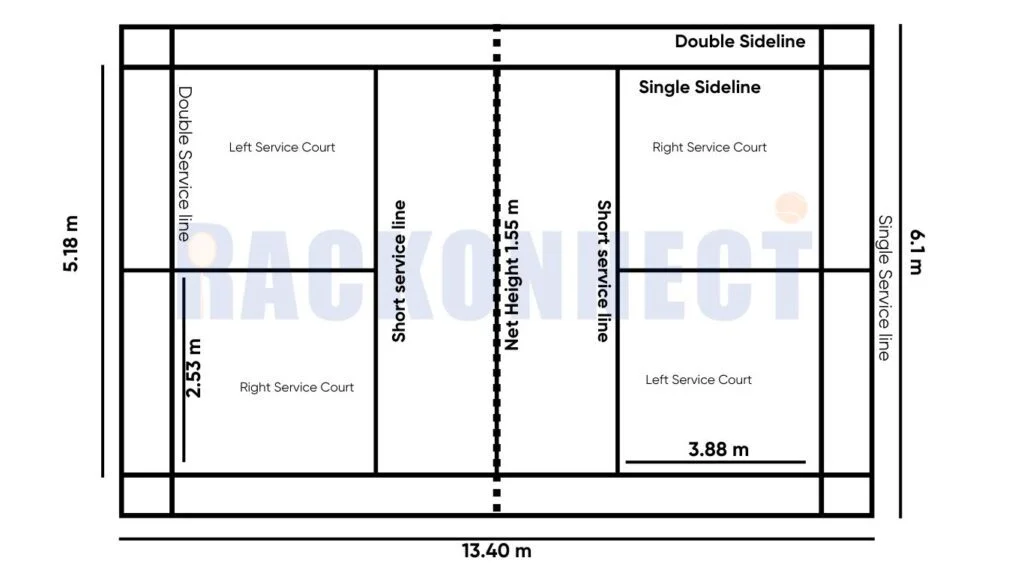
Here are the essential measurements at a glance before we cover each in detail:
Full court length: 13.40 metres (44 feet)
Full court width (doubles): 6.10 metres (20 feet)
Full court width (singles): 5.18 metres (17 feet)
Short service line distance from net: 1.98 metres (6.5 feet)
Net height at centre: 1.524 metres (5 feet exactly)
Net height at posts/edges: 1.55 metres (5 feet 1 inch)
Net width: 6.10 metres (20 feet) - covers the full doubles court width
Doubles long service line distance from back boundary: 0.76 metres (2.5 feet)
Official Badminton Court Dimensions - Full Breakdown
Court Length
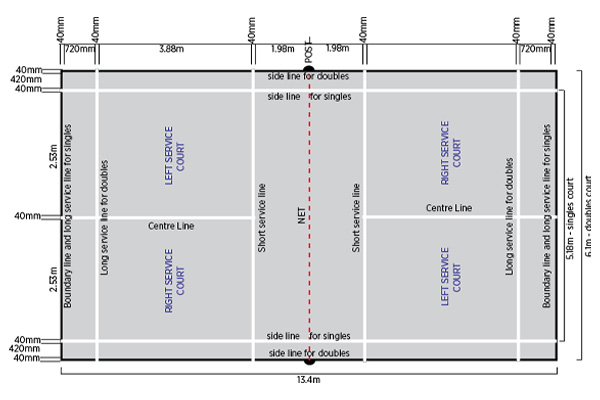
The full length of a standard badminton court is 13.40 metres (44 feet). This measurement applies to both singles and doubles - the length of the court does not change between formats, only the width.
The court is divided symmetrically by the net - each half measures 6.70 metres (approximately 22 feet) from the net to the back boundary line.
Court Width - Singles vs Doubles
This is the most important dimensional difference between singles and doubles play:
Doubles court width: 6.10 metres (20 feet) - the full court width including the outer tramlines on both sides.
Singles court width: 5.18 metres (17 feet) - the inner court width, meaning the outer tramlines (sidelines) on both sides are out of play for singles.
This 0.92-metre difference per side is significant tactically - in singles, players have a narrower court to cover but also a narrower target for their shots. In doubles, the additional width creates more space to exploit and defend.
Short Service Line
The short service line is positioned 1.98 metres (6.5 feet) from the net on both sides of the court. Every serve - in both singles and doubles - must clear this line to be valid. A serve that lands between the net and the short service line is a service fault, regardless of where it would otherwise land.
Long Service Line for Doubles
In doubles, there is an additional service restriction at the back of the court. The doubles long service line is positioned 0.76 metres (2.5 feet) inside the back boundary line. Serves in doubles must land between the short service line and this doubles long service line - not in the rear 0.76 metres of the court.
In singles, the full court length is used for serves - the serve can land anywhere between the short service line and the back boundary.
Centre Line
The centre line runs from the short service line to the back boundary line on each side, dividing each half of the court into left and right service courts. It is used to determine the correct service court for each rally - in singles, the server uses the right service court when their score is even and the left when odd.
Badminton Net Height and Post Placement
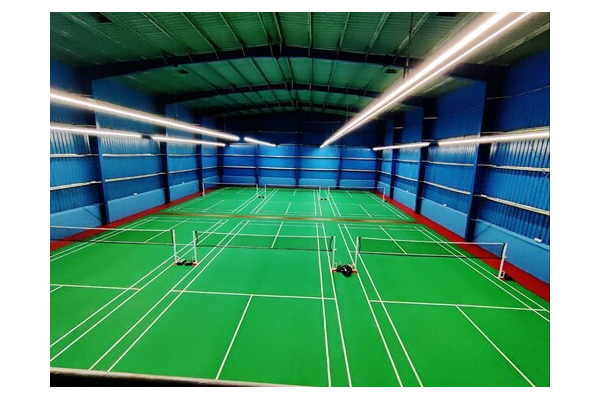
Net Height Specifications
The net height is one of the most precisely specified measurements in badminton - because even a few centimetres difference significantly affects gameplay.
Net height at the centre: Exactly 1.524 metres (5 feet). This is the lowest point of the net, and the measurement most relevant to play since most shots pass over the centre.
Net height at the posts/edges: 1.55 metres (5 feet 1 inch). The net is slightly higher at the posts than at the centre - this natural sag is part of the design. The net should not be pulled so tightly that the centre height exceeds the standard.
Net Width
The net must span the full width of the doubles court - 6.10 metres (20 feet). Even in singles play, the net spans the full doubles court width, with the outer sections simply not in play for that format.
Net Post Placement
For doubles: Net posts should be placed on the doubles sidelines - at the outer boundary of the 6.10-metre width.
For singles: When playing singles on a doubles-marked court, posts should ideally be placed on the singles sidelines (5.18m width). However, in most recreational and club settings, the posts remain on the doubles sidelines for convenience - an accepted compromise in non-tournament settings.
Net Depth and Mesh
The BWF specifies that the net must be made of fine natural or artificial cord with a mesh of between 15mm and 20mm. The net should be 760mm (76cm) deep - measured from the top cord to the bottom. The top of the net should have a white tape or edge covering the cord.
Practical setup tip: Use adjustable tension clamps on both sides of the net to maintain consistent centre height. Check the centre height with a measuring tape before competitive play - particularly in club and tournament settings where precise net height matters.
Singles vs Doubles: Full Measurement Comparison
Understanding exactly what changes between singles and doubles helps players position correctly and referees apply rules accurately.
What stays the same in both formats:
Full court length: 13.40 metres
Short service line position: 1.98 metres from net
Net height: 1.524m at centre, 1.55m at posts
Centre line position and markings
What changes between singles and doubles:
Court width: 5.18m (singles) vs 6.10m (doubles)
Long service line: Full back boundary in singles; 0.76m inside back boundary in doubles
Sideline in play: Inner sideline (singles) vs outer sideline (doubles) during general rallies
One important distinction that confuses many beginners: in doubles, the back tramlines are IN play during general rallies but OUT of play for serves. The back tramlines (the 0.76m strip at the rear of the court) are only restricted for doubles serves - during a rally, a shuttle landing in this area is in.
Step-by-Step Guide to Marking a Badminton Court
Whether you are marking a new permanent court or setting up a temporary playing surface, follow this sequence for accurate court layout.
Step 1: Mark the Outer Boundary
Draw or tape the full outer rectangle: 13.40 metres long × 6.10 metres wide. Use a measuring tape and ensure all four corners are at perfect right angles - a square corner tool or the 3-4-5 triangle method confirms this. Any error in the outer boundary affects every subsequent measurement.
Step 2: Mark the Singles Sidelines
Inside each long side of the court, measure 0.46 metres (46cm) inward and draw the singles sidelines parallel to the doubles sidelines. These lines run the full length of the court. The resulting inner court width should be 5.18 metres between the two singles sidelines.
Step 3: Mark the Short Service Lines
On each half of the court, measure 1.98 metres from the net position toward the back boundary and draw lines parallel to the net across the full court width. These are the short service lines - one on each side of the net.
Step 4: Mark the Centre Lines
Draw a line from the middle of the short service line (on each side) to the middle of the back boundary line. This line divides each half-court into left and right service courts. The centre line runs between the short service line and the back boundary - it does not extend between the short service line and the net.
Step 5: Mark the Doubles Long Service Line
On each half of the court, measure 0.76 metres inward from the back boundary and draw lines parallel to the back boundary across the full doubles court width. These are the doubles long service lines - a key line that many recreational court setups omit but that is essential for correct doubles serve rules.
Step 6: Net Post Position Marking
Mark the net post positions on the sidelines at the mid-point of the court length (6.70 metres from each back boundary). For a doubles court, posts sit on the outer doubles sidelines. Check these positions before installing posts or uprights.
Step 7: Final Measurement Verification
Before play begins, verify:
Centre net height: 1.524 metres
Post/edge net height: 1.55 metres
Short service line distance from net on both sides: 1.98 metres
All lines are clearly visible and of consistent width (typically 40mm/4cm for standard courts)
Types of Badminton Courts: Surface Comparison
1. Wooden Courts (Maple-Based)
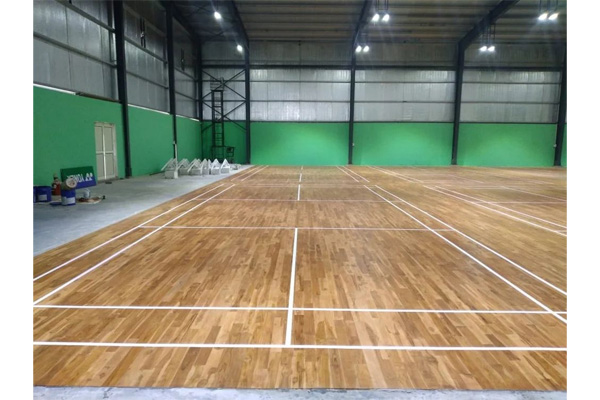
Wooden courts - typically constructed from hard maple - are the traditional standard for professional indoor badminton. They provide excellent shock absorption through natural wood flex, consistent bounce, and a playing feel preferred by many experienced players.
Best suited for: Professional tournament venues, multi-sport indoor stadiums, and facilities with climate control systems to manage humidity. Wooden floors require regular polishing, sealing, and humidity management - particularly in India's varied climate - to prevent warping and maintain consistent surface quality.
2. Synthetic PVC Vinyl Courts
PVC layered vinyl flooring is the current professional standard for dedicated badminton arenas globally - including most Rackonnect venues across Delhi NCR. Multi-layer construction provides superior shock absorption, consistent anti-skid traction, and strong resistance to humidity changes - making it the most practical and player-safe option for Indian climate conditions.
Best suited for: Dedicated badminton facilities, competition venues, and coaching academies. Lower maintenance requirements than wood with better durability under heavy usage. Find Rackonnect venues with professional-grade court surfaces
3. Synthetic Acrylic and PU Coated Courts
Polyurethane-coated or acrylic hard court surfaces are seamless - applied directly over a concrete or cement base. They offer decent grip when new and relatively low installation cost, but provide significantly less shock absorption than layered vinyl systems.
Best suited for: Mid-range multi-use sports facilities, school sports halls, and community centres where budget limits higher-specification flooring.
4. Rubberised Courts
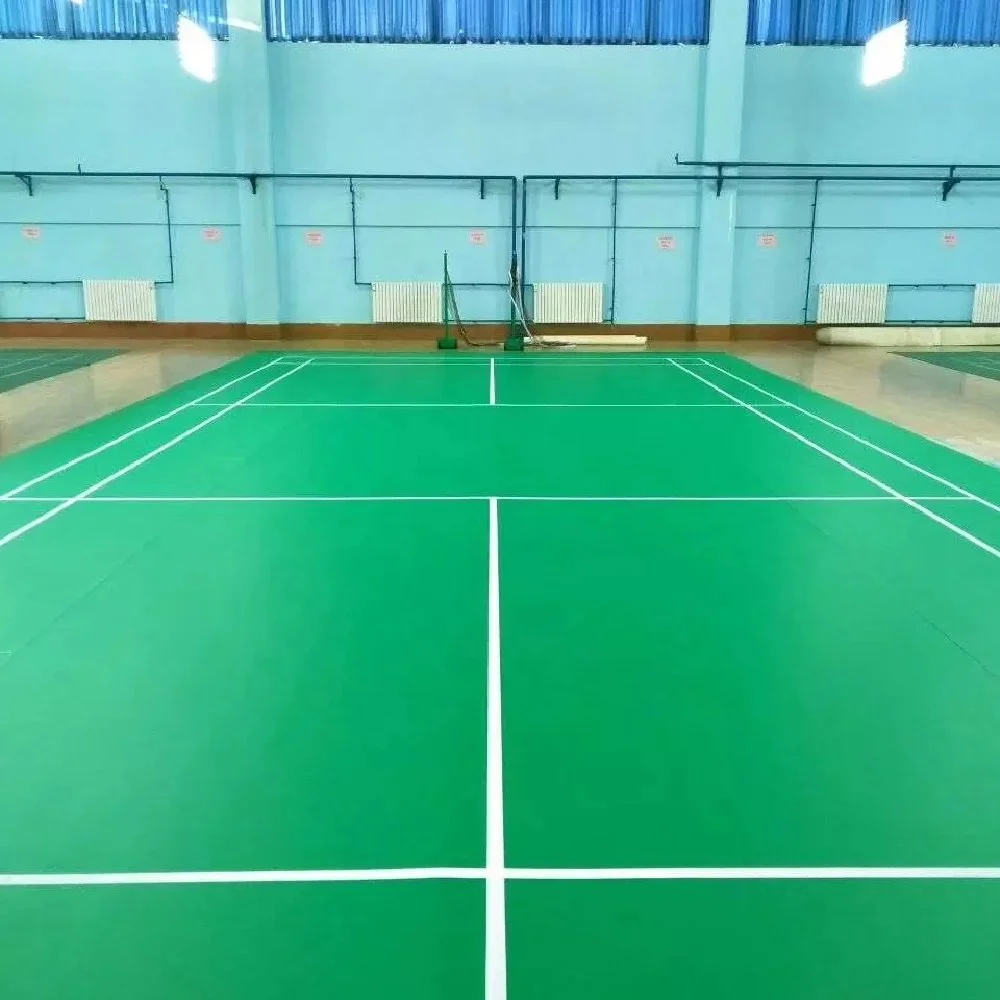
Rubberised surfaces provide additional cushioning through a rubber layer beneath the playing surface. They reduce impact on joints during repeated lunging and jumping - making them particularly suitable for training centres focused on extended, high-volume practice sessions.
Best suited for: Indoor training centres, junior academies, and rehabilitation or injury-prevention focused facilities.
5. Cement and Concrete Courts
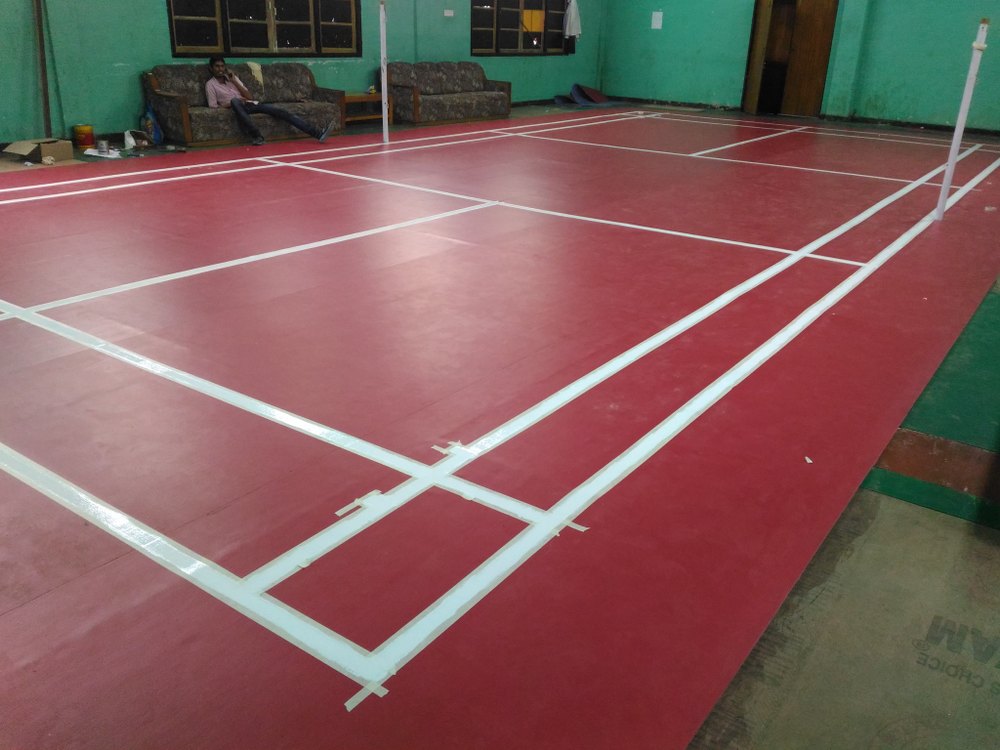
Concrete courts provide no shock absorption - all impact from lunges, jumps, and landings transfers directly to joints. They are durable and low-maintenance but carry the highest injury risk of any surface type for regular badminton play.
Best suited for: Occasional casual recreational play only. Not recommended for regular training or competitive play at any level.
Why Court Measurements Matter for Your Game
Understanding court measurements is not just administrative knowledge - it directly affects how you play, train, and develop as a badminton player.
Positioning and court coverage: Knowing the exact dimensions helps you internalise court geometry - where the tramlines are, how far back the long service line sits, how much space you have for a cross-court shot to land in. Players who have a strong spatial sense of the court move more efficiently and make better shot selection decisions.
Serving accuracy: The service box in doubles - bounded by the short service line, the doubles long service line, the centre line, and the relevant sideline - is a specific target that players must hit consistently under pressure. Understanding its exact dimensions improves serve accuracy training.
Coaching and setting up practice drills: Coaches who understand court geometry can design more effective positional drills, multi-shuttle patterns, and tactical exercises based on precise court zones.
If you are developing your game through structured coaching, Rackonnect's certified coaching programmes use professional-standard courts across Delhi NCR to ensure every drill and exercise is set up to official dimensions.
Frequently Asked Questions (FAQ)
Q: What are the official badminton court measurements in metres? The official BWF measurements are: full court length 13.40 metres, full court width 6.10 metres for doubles and 5.18 metres for singles, short service line 1.98 metres from the net, net height 1.524 metres at the centre and 1.55 metres at the posts, and the doubles long service line 0.76 metres from the back boundary.
Q: What is the difference between singles and doubles court width? The singles court uses a width of 5.18 metres - the inner court, excluding the outer tramlines. The doubles court uses the full width of 6.10 metres, including the tramlines on both sides. The length of the court (13.40 metres) is identical for both formats.
Q: What is the correct net height for badminton? The net height at the centre of the court must be exactly 1.524 metres (5 feet). At the posts or edges, the net height is 1.55 metres (5 feet 1 inch). The slight difference accounts for the natural sag at the centre.
Q: Are the back tramlines in play in doubles badminton? Yes - during general rallies in doubles, the back tramlines are in play. However, for doubles serves, the back 0.76 metres (the area between the doubles long service line and the back boundary) is out of play. This is one of the most commonly misunderstood rules in doubles badminton.
Q: What is the minimum area required to build a badminton court? The playing surface itself measures 13.40m × 6.10m. However, for comfortable play and safety, a minimum clearance of 1.5–2 metres should be allowed on all sides - making the total recommended area approximately 16–18 metres long by 9–10 metres wide per court. Ceiling height for indoor courts should be a minimum of 9 metres to allow for high defensive clears.
Q: What line width is standard for badminton court markings? The BWF specifies that all court lines should be 40mm (4 centimetres) wide. Lines must be clearly visible and uniformly coloured - typically white or yellow - against the court surface colour.
Q: Which court surface is best for a badminton facility in India? PVC vinyl layered flooring is the most recommended surface for dedicated badminton facilities in India. It provides the best combination of shock absorption, consistent traction, humidity resistance (important given India's climate variation), and durability under heavy usage. Wooden courts are an excellent alternative for facilities with proper climate control systems. Find courts with professional surfaces
Conclusion: Precise Measurements, Better Badminton
Correct badminton court measurements are the foundation of fair, consistent, and enjoyable play at every level - from a community sports hall to a professional tournament arena. Whether you are setting up a new court, checking a facility before booking, or simply deepening your understanding of the sport, the measurements in this guide are the official BWF standards that apply everywhere.
For players developing their game, court familiarity - knowing exactly where the lines are, how far the service box extends, and how the net divides the space - is a genuine competitive advantage that comes from time spent on properly marked, professional-grade courts.
Play on professional-standard courts at Rackonnect: