Introduction
If you're new to badminton, improving your footwork should be your top priority. Many beginners focus only on learning smashes and drop shots, but without proper movement, even the best technique won’t work effectively.
Good badminton footwork allows you to:
Reach the shuttle faster
Maintain balance while hitting
Recover quickly for the next shot
Reduce unnecessary fatigue
Professional training programs recommended by the Badminton World Federation (BWF) emphasize that movement and positioning form the foundation of the sport. Before power and advanced strokes, players must master basic movement patterns.
In this guide, you’ll learn beginner-friendly badminton footwork drills that improve speed, coordination, and overall court coverage — even if you’re practicing at home.
Why Footwork Matters in Badminton
Badminton is one of the fastest racket sports in the world. The shuttle can travel at extremely high speeds in professional play. While beginners don’t face that level immediately, quick reactions and efficient movement are still essential.
1. Better Shot Quality
When you reach the shuttle early and in balance, your shots become more accurate and powerful. Poor footwork forces you to stretch or lean awkwardly, leading to weak returns and unforced errors.
2. Faster Recovery
In badminton, every shot is followed by another. Proper footwork helps you:
Move quickly to the shuttle
Hit with stability and control
Return to your base position efficiently
This constant movement and recovery cycle is what builds consistency in rallies.
3. Improved Court Coverage
A badminton court may look small, but during a rally, it feels much larger. Efficient footwork helps you cover:
Front court (net shots)
Mid court (drives and pushes)
Rear court (clears and smashes)
Instead of running randomly, good players use controlled movement patterns such as lunges, side steps, and recovery steps.
4. Injury Prevention
Incorrect movement patterns can put stress on:
Ankles
Knees
Lower back
Learning proper footwork from the beginning reduces the risk of injury and builds long-term athletic strength.
Footwork Fundamentals Every Beginner Must Learn
Before practicing drills, you must understand the core movement principles used in badminton footwork. These fundamentals create the base for all advanced drills and match performance.
1. The Ready Position
The ready position is where every rally begins.
How to perform the ready position:
Stand with feet shoulder-width apart
Bend your knees slightly
Keep your weight on the balls of your feet
Hold the racket in front of your body
Stay relaxed but alert
This position allows you to move quickly in any direction.
2. The Split Step
The split step is a small hop performed just before your opponent hits the shuttle.
Why it’s important:
It helps you react instantly by preloading your leg muscles for explosive movement.
How to practice the split step:
Perform a small, controlled hop
Land softly on the balls of your feet
Immediately push off toward the shuttle direction
Even beginners should practice this movement regularly because it significantly improves reaction speed.
3. Front Court Movement (Lunge)
To reach net shots, players use a lunge step.
Key technique points:
Step forward with one leg
Keep your back straight
Bend your front knee
Keep your rear leg extended for balance
Push back quickly to recover
Always return to your base position after hitting the shuttle.
4. Side Movement (Chasse Step)
The chasse step is used for quick lateral movement.
How to perform it:
Step sideways with your leading foot
Bring the other foot to meet it
Maintain a low and balanced posture
Avoid crossing your legs, as it reduces stability and slows down recovery.
5. Rear Court Movement (Scissor Jump)
For overhead shots in the backcourt, players often use a scissor jump.
Basic technique:
Move backward quickly
Rotate your body sideways
Jump and switch legs mid-air
Land in a balanced position ready to recover
This movement generates power while helping you return to your base position efficiently.
Beginner Badminton Footwork Drills (Step-by-Step Guide)
Now that you understand the fundamentals, it’s time to apply them in structured drills. These beginner badminton footwork drills are simple, effective, and require minimal equipment.
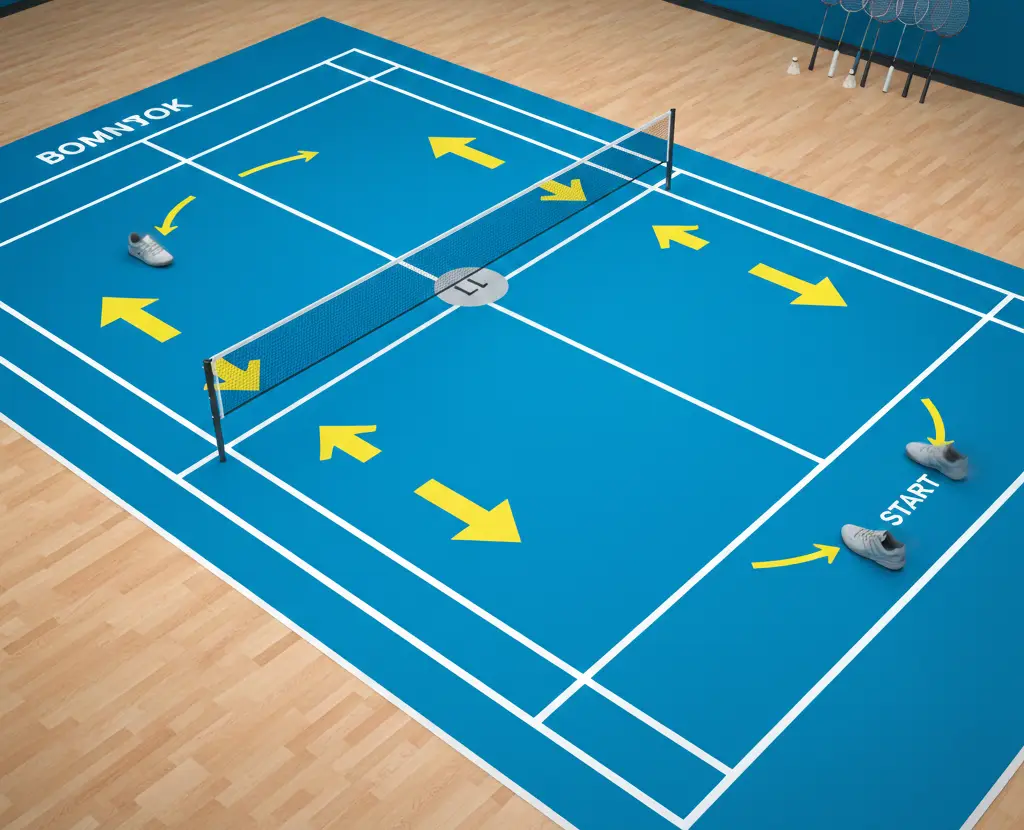
1. Shadow Footwork Drill (6-Point Movement)
Shadow footwork is one of the most important drills for beginners. It improves movement patterns without using a shuttle.
How to perform:
Start in your base position (center of the court).
Move to the front right corner (simulate a net shot).
Return to base.
Move to the front left corner.
Return to base.
Move to the rear right corner.
Return to base.
Move to the rear left corner.
Return to base.
This completes one full cycle.
Repetitions:
6–10 cycles
30–60 seconds per set
3 sets
Focus on:
Staying low
Balanced lunges
Quick recovery
Proper split step before each movement
This drill builds coordination, speed, and court awareness.
2. Agility Ladder Drill
Agility ladder drills improve quick feet and coordination. If you don’t have a ladder, you can draw boxes with tape.
Basic Beginner Pattern:
Place both feet inside each ladder box quickly
Move forward with light, fast steps
Stay on the balls of your feet
Repetitions:
3–5 rounds
20–30 seconds each
Progression:
Try sideways movement
Try single-leg hops
Increase speed gradually
This drill improves reaction time and explosiveness.
3. Cone Direction Drill (Change of Direction)
Place 4–6 cones around your base position to simulate different court corners.
How to perform:
Start in base position
Have a partner call out a cone number (or choose randomly yourself)
Move quickly to that cone
Simulate a shot
Recover to base
Repetitions:
10–15 calls per set
3 sets
This drill improves decision-making speed and directional control.
4. Front Court Lunge Repetition Drill
This drill strengthens your legs and improves net movement.
How to perform:
From base, lunge forward to the net
Simulate a net shot
Push back quickly
Repeat 10 times on the right side
Repeat 10 times on the left side
Sets:
2–3 sets
Focus on controlled balance rather than speed.
5. Rear Court Scissor Jump Drill
This drill builds explosive power and proper recovery after overhead shots.
How to perform:
Move quickly to the rear corner
Perform a scissor jump
Simulate an overhead smash
Land and recover to base
Repetitions:
8–12 repetitions per side
3 sets
Maintain good body rotation and avoid leaning backward excessively.
Sample Beginner Footwork Practice Plan (20-Minute Routine)
Consistency is more important than intensity for beginners. Below is a simple structured routine you can follow 3–4 times per week.
Warm-Up (5 Minutes)
Light jogging or skipping – 2 minutes
Dynamic stretches (leg swings, ankle rolls) – 2 minutes
Slow shadow movements – 1 minute
Main Workout (12–15 Minutes)
1. Shadow Footwork (6-point drill)
3 sets × 45 seconds
30 seconds rest
2. Agility Ladder Drill
3 rounds × 30 seconds
30 seconds rest
3. Front Court Lunge Drill
2 sets × 10 reps each side
4. Rear Court Scissor Jump Drill
2 sets × 8 reps each side
Cool Down (3–5 Minutes)
Slow walking
Light static stretching
Deep breathing
Following this routine regularly will noticeably improve speed, balance, and court movement within 2–4 weeks.
Common Footwork Mistakes Beginners Should Avoid
Improving footwork is not just about doing drills — it’s also about correcting errors.
1. Standing Too Upright
Many beginners stand tall instead of bending their knees.
Fix: Stay slightly crouched in the ready position.
2. Crossing Legs During Side Movement
Crossing legs reduces balance and slows recovery.
Fix: Use the chasse step instead of crossing your feet.
3. Not Returning to Base Position
After hitting a shot, beginners often admire their shot and forget to recover.
Fix: Always return to the center immediately.
4. Heavy Footsteps
Landing flat-footed reduces speed and increases fatigue.
Fix: Stay on the balls of your feet.
5. Ignoring the Split Step
Skipping the split step slows reaction time.
Fix: Make the split step automatic before every opponent’s shot.
Mastering these drills and avoiding common mistakes will build a strong foundation in badminton footwork for beginners. With consistent practice, you’ll notice improved speed, better balance, and stronger overall performance on the court.
Progression Plan: How to Improve Your Footwork Over Time
Once you are comfortable with beginner drills, the next step is gradual progression. Improvement in badminton footwork comes from consistency and controlled increases in intensity.
Week 1–2: Focus on Technique
Practice movements slowly
Prioritize balance and posture
Perform shorter sets with proper rest
Record yourself if possible to check form
Goal: Build correct movement patterns.
Week 3–4: Increase Speed
Reduce rest time between sets
Increase drill duration by 10–15 seconds
Add more directional changes
Combine split step before every movement
Goal: Improve reaction speed and endurance.
Week 5 and Beyond: Add Match Simulation
Combine footwork with real shuttle feeding
Practice random direction drills
Add multi-shuttle drills
Time yourself for 6-point shadow cycles
Goal: Develop game-ready movement and stamina.
Tracking your performance weekly helps measure improvement and keeps training structured.
Equipment Needed for Beginner Footwork Training
One of the best things about badminton footwork drills is that they require minimal equipment.
Essential Equipment
Badminton shoes with good grip
Racket (optional for shadow drills)
Comfortable sports clothing
Optional Training Equipment
Agility ladder (or floor tape)
Cones or water bottles (for direction drills)
Stopwatch or timer
Resistance bands (for strength training)
If you do not have access to a badminton court, you can practice in a small open space at home using marked corners.
Frequently Asked Questions (FAQ)
How often should beginners practice badminton footwork?
Beginners should practice footwork drills at least 3–4 times per week for 15–20 minutes. Consistency is more important than long sessions.
Can I improve badminton footwork at home?
Yes. Shadow footwork, ladder drills, and lunge repetitions can all be performed at home without a shuttle. You only need a small open area.
How long does it take to improve footwork?
With consistent training, most beginners notice improvement in balance and speed within 2–4 weeks.
Is footwork more important than powerful shots?
Yes. Without proper positioning, even strong shots become ineffective. Footwork creates the foundation for accurate and powerful strokes.
Should beginners use resistance training for footwork?
Basic bodyweight exercises are sufficient in the beginning. Once fundamentals are strong, light resistance training can enhance power and stability.
Conclusion: Build Your Foundation First
Badminton footwork is the foundation of every successful player. Before mastering smashes and deceptive shots, you must learn how to move efficiently and recover quickly.
By practicing:
Shadow footwork drills
Agility ladder exercises
Lunge and scissor jump drills
Structured weekly routines
You will develop better balance, faster reactions, and improved court coverage.
Start with just 20 minutes a day. Focus on proper technique. Stay consistent. Over time, you will feel lighter, quicker, and more confident during rallies.
Master your movement — and your entire game will improve.