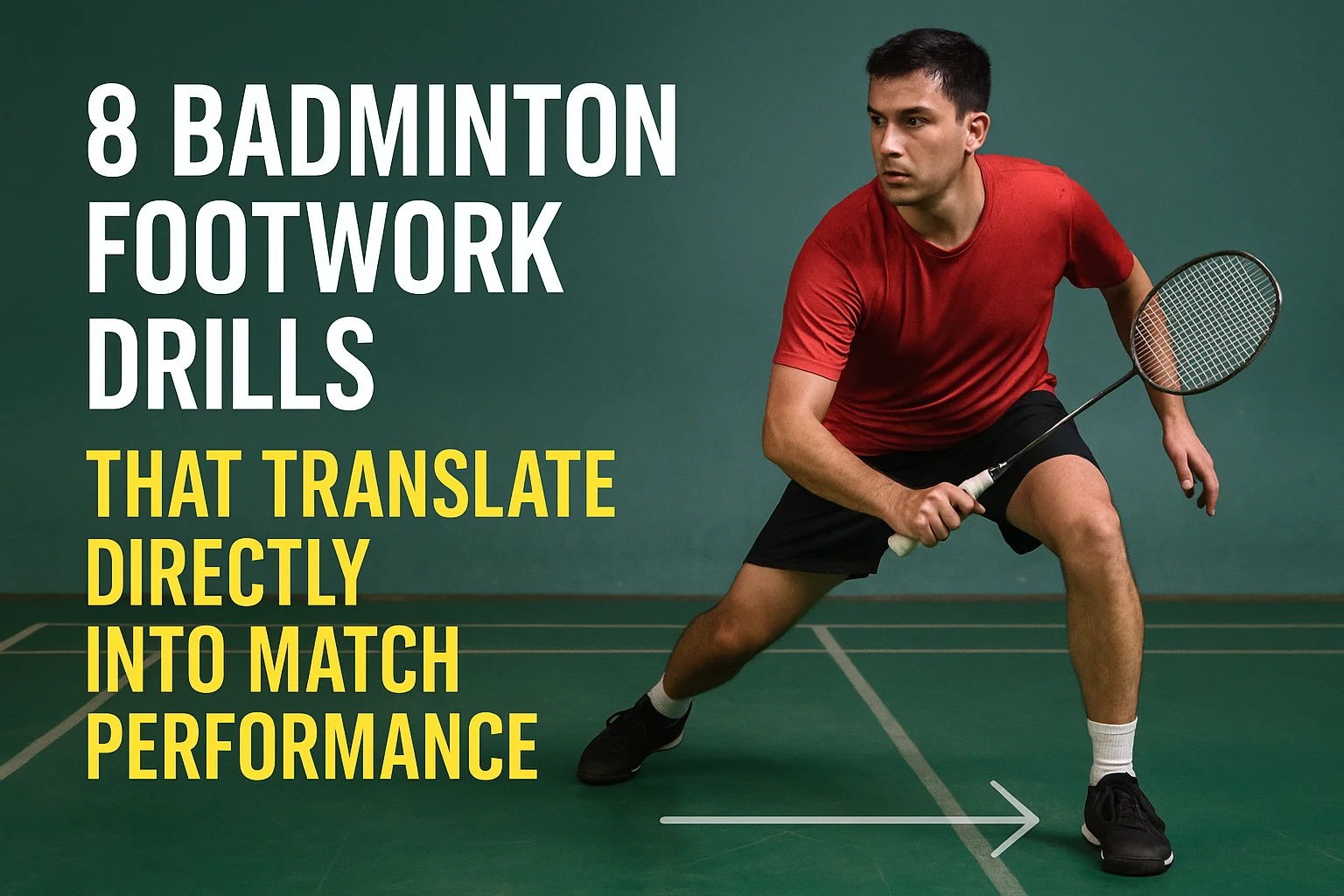
Effective footwork is what separates good badminton players from great ones. No matter how powerful your smash or precise your drop shot is, if you cannot get into position quickly and recover cleanly, you will always be on the back foot. These eight badminton footwork drills are not just general fitness exercises — they are designed to directly replicate the movement patterns you face in a real match. Train with these consistently and you will move faster, recover better, and strike with far greater precision under competitive pressure.
Why Match-Ready Footwork Matters in Badminton
Most recreational players focus almost entirely on stroke technique while ignoring footwork. This is a mistake. In a competitive rally, the ability to react instantly and reach a difficult shot is determined almost entirely by your footwork. Good footwork allows you to arrive at the shuttle early, giving you time to set up a clean, balanced shot rather than scrambling and playing defensively. It also helps you conserve energy across a long match by reducing wasted movement and keeping your body in an efficient, controlled position. Poor footwork, on the other hand, drains energy rapidly and significantly increases the risk of ankle, knee, and hip injuries. If you want to play better badminton, improving your footwork is the single highest-return investment you can make.
8 Badminton Footwork Drills That Improve Match Performance
The following eight drills target the exact movement patterns used in competitive badminton. Each one builds a specific physical quality — explosiveness, lateral agility, balance, or recovery speed — that directly translates to better court movement during a match.
1. High-Knee Running
High-knee running builds the explosive leg power you need to accelerate quickly across the court. Drive your knees up high with each step, focusing on a strong push-off from the balls of your feet. This drill conditions the fast-twitch muscle fibres that fire when you sprint to a net drop or push off from the baseline. Perform three sets of 30 seconds with 15 seconds of rest between sets.
2. Pattering on the Spot
Pattering is a rapid, low-amplitude footwork drill where you alternate feet quickly while staying on the balls of your feet. It sharpens your directional precision and trains your feet to respond to sudden changes in movement direction without losing balance. This drill directly mirrors the split-step rhythm used in badminton between shots. Perform three sets of 30 seconds, focusing on keeping your upper body still and relaxed.
3. Short Front Split (Forward Lunges)
The forward lunge replicates the reaching movement you use to retrieve net drops and tight net returns. Step forward into a deep lunge, then push explosively back to your starting position. The emphasis should be on the recovery — snapping back to your base position quickly is what makes this drill match-relevant. Perform ten repetitions on each leg for three sets.
4. Short Side Split (Lateral Lunges)
Lateral lunges simulate the cross-court defensive response and wide-body movements you make during fast rallies. Step out wide to the side, sink into the lunge, and drive back to centre with control. This drill builds the inner thigh and glute strength needed for stable wide-court coverage. Perform ten repetitions on each side for three sets.
5. Single-Leg Zig-Zag Hops
This drill builds single-leg stability and agility simultaneously — two qualities essential for landing cleanly from deep lunges or explosive split steps. Hop forward in a zig-zag pattern on one foot, sticking each landing with control before the next hop. Keep your knee soft on landing to reduce impact. Perform three sets of 20 hops per leg.
6. Sideways Chassé
The chassé is a lateral shuffle movement that is one of the most frequently used footwork patterns in badminton during fast net and mid-court rallies. Step sideways, bring your trailing foot to meet the lead foot, then step again — keeping your hips low and your weight centred. Avoid crossing your feet, as this disrupts balance. Perform three sets of 30 seconds in each direction.
7. One-Step Shadows
Shadow footwork is the most match-specific drill on this list. In shadow footwork, you move to all six corners of the court — front left, front right, mid left, mid right, rear left, rear right — in sequence, mimicking the exact movement patterns of a real rally. One-step shadows focus on the final lunge step to each corner, which is where most footwork errors occur. Performing this consistently builds muscle memory that carries directly into matches. Perform three sets of 60 seconds at a controlled pace.
8. Squat and Split
The squat and split combines lower body strength, flexibility, and endurance into a single movement. Begin in a wide squat, hold briefly, then split into a lunge and return. This drill trains the type of sustained lower body effort needed in long, physically demanding matches where fatigue begins to compromise movement quality. Perform three sets of 12 repetitions.
Common Footwork Mistakes Badminton Players Make
Even experienced players develop bad movement habits that limit their performance. Being aware of these mistakes is the first step to correcting them.
Moving flat-footed is one of the most common errors. When your heels hit the court first, your reaction time slows significantly. Always stay on the balls of your feet between shots, ready to explode in any direction.
Taking large, bounding steps makes your movement predictable and slow. Badminton footwork is built on small, quick, controlled steps that allow you to adjust your position smoothly and change direction without losing momentum.
Crossing your feet during lateral shuffles is a balance killer. Keep your feet parallel and your hips low during sideways movement to stay stable and ready.
Neglecting recovery is perhaps the most damaging habit. Many players focus entirely on reaching the shuttle but forget to return to their base position immediately after playing the shot. Every drill you practise should end with a deliberate return to the ready position — not a static stop.
Pro Tips to Improve Your Badminton Footwork Faster
Always warm up dynamically before footwork training. Light jogging combined with leg swings, hip circles, and ankle rotations prepares your joints and muscles for explosive movement and significantly reduces injury risk.
Prioritise technique over speed when learning a new drill. Perfect the movement pattern at a slow, controlled pace first. Once the correct form is automatic, gradually increase the speed. Rushing the learning process creates ingrained bad habits that are difficult to correct later.
Progress your drills gradually over weeks and months. Increase duration, intensity, or complexity only when you can perform the current level cleanly and without fatigue affecting your form.
Cool down properly after every session. Five to ten minutes of light stretching targeting the calves, hip flexors, hamstrings, and groin maintains flexibility and aids muscle recovery so you can train consistently without accumulating soreness.
Invest in proper badminton shoes. Court grip, lateral support, and cushioning in badminton-specific footwear have a direct and measurable impact on your ability to execute footwork drills safely and effectively. General sports shoes or running shoes are not suitable substitutes.
How to Structure Your Badminton Footwork Training Sessions
For footwork training to produce real match improvements, it needs to be structured consistently across your weekly training schedule. Practise footwork drills at least two to three times per week for meaningful gains in agility and muscle memory.
Begin every session with five to ten minutes of dynamic warm-up. Follow with a technical practice phase of three sets per drill at a controlled pace, focusing entirely on form and posture. Then move into a speed phase where you perform the same drills at maximum effort for 30 to 45 seconds per set, building the agility and reaction speed that matches demand. Finish each session with light footwork and stretching to support balance, stamina, and injury prevention.
Incorporate shadow footwork into your rally practice to train smooth transitions between shots. Schedule footwork drills early in your training sessions when your energy and concentration levels are highest. Mixing in short sprint sets and shuttle run bursts also helps replicate the stop-start intensity of a real match.
Frequently Asked Questions About Badminton Footwork Drills
How often should I practise badminton footwork drills?
Practise footwork drills at least two to three times per week to build the muscle memory, agility, and conditioning needed for match-level movement. Consistency over weeks and months is what produces lasting improvement — one intensive session per week is not enough.
Can badminton footwork drills be done solo?
Yes. The majority of these drills — including shadow footwork, splits, zig-zag hops, and chassé — are designed to be performed solo and are highly effective without a training partner or coach. All you need is a small clear space and a pair of proper badminton shoes.
Are these footwork drills suitable for beginners?
Absolutely. These drills are beneficial for players at every level. Beginners should start at a slow pace and focus entirely on correct technique before increasing speed or intensity. Building correct movement habits from the start will pay dividends throughout your entire badminton development.
What is the most important footwork drill for badminton?
Shadow footwork is widely considered the most valuable footwork drill in badminton. It replicates all six court directions used in a real rally and builds the movement patterns and muscle memory that transfer most directly into match performance. If you only have time for one drill, make it shadow footwork.
How long does it take to see improvement in badminton footwork?
Most players notice measurable improvements in court movement within four to six weeks of consistent footwork training two to three times per week. Full match-level fluency in all six court directions typically develops over three to four months of disciplined practice.
Footwork is the foundation of every shot you play in badminton. No matter your current level, dedicating structured time to these eight drills will accelerate your court movement, reduce energy waste, and give you the physical base needed to compete with confidence. Start with two sessions per week, focus on technique before speed, and stay consistent — the results will show in your matches far sooner than you expect.