Badminton Grip Techniques Explained
Badminton is a fast-paced sport that demands precision, control, and explosive power. However, all of these elements begin with one fundamental skill — how you hold your racket. Mastering the correct badminton grip techniques is the foundation of power, accuracy, and quick reaction time.
Whether you are a beginner learning basic strokes or an intermediate player aiming to improve your smash and defense, understanding proper grip technique will dramatically enhance your performance.
According to coaching programs from the Badminton World Federation (BWF), grip fundamentals are among the first skills taught to players because every stroke in badminton depends on correct hand positioning and smooth grip transitions.
In this guide, you will learn why grip technique matters and how to use the four essential badminton grips correctly.
Why the Right Grip Matters
Many players underestimate the importance of proper grip technique. Instead of focusing on how they hold the racket, they concentrate only on strength or swing speed. Unfortunately, an incorrect grip can reduce control, slow reaction time, and even cause wrist strain.
Here’s why using the correct badminton grip is essential:
1. Improved Shot Control
A proper grip allows precise shuttle placement. Small adjustments in finger pressure and racket angle determine the direction and accuracy of your shot. With the correct grip, you can control clears, drops, drives, and smashes more effectively.
2. Increased Power Without Extra Effort
Power in badminton does not come from squeezing the racket tightly. Instead, it comes from a relaxed grip combined with a quick tightening motion at the moment of impact. This technique generates higher racket head speed and produces powerful shots without unnecessary strain.
3. Faster Reaction Time
Badminton is one of the fastest racket sports in the world. Players must react instantly. If your grip is incorrect or too tight, switching between forehand and backhand shots becomes slow and awkward. A proper grip enables seamless transitions and quicker defensive responses.
4. Reduced Risk of Injury
Over-gripping places stress on the wrist, forearm, and elbow. Maintaining a relaxed and flexible grip reduces muscle tension and helps prevent long-term injuries.
Professional training systems emphasize learning a neutral grip first and then mastering quick grip changes. This foundation allows players to develop advanced techniques more efficiently.
The 4 Main Badminton Grips — What They Are & When to Use Them
Understanding the four fundamental badminton grips will allow you to execute every essential stroke effectively. Each grip has a specific purpose, and knowing when to use them is critical for performance.
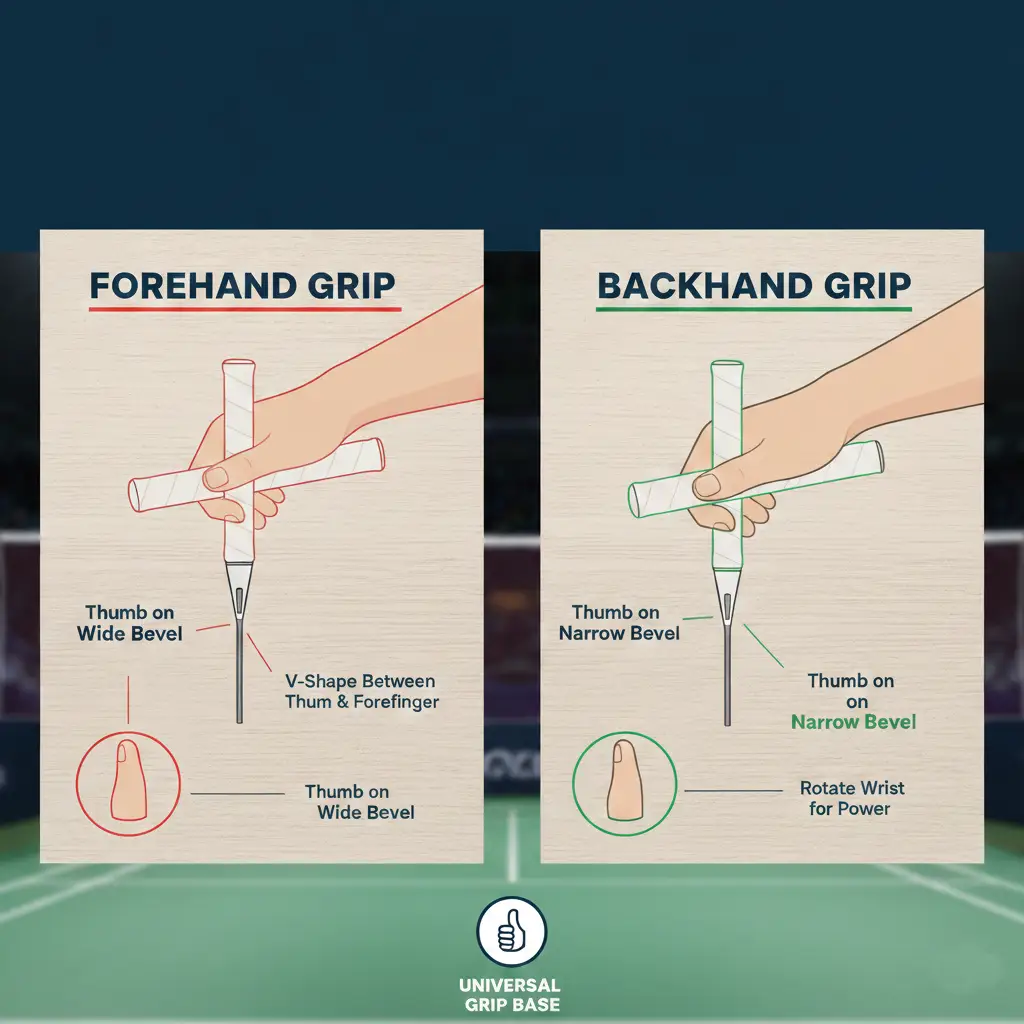
1. Neutral / Forehand (V) Grip
The forehand grip, often called the “V grip” or “handshake grip,” is the most basic and widely used grip in badminton.
How to Hold the Forehand Grip
Hold the racket as if you are shaking hands with it.
Your thumb and index finger should form a “V” shape along the bevel of the handle.
Keep your fingers relaxed rather than tightly wrapped.
Leave a small gap between your palm and the handle for flexibility and control.
When to Use the Forehand Grip
Forehand clears
Forehand smashes
Drives
Most overhead shots
Common Mistake
Avoid holding the racket like a frying pan when performing rear-court shots. This incorrect variation (panhandle grip) reduces swing range and limits power.
2. Backhand Grip
The backhand grip is essential for shots played on the non-dominant side of your body. Proper thumb placement is the key to generating power in backhand strokes.
How to Hold the Backhand Grip
Begin from the neutral forehand grip position.
Rotate the racket slightly inward.
Place your thumb flat against the wider bevel of the handle.
Apply pressure with your thumb during contact to create leverage and control.
When to Use the Backhand Grip
Backhand clears
Backhand drives
Defensive lifts
Net blocks on the backhand side
Key Tip
Power in backhand shots comes from thumb pressure and forearm rotation, not from swinging harder. Focus on controlled wrist movement rather than excessive arm motion.
3. Bevel / Panhandle Grip
The bevel or panhandle grip is often misunderstood. While it should not be overused, it plays an important tactical role in specific situations.
How to Hold the Panhandle Grip
Hold the racket similarly to gripping a frying pan.
Your palm faces more directly behind the racket face.
The “V” formed by your thumb and index finger shifts slightly toward the top of the handle.
When to Use the Panhandle Grip
Net kills
Forecourt interceptions
Certain overhead net shots
Quick finishing shots at the net
Important Note
Using the panhandle grip for backcourt overhead shots reduces power and limits full-arm rotation. It should mainly be used for forecourt play and quick net situations.
4. Hammer / Power Grip
The hammer grip resembles holding a hammer and is typically used for powerful downward strokes.
How to Hold the Hammer Grip
Grip the racket firmly as you would hold a hammer.
Wrap your fingers evenly around the handle.
Stay relaxed before impact, tightening only at the moment of contact.
When to Use the Hammer Grip
Jump smashes
Steep downward shots
Certain defensive blocks
Pro Tip
Even when using a power grip, avoid constant tension. Relaxation before impact increases swing speed and overall shot effectiveness.
Grip Transition — How to Switch Quickly Between Grips
In badminton, holding the correct grip is important — but switching between grips quickly is even more important. Since rallies happen at high speed, players must adjust their grip position within fractions of a second.
The ability to transition smoothly between forehand and backhand grips allows you to react faster, generate better angles, and maintain control under pressure.
Why Grip Switching Is Essential
Prevents late or weak shots
Improves defensive reaction time
Helps maintain correct stroke technique
Increases overall court confidence
Players should never hold the racket in one fixed grip throughout a rally. Instead, the grip should remain relaxed so the fingers can adjust naturally depending on the incoming shuttle.
How to Practice Grip Switching
1. Shadow Grip Switch Drill
Stand in ready position.
Hold the racket using a neutral grip.
Quickly rotate between forehand and backhand grips without hitting a shuttle.
Repeat for 1–2 minutes continuously.
Focus on speed and smoothness rather than force.
2. Balloon or Shuttle Tap Drill
Use a balloon (for beginners) or a shuttle.
Alternate between forehand and backhand taps.
Concentrate on switching grips before each contact.
This drill builds muscle memory and improves coordination.
Pro Tip
Keep your grip relaxed in the ready position. If your fingers are too tight, switching becomes slow and awkward. Think of your grip as dynamic — not fixed.
Common Grip Mistakes & How to Fix Them
Even experienced players sometimes develop bad grip habits. Recognizing and correcting these mistakes early can significantly improve performance.
1. Gripping Too Tightly
Problem: Constant tension reduces wrist flexibility and slows racket speed.
Effect: Weak smashes and reduced control.
Solution: Practice holding the racket at 4–5 out of 10 pressure and tighten only at the moment of impact.
2. Using the Panhandle Grip Too Often
Problem: Many beginners unknowingly hold the racket like a frying pan for all shots.
Effect: Limited power in overhead clears and smashes.
Solution: Return to the neutral forehand grip for rear-court shots.
3. Incorrect Thumb Placement in Backhand
Problem: Thumb wraps around the handle instead of pressing flat on the bevel.
Effect: Weak backhand shots and poor control.
Solution: Place your thumb flat against the wider bevel to generate leverage.
4. Not Switching Grips During Rallies
Problem: Players stick to one grip position.
Effect: Late contact and rushed strokes.
Solution: Practice grip-switch drills daily to build automatic transitions.
Correcting these common mistakes will immediately improve shot consistency and reduce unnecessary strain on your wrist and forearm.
Drills & 3-Week Practice Plan to Improve Your Grip Technique
Improvement in badminton grip technique requires consistent, structured practice. Below is a simple three-week plan suitable for beginners and intermediate players.
Week 1: Foundation & Awareness
Goal: Develop correct grip positioning and relaxation.
Practice holding forehand and backhand grips correctly for 5–10 minutes daily.
Perform shadow grip-switch drills (2 minutes × 3 sets).
Use a balloon or shuttle to tap slowly while alternating grips.
Focus on correct hand positioning and relaxed control.
Week 2: Controlled Movement & Accuracy
Goal: Apply grip transitions in light rally situations.
Practice forehand and backhand drives with a partner.
Perform net drills alternating between forehand and backhand shots.
Add light footwork while maintaining proper grip technique.
Measure progress by counting successful clean contacts during rallies.
Week 3: Match Simulation & Speed
Goal: Use correct grips instinctively under pressure.
Play half-court singles focusing on quick grip changes.
Practice defensive lifts and smashes with proper grip adjustments.
Time yourself performing rapid grip-switch drills (increase speed weekly).
By the end of Week 3, grip transitions should feel automatic rather than forced.
Consistency Is Key
Even 10–15 minutes of focused grip practice daily can significantly improve shot quality and reaction time. Over time, correct grip technique becomes muscle memory, allowing you to focus on strategy and movement during matches.
Equipment & Grip Tape — Choosing the Right Setup
While technique is crucial, your equipment also plays an important role in grip comfort and control. The size and texture of your racket handle can directly affect your performance.
1. Grip Size Matters
If the handle is too small, you may over-squeeze to maintain control.
If it is too large, your wrist movement becomes restricted.
Choose a grip size that allows you to hold the racket comfortably while leaving slight space between your palm and fingers. This ensures flexibility and proper finger control.
2. Overgrips vs Replacement Grips
Replacement Grip: The base grip that comes with the racket. Thicker and more cushioned.
Overgrip: A thinner layer wrapped over the base grip for extra comfort and sweat absorption.
Players who sweat heavily should use absorbent overgrips and change them regularly to prevent slipping.
3. When to Replace Your Grip
You should replace your grip when:
It becomes slippery
The surface starts peeling
It feels hard and uncomfortable
You notice reduced control
A fresh grip improves comfort, prevents blisters, and enhances shot precision.
Pro Tips from Coaches to Improve Your Grip Technique
Professional coaching systems, including those promoted by the Badminton World Federation (BWF), emphasize relaxed control and smooth transitions as key fundamentals.
Here are some practical tips used by coaches:
Keep your grip relaxed in the ready position.
Tighten your fingers only at the moment of shuttle contact.
Use finger power rather than full arm swings for drives and net shots.
Practice forearm rotation (pronation and supination) for better power generation.
Avoid locking your wrist — flexibility improves control.
Always return to the neutral grip after each shot.
Consistent attention to these small details can dramatically improve your overall game.
Frequently Asked Questions (FAQs)
1. What is the best badminton grip for beginners?
The neutral or forehand “V grip” is the best starting point for beginners. It allows flexibility and makes it easier to transition between different strokes.
2. How tight should I hold the badminton racket?
You should hold the racket at about 4–5 out of 10 pressure. Tighten your grip only at the moment of impact to generate power without reducing flexibility.
3. How can I switch from forehand to backhand quickly?
Keep your grip relaxed in the ready position and practice daily grip-switch drills. Muscle memory develops over time, allowing faster and smoother transitions during rallies.
4. When should I use the panhandle grip?
The panhandle grip is mainly used for net kills, forecourt interceptions, and quick finishing shots at the net. It should not be used for rear-court overhead shots.
5. Why is my backhand weak even with proper technique?
Many players fail to use proper thumb pressure. Ensure your thumb is placed flat against the bevel of the handle and combine it with forearm rotation for added power.
6. Does grip technique affect smash power?
Yes. Smash power depends on a relaxed grip before contact and a quick tightening motion at impact. Over-gripping reduces racket head speed and limits power.
Conclusion
Mastering badminton grip techniques is essential for developing control, power, and speed on the court. From the neutral forehand grip to quick transitions and tactical use of the panhandle grip, each technique plays a specific role in your overall performance.
By correcting common mistakes, practicing grip-switch drills, and following a structured training plan, you can significantly improve your shot consistency and reaction time.
Remember — the right grip is not about strength. It is about relaxation, timing, and control.
Start applying these techniques in your next practice session and focus on building correct muscle memory. With consistency and awareness, proper grip technique will soon become automatic.