
Why Net Play Matters in Badminton
Net play is one of the most important aspects of modern badminton. While powerful smashes and fast drives often get attention, the ability to control the shuttle at the net is what truly determines who controls the rally.
Strong front-court skills allow you to apply pressure, force weak returns, and create attacking opportunities — often without needing a smash at all. Yet net play is one of the most underdrilled areas for club and recreational players across India, where most practice time goes toward baseline clears and smashes.
In this complete guide, you will learn every element needed to build elite-level net play — from grip and stance to advanced deception, footwork patterns, progressive drills, and a structured 4-week training plan.
Why Net Play Controls Rallies
1. Creates attacking opportunities → A tight net shot forces your opponent to lift. A weak lift gives you the smash or steep drop you want.
2. Disrupts your opponent's rhythm → A well-placed cross-court net shot pulls opponents off balance and breaks their movement pattern.
3. Wins quick points → Loose or high net returns can be punished instantly with a net kill — especially in doubles.
4. Essential in both singles and doubles → Singles: net play builds pressure and creates space. Doubles: the front-court player intercepts and finishes at the net.
If you control the net, you control the rally.
Quick Overview: Net Play Shot Types at a Glance
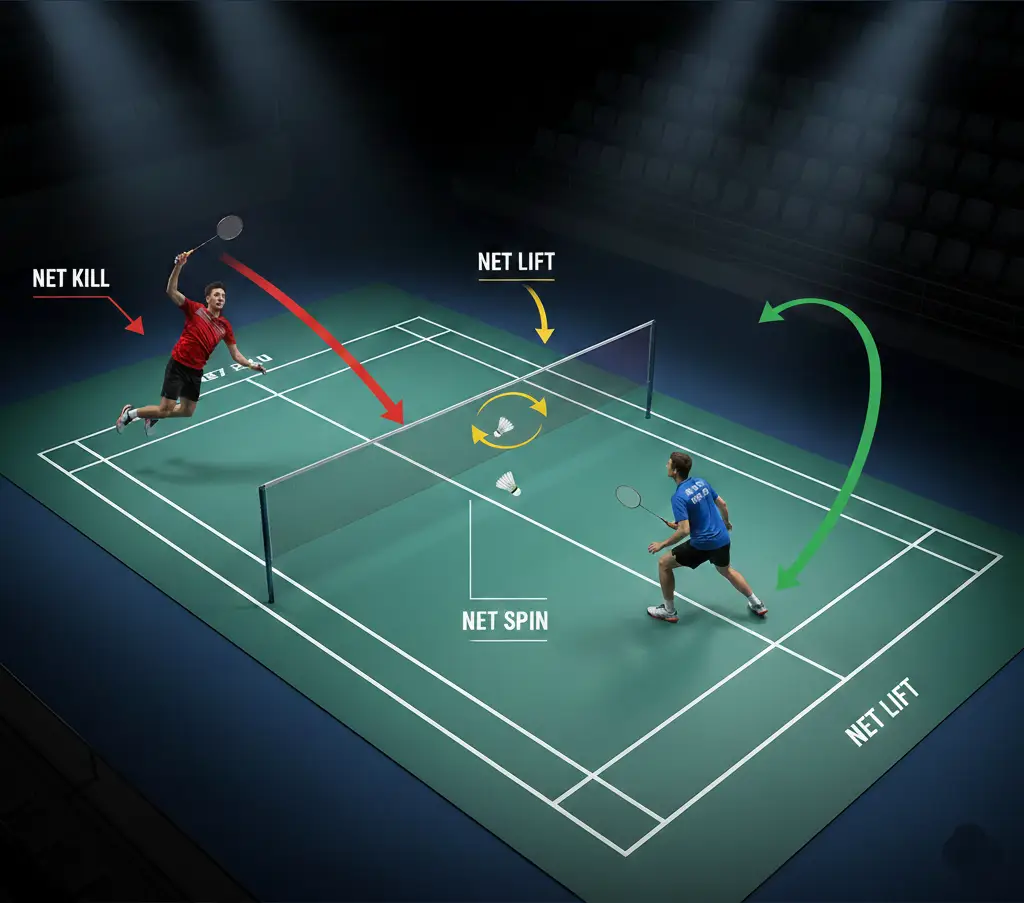
Here is a summary of all five net shot types and when to use each:
1. Straight Net Shot (Tight Net Shot) → Played softly close to the tape; forces a lift; used under pressure or to maintain rally control
2. Cross-Court Net Shot → Sent diagonally to pull opponent out of position; use when opponent leans toward straight reply
3. Spinning (Tumbling) Net Shot → Shuttle spins over tape making return difficult; use when you have early contact and good balance
4. Net Lift → Defensive option when you arrive late or shuttle is too tight; aim high and deep to reset the rally
5. Net Kill → Sharp downward tap to finish the rally; use only when shuttle is above tape height and you are close
Net Play Fundamentals: Grip, Stance & Racket Control
Before advancing to deception or complex tactical strategies, mastering the basic technical elements of net play is essential. Strong fundamentals ensure consistency, precision, and fast recovery under match pressure.
1. Correct Grip for Net Shots
Your grip directly influences shuttle control and accuracy at the net.
Forehand Net Shot Grip
Use a relaxed forehand grip — similar to a handshake position
Keep your fingers slightly loose to improve touch and feel
Avoid gripping too tightly — tension reduces control significantly
Apply a light squeeze only at the moment of contact
Backhand Net Shot Grip
Use a bevel or thumb grip depending on the shuttle's exact position
Apply finger power rather than large arm swings for better precision
Keep the racket face slightly open to guide the shuttle gently over the net
Pro tip: Keep the grip relaxed during preparation and apply a slight squeeze at the moment of contact. This combination of relaxation and precise timing is what creates soft, controlled net shots consistently.
2. Ready Stance and Positioning
Good net play begins with proper positioning and balance before the shuttle even arrives.
Stay on the balls of your feet — not flat-footed
Keep your knees slightly bent at all times
Hold your racket in front of your body at chest height
Perform a small split step as your opponent strikes the shuttle
When moving forward to the net:
Take a quick, controlled lunge step — not a slow walk
Keep your upper body balanced and upright
Avoid leaning excessively toward the net to prevent faults
After playing your shot, recover immediately to your base position. Quick recovery is not optional — it is what keeps you in control of the next exchange.
3. Wrist Action and Racket Motion
Net shots require small, precise movements rather than large swings. The smaller and more controlled your movement, the faster you can react to the next shot.
For standard net shots:
Use a compact, controlled brushing motion
Make contact with the shuttle slightly above tape height
Keep the racket head up at all times for faster reaction
For spinning net shots:
Gently brush the shuttle feathers to create tumble and spin
Use finger power and subtle wrist rotation
Keep the movement short and disguised — deception starts here
For net kills:
Use minimal backswing — large backswings telegraph your intention
Execute a quick downward tapping motion
Recover immediately after contact
Shot Types and Decision-Making in Net Play
Understanding when to use each net shot is just as important as executing it correctly. The right decision at the right moment shifts rally momentum in your favor.
1. Straight Net Shot (Tight Net Shot)
This shot is played softly so the shuttle lands as close to the net tape as possible on the opponent's side.
Use it when:
The shuttle is below tape height and a kill is not possible
You want to force your opponent into a weak lift
You are maintaining pressure during a tight net exchange
Keep the shuttle as tight to the net as possible — a loose straight net shot invites an immediate net kill.
2. Cross-Court Net Shot
The cross-court net shot sends the shuttle diagonally across the net, pulling your opponent out of their base position.
Use it when:
Your opponent is leaning or anticipating a straight reply
You want to create space on the opposite side of the court
You want to disrupt their front-court balance and rhythm
Be aware that this shot travels a longer distance and carries slightly more risk than a straight net shot — use it selectively.
3. Spinning (Tumbling) Net Shot
This advanced net shot causes the shuttle to spin and tumble over the tape, making it extremely difficult for opponents to control their return.
Use it when:
You have good balance and early shuttle contact
You want to apply maximum pressure in tight net exchanges
Your opponent struggles with delicate touch shots
Proper brushing technique and a relaxed grip are essential. Rushing this shot causes errors.
4. Net Lift
The net lift is a defensive option used when you are under pressure and a quality net shot is not possible.
Use it when:
You arrive late to the shuttle
The shuttle is too tight to play a quality net shot safely
You need to reset the rally and buy recovery time
Always aim for a high and deep lift — a short lift hands the attack straight back to your opponent.
5. Net Kill
The net kill is a quick downward tap used to finish the rally decisively.
Use it when:
Your opponent plays a loose or high net shot above the tape
You are close enough to the net to strike from above
In doubles, to intercept weak front-court returns immediately
Keep the motion short and controlled. Avoid large swings — they reduce accuracy and slow your recovery for the next shot.
Decision-Making Principles at the Net
Follow these tactical rules consistently:
Take the shuttle as early as possible — being early gives you more options
If the shuttle is high, attack — net kill or steep drop
If the shuttle is tight and low, play soft and controlled
If you are off balance or late, choose a safe high lift — never force a risky shot
Always recover quickly after your shot — the rally continues
Smart decision-making combined with strong fundamentals transforms average net play into match-winning front-court dominance.
Deception and Disguise Techniques at the Net
Deception is what separates good net players from great ones. When your opponent cannot read your shot early, they hesitate — and hesitation creates weak replies.
1. Maintain a Neutral Preparation
Keep your racket preparation identical for multiple shot options. Whether you intend to play a straight net shot, cross-court net, or lift — your initial movement should look exactly the same.
Keep the racket head up throughout preparation
Use a compact, consistent backswing for all shots
Avoid obvious body signals — shoulders, eyes, and hips that reveal direction
The goal is to make your opponent commit their movement before you reveal your shot.
2. The Hold-and-Flick Technique
This technique involves briefly pausing at the net before executing your shot — forcing the opponent to guess and move before you decide.
Pause slightly before contact, racket held still
Watch your opponent's movement and weight shift
Play your shot at the last possible moment
Examples:
Fake a soft net shot, then gently lift at the last moment
Show a lift preparation, then brush softly across the net
Pause at the net, then redirect cross-court
Timing is critical here. The hold must be subtle — too long and you risk losing your own balance.
3. Deceptive Cross Net Shot
Instead of changing your swing direction visibly, use the same forward motion and adjust only the racket face angle at the last second.
Approach the shuttle as if playing a straight net shot
Rotate the racket face slightly at the moment of contact
Guide the shuttle diagonally without changing your swing path
Because the approach motion appears identical to a straight shot, your opponent reacts late and is already moving in the wrong direction.
4. Body Language Control
Your shoulders, hips, and eyes often reveal your intention before your racket does. Controlling these cues is advanced net play:
Avoid looking toward your intended target too early
Keep your shoulders square and relaxed during preparation
Minimize exaggerated body movements that telegraph direction
The less information you give away during preparation, the more effective your deception becomes — and the more your opponent hesitates.
5. When to Use Deception
Deception works best when you are balanced and have reached the shuttle early, your opponent is aggressive and leaning at the net, and you want to break fast net exchanges and create uncertainty.
Avoid overusing deception. Smart net play balances consistency with surprise — if you try to deceive every shot, your opponent adjusts and your errors increase.
💡 Want to develop deceptive net play under professional guidance? Rackonnect coaches work with players at all levels to build front-court skills that hold up under match pressure. Explore coaching →
Footwork and Recovery for Net Control
Technical skill at the net is ineffective without proper footwork. Fast, balanced movement allows you to reach the shuttle early and recover for the next shot consistently.
1. The Split Step
The split step is the starting point of every net movement:
Perform a small hop as your opponent strikes the shuttle
Land on the balls of both feet simultaneously
Keep knees slightly bent and body weight slightly forward
React explosively from this position toward the net
Without the split step, your first movement is slow and your weight is already committed — you arrive late.
2. Forward Lunge Technique
When moving to the net:
Take a quick, explosive first step forward immediately after the split step
Extend into a controlled, balanced lunge
Keep your front knee aligned over your ankle — not collapsing inward
Maintain an upright upper body throughout the lunge
A balanced lunge allows precise net shots and faster push-back recovery than an off-balance reach.
3. Quick Recovery to Base
After playing your net shot — especially after a net kill or tight net shot:
Push off your front leg immediately after contact
Return to your base position in the center of the court
Keep your racket up during recovery — the next shot may come fast
Do not watch your shot travel — assume the rally continues
Many players lose points not because of a poor net shot, but because of slow recovery afterward.
4. Movement Efficiency
Use short, quick steps rather than long strides when moving forward
Avoid unnecessary hopping between shots
Stay light and relaxed — tense footwork is slow footwork
In doubles, recovery speed is even more critical because rallies are faster
5. Common Footwork Mistakes to Avoid
Overreaching and losing balance on the lunge
Leaning too far forward over the net
Recovering slowly after net kills
Standing flat-footed between shots instead of on the balls of the feet
Correct footwork ensures that your net play remains consistent even under pressure in long rallies.
Net Play in Singles vs Doubles
The fundamentals of net play remain the same in both formats, but the tactical application differs significantly.
Net Play in Singles
In singles, net play is primarily used to build attacking opportunities and move your opponent around the court strategically.
Key focus areas:
Play tight straight net shots consistently to force lifts
Use cross-court net shots selectively to create space on the opposite side
Be patient — singles net exchanges are longer and require tactical construction
Prioritize recovery to cover the full court after every front-court shot
Net play in singles is controlled and strategic rather than immediately aggressive
Net Play in Doubles
In doubles, net play is far more aggressive and fast-paced. The front-court player's role is to intercept and finish — not to construct long exchanges.
Key focus areas:
Intercept loose shuttles immediately — do not wait
Look for net kill opportunities on any high or loose return
Coordinate with your partner — call shots clearly to avoid confusion
Maintain attacking formation after a successful net kill
Transition quickly from side-by-side defense to front-back attack
The key tactical difference: In singles, net play is about patience and building the rally. In doubles, it is about speed, aggression, and finishing quickly. Practicing both formats separately sharpens your ability to switch between these mindsets in competition.
Progressive Net Drills for Mastery
Drill 1: Shadow Net Control (Solo Drill)
Purpose: Improve wrist control and movement balance without shuttle pressure.
Start at center base position
Move to each front corner using proper lunge technique — no shuttle
Simulate the brushing motion at the net and push back to base
Perform 3 sets of 30 seconds per side
Focus: Smooth, compact movements with complete recovery after each lunge.
Drill 2: Partner Soft Feed Accuracy Drill
Purpose: Develop tight net control and precise placement.
Partner feeds soft shots to alternating net positions
Aim to land the shuttle within a small target zone near the tape
10 repetitions per side, switch roles after each round
Progress to mixing straight and cross-court targets
Focus: Touch and precision — not pace.
Drill 3: Net Kill Reaction Drill
Purpose: Improve finishing ability and reaction speed.
Partner deliberately plays loose, high net shots
Step in quickly and execute a controlled net kill
Recover to base immediately after contact
15 repetitions per side, 3 sets
Focus: Minimal backswing and immediate recovery after the kill.
Drill 4: Multi-Shuttle Net Pressure Drill
Purpose: Build stamina and consistency under match-like pressure.
Coach or partner feeds multiple shuttles rapidly to the front court
Alternate between straight and cross net shot responses
Continue for 45–60 seconds per set, 3 sets with 90-second rest
Focus: Maintain technique and decision-making quality as fatigue builds.
Drill 5: Deception Progression Drill
Purpose: Improve disguise and shot variation under controlled conditions.
Play 3 straight net shots in a row
On the fourth shot, execute a deceptive cross or hold-and-lift
Repeat the pattern for 10 cycles
Progress by making the disguise more subtle each week
Focus: Identical preparation for all shots — the deception comes from the racket face, not the body.
🏸 Book a court and run these drills today. Rackonnect venues across Delhi NCR offer premium, consistent courts for structured training:
Common Net Play Mistakes and How to Fix Them
Mistake 1: Hitting the Shuttle Too High Above the Net
Problem: Loose net shots sit up and invite immediate net kills or steep drops. Fix: Aim to contact the shuttle just slightly above tape height. Use a gentle brushing motion rather than pushing. Soft hands and relaxed grip pressure are the keys.
Mistake 2: Overusing Power Instead of Touch
Problem: Swinging too hard at the net reduces control and increases unforced errors. Fix: Shorten your swing dramatically. Use finger power and subtle wrist control instead of arm movement. Practice compact motions in every drill session until they feel natural.
Mistake 3: Poor Recovery After the Shot
Problem: Players watch their shot land instead of recovering immediately to base. Fix: Push off your front leg the moment after contact. Keep your racket raised during recovery. Build recovery as a non-negotiable habit in every drill — not just matches.
Mistake 4: Leaning Too Far Over the Net
Problem: Overreaching causes loss of balance and leads to net faults in competitive play. Fix: Maintain a stable, balanced lunge position. Keep your center of gravity controlled. Extend your racket arm — not your entire body — toward the net.
Mistake 5: Predictable Shot Selection
Problem: Repeating the same straight net shot every time allows opponents to anticipate and position early. Fix: Mix straight and cross-court shots regularly. Add occasional lifts to disrupt opponent rhythm. Use hold-and-flick deception to make your shot selection unreadable.
Mistake 6: Playing Net Kills When Not in Position
Problem: Attempting net kills from below tape height results in shots into the net or weak pop-ups. Fix: Only execute a net kill when the shuttle is clearly above tape height and you are close enough to strike downward. When in doubt, play a tight net shot instead.
4-Week Net Play Training Plan
Week 1: Technical Foundation
Focus: Grip refinement, soft touch control, straight net shot consistency.
Shadow net practice — 10 minutes per session
Target accuracy drill — 3 sets of 10 per side
15–20 minutes controlled rally with partner focusing on net exchanges
Goal: Reduce unforced net errors by building consistent grip and contact habits.
Week 2: Footwork and Recovery
Focus: Split step timing, balanced lunges, quick recovery to base.
Multi-direction front-court movement drills — 3 sets of 45 seconds
Net kill recovery drill — 15 reps per side
Controlled match play emphasizing recovery after every net shot
Goal: Improve arrival speed and stability at the net, with faster base recovery.
Week 3: Deception and Variation
Focus: Hold-and-flick technique, cross-court accuracy, shot disguise.
Deception progression drill — 10 cycles per session
Cross vs straight variation drill — 3 sets of 10 per side
Practice games focused exclusively on front-court exchanges
Goal: Increase unpredictability and force opponent hesitation during net rallies.
Week 4: Match Simulation and Pressure Training
Focus: Decision-making under pressure, consistency during fatigue, tactical awareness.
Multi-shuttle high-intensity net drill — 3 sets of 60 seconds
Competitive net-only mini games (no lifts rule) — first to 15 points
Full match play with net performance as the specific focus area
Goal: Maintain net dominance and correct decision-making under realistic match conditions.
Frequently Asked Questions (FAQ)
Q: How can I improve my net shots in badminton quickly? Focus on three things first: a relaxed grip with finger control, compact wrist motion rather than arm swings, and consistent recovery after every shot. Regular front-court accuracy drills with a partner accelerate improvement faster than match play alone.
Q: When should I play a net kill? Only when the shuttle is clearly above tape height and you are close enough to strike downward. Avoid large backswings — use a short, controlled downward tap. Attempting net kills from below tape height results in net faults or weak pop-ups that invite counter-attacks.
Q: How do I practice net play alone? Use shadow drills to simulate lunges and brushing movements toward both front corners. You can also practice racket control and wrist brushing by gently tapping a shuttle repeatedly close to a wall or with a wall target zone.
Q: Is net play more important in singles or doubles? Both, but in different ways. In singles, net play builds pressure, creates space, and forces attacking positions. In doubles, net play is more aggressive — the front-court player's primary role is to intercept and finish at the net quickly. Both formats require excellent net fundamentals.
Q: What is the most common net play mistake at club level? Poor recovery after the net shot. Most club players admire their net shot instead of immediately pushing back to base position. This leaves them out of position for the next shot. Build recovery as a habit in every drill, not just matches.
Q: How do I stop my net shots from sitting up too high? Contact the shuttle as early as possible — the higher above the tape you contact it, the easier it is to keep it low. Use a gentle brushing motion and soft hands rather than pushing the shuttle. A tight grip at contact causes the shuttle to pop up.
Q: How long does it take to develop good net play? With focused, deliberate practice 2–3 times per week, most players see noticeable improvement in net consistency within 4–6 weeks. Deceptive net play takes longer — typically 3–6 months of regular drilling to become natural under match pressure.
Conclusion: Building True Net Play Mastery
Badminton net play mastery requires technical precision, intelligent decision-making, effective deception, and fast recovery working together as one system. No single element works in isolation — grip, footwork, shot selection, and tactical awareness must all be developed in parallel.
By strengthening your fundamentals, improving your footwork, drilling consistently, and following the 4-week plan in this guide, you can transform your front-court performance into one of your strongest competitive weapons.
Net play does not require great physical power — it requires great feel, smart decisions, and consistent practice. Players who commit to developing it gain an advantage that holds up in every rally, every match, and every format.
Ready to build your net game with structured coaching and premium courts?