
1. Introduction
In badminton, the serve is much more than just the first shot of a rally — it is a tactical opportunity to gain control of the point from the very beginning. Whether you are a beginner learning the basics or a competitive player participating in tournaments, understanding official badminton serving rules is essential.
The laws of the game are established by the Badminton World Federation (BWF), the global governing body responsible for maintaining standardized regulations across international competitions. These serving rules are designed to ensure fairness, consistency, and competitive integrity.
Many players lose valuable points due to simple service faults such as incorrect shuttle height, improper foot positioning, or illegal racket movement. By mastering the correct serving regulations, you can:
Avoid unnecessary service faults
Maintain scoring momentum
Improve match confidence
Develop better tactical control
In this guide, we will break down the official badminton serving rules and regulations, explain legal serve requirements, and clarify key technical points every player must know.
2. What Is a Serve in Badminton?
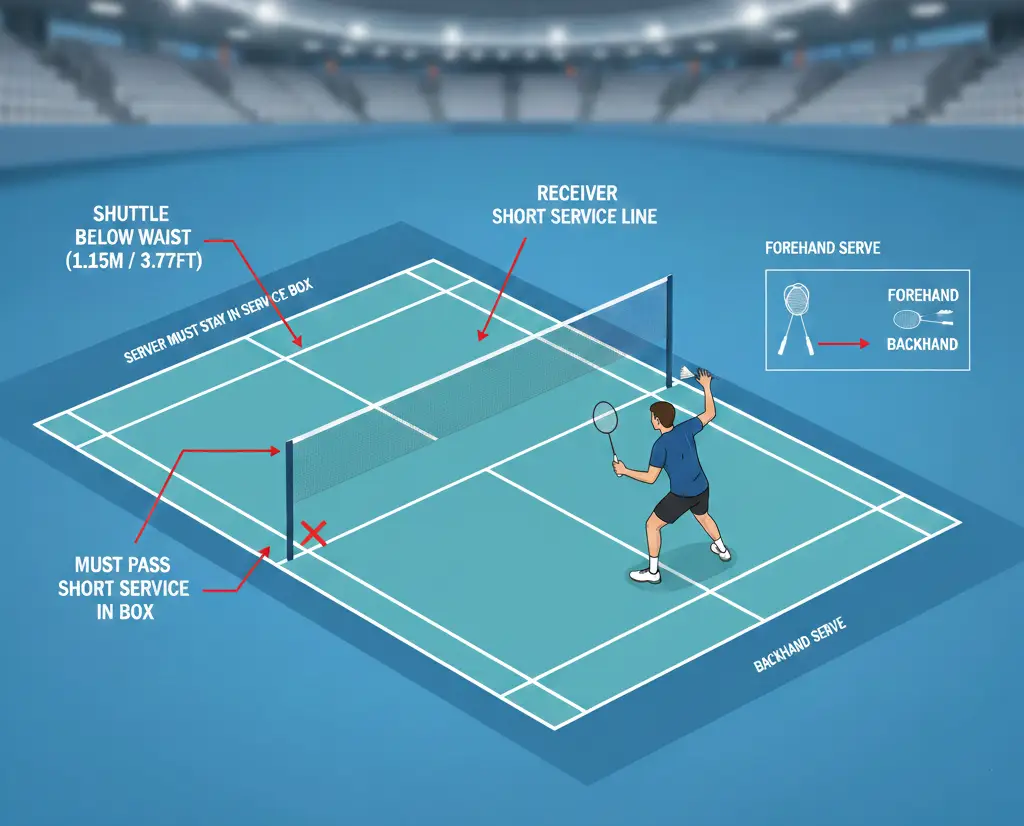
A serve in badminton is the first shot that initiates a rally. It must be delivered from the server’s designated service court and travel diagonally across the net into the opponent’s corresponding service court.
Unlike regular rally shots, a serve must follow strict technical guidelines. The rally officially begins at the moment the shuttle is struck by the server’s racket.
Key Characteristics of a Legal Serve
The shuttle must be struck under defined height regulations.
The serve must travel diagonally to the opponent’s service box.
Both server and receiver must stand inside their respective service courts.
The server must use a continuous forward racket motion.
At the start of a match, a coin toss (or shuttle toss) determines which side serves first. After that, service alternates depending on rally outcomes and the scoring system.
Understanding what qualifies as a proper serve is critical because any violation results in a service fault, immediately awarding a point to the opponent.
3. Legal Serving Regulations (According to BWF Laws)
To perform a legal serve in badminton, players must follow specific technical requirements defined by the official laws of the game. These regulations apply equally to singles and doubles matches.
3.1 Correct Contact Point (Waist Rule)
At the moment the shuttle is struck:
The shuttle must be hit below the server’s waist.
The waist is defined as an imaginary line around the body at the lowest rib.
The entire shuttle must be below 1.15 meters from the court surface at the point of contact.
Striking the shuttle above this height results in an immediate fault.
3.2 Racket Position Rule
During contact with the shuttle:
The shaft of the racket must point downward.
The racket head must be clearly below the server’s hand.
If the racket head is above the hand at the moment of impact, the serve is considered illegal.
3.3 Feet and Court Position Rules
Proper stance and positioning are essential during a serve. The following rules must be followed:
Both feet must remain in contact with the court surface.
Neither foot may touch the boundary lines of the service court.
The server must stand within the correct service box.
Feet must remain stationary until the shuttle is struck.
Lifting a foot, stepping on a line, or moving before contact will result in a service fault.
3.4 Continuous Forward Motion
The serving action must be smooth and continuous.
The racket must move forward in one uninterrupted motion.
Double actions or fake swings are not allowed.
Pausing or stopping the racket once the serving motion has begun is illegal.
Any violation of this rule results in a fault and loss of the point.
4. Serve Direction and Service Courts (Singles & Doubles)
Understanding where to serve is just as important as how to serve. In badminton, every serve must travel diagonally across the net into the opponent’s correct service court.
4.1 Singles Serving Rules
In singles, the service court is long and narrow. The server must serve diagonally to the opponent’s corresponding service box.
The position of the server depends on their score:
If the server’s score is even (0, 2, 4, 6, etc.), they serve from the right service court.
If the server’s score is odd (1, 3, 5, 7, etc.), they serve from the left service court.
The shuttle must land within the opponent’s singles service boundary. If it lands outside the correct diagonal box, it is a fault.
After winning a rally while serving, the server switches service courts and serves again. If the server loses the rally, the opponent gains the point and the right to serve.
4.2 Doubles Serving Rules
Doubles serving follows similar diagonal principles, but the service court dimensions are different. In doubles:
The court is wider but shorter compared to singles.
The back boundary line for serves is the short doubles service line (not the full baseline).
Service position in doubles also depends on the serving side’s score:
Even score → Serve from the right service court.
Odd score → Serve from the left service court.
Only one player from the serving side serves at a time. The serving side continues serving as long as they win rallies. When they lose a rally, the opponents gain the point and the right to serve.
Players must also ensure that:
The correct player serves from the correct court.
The receiver stands diagonally opposite the server.
Serving out of turn or from the wrong court results in a fault.
5. Common Service Faults in Badminton
Service faults are among the most common reasons players lose points. Even experienced players can commit faults if they are not careful with technique and positioning.
Below are the most frequent serving faults:
5.1 Hitting the Shuttle Above the Waist
If the shuttle is struck above the defined waist level or above 1.15 meters from the court surface, it is a fault.
5.2 Incorrect Racket Position
If the racket head is not pointing downward or is above the server’s hand at the moment of contact, the serve is illegal.
5.3 Foot Faults
Foot faults occur when:
A foot touches the boundary lines.
A foot is lifted off the ground before contact.
The server steps outside the service court.
Both feet must remain stationary and in contact with the court until the shuttle is hit.
5.4 Incomplete or Fake Serving Motion
The serve must be delivered in one continuous forward motion. Pausing, double swinging, or attempting to deceive with a fake movement results in a fault.
5.5 Serving to the Wrong Court
Serving straight instead of diagonally, or landing outside the correct service box, results in a fault. In doubles, serving from the wrong side or out of turn also counts as a violation.
5.6 Missing the Shuttle
If the server attempts to hit the shuttle and misses it completely, it is considered a fault.
Avoiding these common mistakes will significantly improve your serving consistency and reduce unnecessary point losses.
6. Scoring and Service Changes
Badminton follows the rally-point scoring system. A point is awarded after every rally, regardless of which side served.
6.1 Basic Scoring Structure
A game is played to 21 points.
A player or pair must win by at least 2 points.
If the score reaches 29-29, the side that scores the 30th point wins the game.
Matches are typically played as best of three games.
6.2 Service Continuation
If the serving side wins a rally:
They score a point.
The same player continues serving.
The server switches service courts (right to left or left to right).
If the serving side loses the rally:
The opponents score a point.
The opponents gain the right to serve.
6.3 Service Rotation in Doubles
In doubles:
Only one player from the serving side serves during their service turn.
The serving side keeps serving until they lose a rally.
Once they lose a rally, service passes to the opposing team.
Players must maintain correct service court positions based on the current score.
Understanding scoring and service transitions helps players avoid positional confusion and ensures smooth match flow.
7. Practical Tips to Improve Your Badminton Serve
Mastering the rules is important, but applying them effectively is what truly improves performance. Below are practical serving tips that will help you stay within regulations while gaining a tactical advantage.
7.1 Focus on Consistency First
Before attempting advanced variations, ensure that:
Your shuttle contact point is always below 1.15 meters.
Your racket motion is smooth and continuous.
Your feet remain stable and inside the service court.
Consistency reduces service faults and builds confidence during matches.
7.2 Master the Low Serve (Especially in Doubles)
The low serve is one of the most effective serves in doubles because it:
Travels just above the net.
Limits the opponent’s attacking options.
Forces a weak return.
Keep the shuttle tight to the net and aim close to the front service line.
7.3 Use the High Serve Strategically (Singles)
In singles, the high serve can push your opponent to the backcourt. This:
Creates space in the front court.
Allows you to prepare for a defensive or attacking return.
Ensure the shuttle lands deep within the back boundary line.
7.4 Practice Serve Variations
Once your fundamentals are strong, practice:
Flick serves (to surprise opponents expecting a low serve)
Drive serves (used occasionally as an attacking variation)
Short and tight serves
Variation makes your serve unpredictable and more effective.
7.5 Develop a Pre-Serve Routine
A simple routine before serving can:
Improve focus
Reduce nervous errors
Maintain rhythm during crucial points
Take a breath, confirm your court position, check your opponent’s stance, and execute with confidence.
8. Frequently Asked Questions (FAQs)
Q1: What is the legal serve height in badminton?
The shuttle must be struck below the server’s waist, and the entire shuttle must be below 1.15 meters from the court surface at the moment of contact.
Q2: Can you jump while serving in badminton?
No. Both feet must remain in contact with the court surface until the shuttle is struck. Jumping or lifting a foot results in a fault.
Q3: Does the serve have to go diagonally?
Yes. Every serve must travel diagonally into the opponent’s corresponding service court. Serving straight ahead is illegal.
Q4: What happens if you miss the shuttle while serving?
Missing the shuttle during a serve attempt is considered a fault, and the opponent receives the point.
Q5: Who serves first in a badminton match?
A coin toss or shuttle toss determines which side serves first. The winner of the toss can choose to serve or receive.
9. Conclusion
Understanding badminton serving rules and regulations is essential for every player — from beginners to competitive athletes. A legal serve requires correct shuttle height, proper racket positioning, stable foot placement, and accurate court targeting.
Even a minor mistake can result in an immediate fault and loss of a point. That is why mastering serving fundamentals is critical to building consistency and gaining a competitive advantage.
By following official regulations, practicing regularly, and incorporating tactical serve variations, you can transform your serve from a basic starting shot into a strategic weapon.
Whether you are playing singles or doubles, applying these rules correctly will ensure fair play, improved confidence, and better overall match performance.