Introduction: Why Shot Selection Decides Rallies
Technical ability alone does not win badminton matches. Intelligent shot selection determines whether a rally builds pressure on your opponent or hands the advantage straight back to them.
Every shuttle you hit is a decision — and in a fast-paced match, those decisions happen in fractions of a second. Players who make consistently better decisions win more rallies, conserve more energy, and perform more reliably under pressure. Players who rely on power or muscle memory without tactical awareness become predictable and easy to read.
Understanding when to clear, drop, smash, or drive transforms average performance into competitive dominance. This complete guide explains badminton shot selection strategy using international coaching principles, match analysis insights, and practical drills — so you can build the tactical intelligence that separates competitive players from recreational ones.
Quick Overview: Shot Selection by Situation
Here is a summary of the key shot choices covered in this guide:
1. Rear court with good balance and high shuttle → Smash to finish, or attacking clear to rush opponent
2. Rear court under pressure or off-balance → Deep defensive clear to reset and recover
3. Rear court with opponent at net → Drop shot to draw them forward and create space behind
4. Mid-court with shuttle at body height → Fast flat drive to maintain pressure and break rhythm
5. Net with shuttle above tape → Net kill to finish the rally immediately
6. Net with shuttle below tape → Tight spinning net shot to force a weak lift
7. Under pressure anywhere on court → High deep lift or defensive clear — never force a risky shot
Understanding the Core Principles of Shot Selection
Effective shot selection is built on four primary factors that must be assessed simultaneously — often in under a second.
1. Your Court Position and Balance
Balance is the most important factor in shot selection. A player who is well-positioned and balanced has more shot options and can execute them with greater accuracy. A player who is stretched, off-balance, or late to the shuttle has fewer options and higher error risk on every choice.
Rule: Never attempt a high-risk shot from a low-quality position. The shot you can execute cleanly is always better than the shot you wish you could play.
2. Opponent Positioning
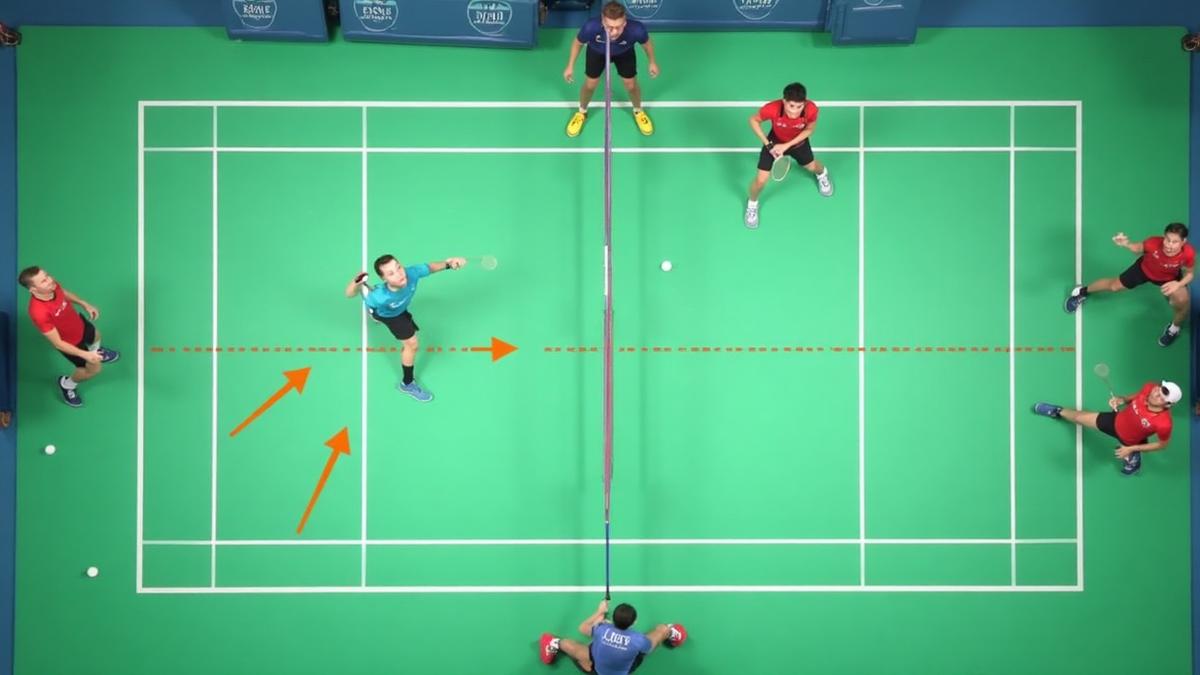
Where your opponent is standing determines where the open spaces are. Before choosing your shot, ask: where is my opponent, where are they moving, and what do they expect?
If opponent is near the net → clear deep or play behind them
If opponent is deep in the backcourt → drop short or drive flat
If opponent is centered → use deception and target corners
If opponent is leaning to one side → play the other side
Reading opponent position is a skill that improves with deliberate practice and match experience.
3. Shuttle Height and Timing
The height at which you contact the shuttle is the clearest indicator of whether you should attack or defend.
Above shoulder height → attacking options available: smash, attacking clear, steep drop
At net height → neutral options: flat drive, controlled drop, net shot
Below net height → defensive options only: tight net shot, controlled lift, defensive clear
Attempting attacking shots from low contact points is one of the most common causes of unforced errors at every level of play.
4. Risk vs Reward Assessment
Every shot carries a level of risk. A cross-court smash from the rear corner is high-risk and high-reward. A straight defensive clear from a difficult position is low-risk and low-reward. The best players constantly assess whether the potential reward justifies the risk based on their current position, balance, and the score.
High percentage badminton — choosing consistent, reliable shots rather than spectacular ones — is what wins matches at every level.
Shot Selection Based on Court Zones
Rear Court Decisions
From the backcourt, the three primary choices are clear, drop, and smash. The correct choice depends entirely on your balance, the shuttle height, and your opponent's position.
Smash → Use when the shuttle is high, you are well-balanced, and your opponent is in a weak or central position. A smash from poor balance loses both the point and your court position.
Drop shot → Use to draw your opponent forward, create space in the backcourt, and change the pace of the rally. A deceptive drop that looks like a smash preparation is one of the most effective shots in badminton.
Defensive clear → Use when you are under pressure, off-balance, or need time to recover. Always aim deep to the opponent's backhand corner — a short clear is an invitation to be smashed again immediately.
Attacking clear → Use to rush an opponent who has drifted toward the net or to change pace with a flat, fast clear that reduces their preparation time.
Mid-Court Decisions
The mid-court is where rallies are either won or lost in transition. Decisions here must be made instantly.
Fast flat drive → When the shuttle arrives at body height or above, a drive flat across the net maintains pressure and forces the opponent into a difficult interception.
Push to gaps → Angled pushes between two doubles opponents, or toward the hip of a singles opponent, create immediate defensive pressure.
Lift or clear → Only when the shuttle is too low to drive safely — always aim high and deep.
The key in mid-court is speed of decision. Hesitation here leads to late shots, poor contact, and easy put-aways for the opponent.
Front Court Decisions
Net play decisions are the most time-sensitive in the entire game. The shuttle arrives fast, and your choice must be made before you reach it.
Net kill → Only when the shuttle is clearly above tape height. Use a short, controlled downward tap. Never attempt a net kill from below the tape — it results in a net fault or a pop-up return.
Tight spinning net shot → When the shuttle is at or below tape height. Keep it as close to the net tape as possible to force a weak lift.
Cross-court net shot → Use selectively to surprise an opponent who is leaning toward the straight reply. Higher risk — use with deception.
Defensive lift → When you arrive late or the shuttle is too tight to play a net shot safely. Always high and deep — a short lift is immediately punished.
Offensive Shot Selection Strategy
Smart attacking badminton is about constructing points through tactical sequences — not simply smashing every opportunity regardless of position or balance.
Build Before You Attack
The most effective attacking patterns in badminton follow a construction phase before the finishing shot:
Pattern 1: Clear → Drop → Smash Push opponent deep with a clear, draw them forward with a drop, then smash the weak lift that follows.
Pattern 2: Drive → Drive → Net Kill Maintain fast mid-court pressure with drives until a loose return sits up, then finish at the net.
Pattern 3: Net shot → Lift bait → Smash Play a tight net shot, anticipate the forced lift, move early, and smash from a balanced position.
Rushing to the finish without the construction phase produces smashes from poor positions — which result in errors or easy returns.
Vary Pace and Trajectory Deliberately
Opponents adapt to predictable pace. Mix fast and slow shots, flat and steep trajectories, to prevent early movement and keep opponents guessing:
After three consecutive fast exchanges, play a slow drop to break rhythm
After clearing deep repeatedly, play a short drop or net shot
After straight shots, go cross-court
Pace variation is a tactical weapon that costs no additional physical effort but creates significant mental pressure on the opponent.
Use Deception to Create Better Opportunities
Deception in shot selection means preparing one shot and executing another. The most effective deceptive shots include the slice drop (looks like a smash, becomes a steep angled drop), the hold-and-flick at the net (pause then redirect), and the late-direction clear (body shows one direction, shuttle goes another).
Deception works best when your preparation is consistent and your opponent is already moving. Against a stationary opponent, deception has less effect.
Defensive Shot Selection Strategy
Defense in badminton is not about survival — it is about control and transition. The goal of every defensive shot is to reduce the quality of the opponent's next attack and create a path back to neutral or offensive position.
When to Lift Deep
A high, deep lift to the opponent's backhand corner is the safest defensive choice when you are under heavy pressure. It buys recovery time, forces the opponent back to the rear court, and resets the rally. A short lift is the worst defensive error — it gives the opponent another easy attack from an even better position.
When to Block
When the smash is steep and fast, a tight net block is often more effective than a lift. A soft block that drops just over the net tape forces the attacker to rush forward and hit upward, immediately reversing the pressure. This is one of the most underused defensive tools at club level across India.
When to Drive
A flat drive counter against a smash is the most aggressive defensive choice. It works best when the smash is not too steep, you are balanced and ready, and the drive can be directed at the attacker's body or into a gap. A well-timed counter-drive breaks the opponent's attacking rhythm instantly.
💡 Want to develop tactical shot selection under professional coaching? Rackonnect's certified coaches run structured match-play sessions that train decision-making under realistic pressure. Explore coaching →
Shot Selection in Singles
Singles requires patience, structured rally construction, and consistent tactical discipline. Points are rarely won with a single spectacular shot — they are built over multiple exchanges.
Core Singles Principles
Move opponent corner to corner Force the opponent to cover maximum court distance on every rally. Alternate deep-to-short and side-to-side patterns to create gaps and opportunities.
Create space before attacking Do not smash the first opportunity you see. Use drops, clears, and net shots to move the opponent out of position before the finishing shot.
Maintain central base position After every shot, return to the center of your court. This minimizes the distance you need to cover for the next shot and gives you equal coverage in all directions.
Target the backhand corner consistently Most players are weaker on the backhand rear corner. Repeated pressure on this area forces errors and creates short, attackable returns.
Vary speed and trajectory Alternate fast attacking clears with slow drops. Mix steep smashes with flat drives. The player who varies pace better wins more singles matches.
Singles Shot Selection by Score Situation
When leading: Play high-percentage shots — deep clears, tight drops, controlled net shots. Avoid risky cross-court smashes that could give momentum back.
When trailing: Increase variation and deception. Introduce more cross-court shots and change-of-pace drops to disrupt the opponent's rhythm.
At deuce or close games: Prioritize balance and positioning over power. Unforced errors at critical moments are rally-killers — choose shots you can execute cleanly.
Shot Selection in Doubles
Doubles emphasizes speed, flat exchanges, and fast rotational transitions. The tactical framework is very different from singles.
Core Doubles Principles
Use quick drives to maintain pressure Fast, flat drives at the body or into gaps between opponents maintain an attacking momentum that is difficult to break. Drive exchanges are the heartbeat of doubles offense.
Target the middle gap between opponents Shots directed at the gap between two defenders create confusion about responsibility — hesitation leads to weak or mistimed returns. The middle drive is one of the highest-percentage attacking shots in doubles.
Avoid unnecessary lifts Every lift in doubles gives the opposing pair the attack. Only lift when it is the only safe option — when the shuttle is too tight, too low, or when you are completely off-balance.
Rotate quickly after every shot After one player attacks from the rear, the other must be in position to intercept the net return. After a net kill or tight net shot, transition immediately to front-back formation to maintain pressure.
Finish at the net when possible The fastest way to win doubles points is through net kills, steep drops, and quick net interceptions. The front player's job is to be aggressive, intercept every loose return, and finish the rally — not to play conservative exchanges.
Doubles Shot Selection by Formation
When in front-back formation (attacking): Rear player smashes, drives, or drops; front player intercepts net returns and looks for kills immediately.
When in side-by-side formation (defending): Both players focus on controlled blocks and drives to neutralize the attack. Look for the earliest opportunity to transition back to front-back formation.
🏸 Practice your doubles tactics at a Rackonnect court. Our venues across Delhi NCR provide premium courts for structured doubles training:
Reading Opponent Patterns to Improve Shot Selection
Anticipation is the advanced layer of shot selection. Players who read opponents early do not just react to the shuttle — they are already moving before it is hit.
What to Observe During a Match
Preferred smash direction Most players have a dominant smash direction — usually straight or to one specific corner. Note this in the first game and position accordingly in the second.
Backhand weakness Observe how your opponent handles pressure on their backhand rear corner. If they consistently return short or straight, continue targeting that area.
Drop shot habits Many players have a preferred drop shot — straight or cross, steep or shallow. Identifying this allows you to move early and intercept.
Body language before shots Shoulder rotation, weight shift, and racket preparation angle all telegraph shot direction before the shuttle is hit. Advanced players read these signals and move before contact.
How to Build Pattern Recognition
Keep a simple mental note of the first three shots your opponent plays from each position
After each game, recall what patterns you observed
In training, ask a partner to play predictable patterns first, then gradually add deception
Pattern recognition is a skill that develops with deliberate attention — it does not happen automatically.
Common Shot Selection Mistakes and How to Fix Them
1. Smashing from an off-balance position → This produces weak smashes that sit up for easy returns. Fix: only smash when you are balanced, well-positioned, and have a high contact point.
2. Playing predictable straight shots repeatedly → Opponents anticipate and move early. Fix: introduce cross-court variation and change-of-pace shots every 3–4 rallies to stay unpredictable.
3. Ignoring opponent court coverage → Hitting to covered areas rather than open spaces. Fix: before every shot, note where your opponent is standing and aim for the opposite space.
4. Choosing risky shots under fatigue → Tired players force winners and make more unforced errors. Fix: when fatigued, choose high-percentage shots — deep clears, tight net shots — and extend the rally until your position improves.
5. Lifting short under pressure → A short lift is immediately punished. Fix: always prioritize depth over safety on lifts — a high, deep lift to the backhand corner is always better than a short one to anywhere.
6. Using the same shot from the same position every time → This makes you completely predictable. Fix: develop at least two shot options from every court position and vary them during practice rallies.
Drills to Improve Shot Selection
Drill 1: Condition-Based Rally Drill
Purpose: Train tactical adaptability under defined constraints.
Set a condition before the rally begins — for example: no smashes allowed, only cross-court shots, or only drops and net shots. Play out full rallies within the constraint.
5-minute rounds per condition
Switch conditions every round
3–4 rounds per session
This forces you to think creatively and find solutions when your preferred shot is removed.
Drill 2: Random Feed Decision Drill
Purpose: Improve instant decision-making from unpredictable shuttle feeds.
A coach or partner feeds shuttles randomly to all six court positions in no predictable order. Player must choose and execute the appropriate shot immediately.
30–45 seconds per set
4–5 sets with 60-second rest
Progress by increasing feed speed over weeks
This drill most closely replicates the decision-making pressure of live match play.
Drill 3: Restricted Shot Practice
Purpose: Develop creativity and tactical awareness within limitations.
Both players agree on a restriction — for example, one player can only play straight shots, or both players must play a net shot before any clear. Play competitive points within the restriction.
Play to 11 points per game
Rotate restrictions each game
This trains players to find opportunities within tactical constraints — a key skill under pressure.
Drill 4: Pattern Play Drill
Purpose: Build and execute specific tactical patterns reliably.
Agree on a fixed 3-shot pattern — for example: clear → drop → smash. Execute the pattern cooperatively first, then under competitive conditions where the opponent tries to disrupt it.
10 cooperative repetitions per pattern
Then play competitively using the same pattern
3–4 patterns per session
This builds tactical fluency and the muscle memory to execute planned sequences under match pressure.
Frequently Asked Questions (FAQ)
Q: How can shot selection decision-making improve under pressure? Through consistent repetition of match simulation drills and maintaining physical fitness. When you are fit, decisions are clearer. When you are familiar with tactical patterns from drilling, your brain retrieves the correct choice faster under pressure — decision-making under stress improves through exposure to stress in training.
Q: Is the smash always the best attacking option in badminton? No. Controlled placement and deception often create more reliable winning opportunities than constant smashing. A well-disguised drop shot or a fast cross-court drive can be more effective than a smash — especially when you are not fully balanced or the opponent is already in a good defensive position.
Q: How can I reduce unforced errors in badminton? Focus on three things: balance before every shot, choosing high-percentage shots rather than spectacular ones, and selecting shots that match the shuttle height. Most unforced errors happen when players attempt attacking shots from low contact points or from off-balance positions.
Q: Does physical fitness affect shot selection? Yes — significantly. Fatigue consistently leads to poor decision-making and rushed execution. A tired player defaults to predictable shots, lifts short, and attempts forced winners from bad positions. Improving your fitness directly improves your tactical decision-making in the third game and in long rallies.
Q: How do I develop tactical awareness faster? Study your own matches — even short video clips on a phone. Watch where you hit from each position, notice when you made the wrong choice, and identify patterns your opponents exploited. Deliberate self-review accelerates tactical development faster than match play alone.
Q: What is the highest-percentage shot in badminton under pressure? A high, deep defensive clear to the opponent's backhand rear corner. It buys maximum recovery time, forces the opponent back, and is the lowest-risk shot available from almost any court position. When in doubt, clear deep — it is always a better choice than a rushed or forced attacking shot.
Q: How do singles and doubles shot selection differ? Singles requires patience, rally construction, and moving the opponent to create space before attacking. Doubles prioritizes speed, flat drives, finishing at the net quickly, and avoiding lifts. The core tactical thinking is different — singles is strategic and positional, doubles is fast and rotational.
Conclusion: Tactical Intelligence Is a Trainable Skill
Badminton shot selection strategy is not a natural gift — it is a trainable skill that improves with deliberate practice, match experience, and honest self-analysis.
Players who combine technical ability with tactical intelligence gain a long-term competitive edge that holds up under pressure, across all formats, and at every level. They make fewer unforced errors, construct points more effectively, and are significantly harder to read than players who rely on power or habit.
Start with the fundamentals — balance, shuttle height, opponent position — and build from there. Use the drills in this guide consistently, study your own matches, and apply tactical patterns in practice before expecting them to appear under match pressure.
Tactical intelligence, once developed, does not disappear. It compounds over time and becomes your most reliable competitive asset.
Build your tactical game at a Rackonnect court near you: