1. Introduction: Why Proper Tournament Preparation Matters
Preparing for a badminton tournament is not just about practicing smashes and drop shots. It requires structured physical training, tactical preparation, mental focus, and proper recovery. Players who prepare strategically perform more consistently and handle pressure better during competition.
Many athletes train hard but lack a structured preparation plan. As a result, they either overtrain, neglect recovery, or fail to peak at the right time. The difference between early elimination and advancing to later rounds often comes down to preparation.
This Badminton Tournament Preparation Guide provides a step-by-step approach to help you prepare effectively. You will learn how to plan your training weeks before the event, structure physical conditioning, set realistic goals, and build a strong foundation for match performance.
This guide is designed for:
Club-level competitive players
Intermediate to advanced badminton athletes
Junior players preparing for tournaments
Adult competitors entering district or state events
With proper preparation, you can enter your tournament confident, physically ready, and mentally sharp.
2. How to Set Realistic Goals & Plan Your Tournament Week
Preparation begins with clarity. Before increasing training intensity, you must define your objectives.
Setting the Right Goals
There are two types of goals every badminton player should understand:
Outcome Goals (Result-Based Goals)
These focus on results such as:
Winning the tournament
Reaching the semi-finals
Defeating a specific opponent
Process Goals (Performance-Based Goals)
These focus on actions within your control:
Maintaining serve consistency
Reducing unforced errors
Staying focused between points
Executing planned tactics
While outcome goals are motivating, process goals directly improve performance. Focus primarily on controllable performance targets.
Tournament Preparation Timeline
A structured timeline ensures that you peak at the right moment.
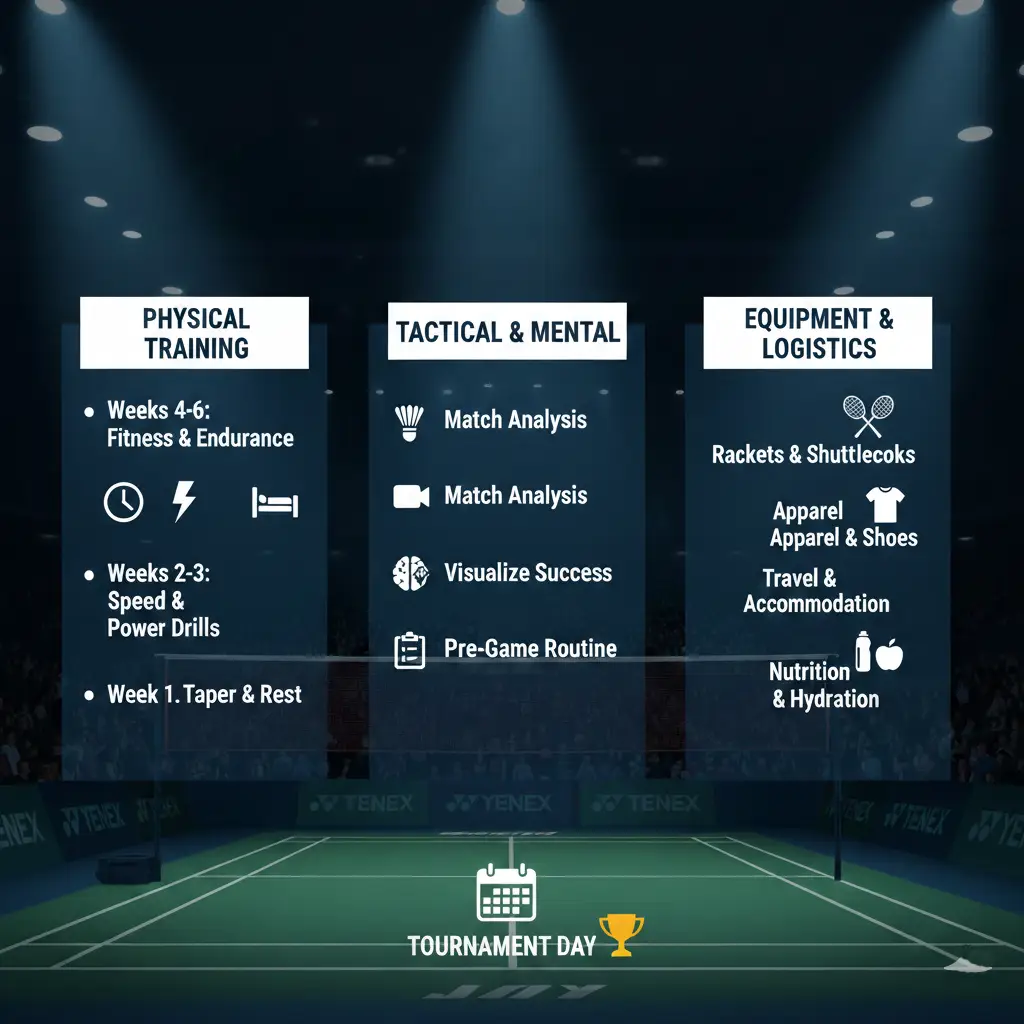
Four Weeks Before the Tournament
Focus on building physical capacity and technical refinement.
Improve endurance and court stamina
Increase footwork speed and agility
Practice match simulations
Identify and improve technical weaknesses
Suggested weekly structure:
3 to 4 on-court training sessions
2 strength and conditioning sessions
1 active recovery day
This phase builds your foundation.
Two Weeks Before the Tournament
Focus on match-specific preparation.
Play practice matches under tournament scoring
Improve serve and return accuracy
Increase high-intensity rally drills
Reduce overall training volume slightly
Avoid:
Learning completely new techniques
Heavy strength sessions that cause fatigue
The goal is to sharpen performance while preventing overtraining.
One Week Before the Tournament
Focus on recovery and sharpness.
Short, high-quality practice sessions
Maintain intensity but reduce total volume by 30 to 40 percent
Prioritize sleep (7 to 9 hours daily)
Emphasize reaction drills and tactical execution
This tapering period allows your body to recover while maintaining explosiveness.
3. Physical Training: What to Focus on Before the Tournament
Badminton demands explosive power, agility, speed, endurance, and rapid directional changes. Tournament matches, especially when multiple rounds are played in one day, require exceptional conditioning.
Proper physical preparation ensures you maintain performance from the first rally to the final point.
Cardiovascular Conditioning
Badminton involves repeated high-intensity rallies with short recovery periods. Your training should reflect this pattern.
Effective conditioning methods include:
Interval court sprints (20 to 30 seconds high intensity, followed by 40 seconds rest)
Multi-shuttle drills
Shadow badminton footwork circuits
High-intensity rally simulations
These exercises improve anaerobic capacity and allow faster recovery between rallies.
Strength and Power Training
Strength supports explosive movement and injury prevention.
Focus on:
Squats and lunges for lower body strength
Calf raises for explosive push-off
Core exercises such as planks and rotational movements
Shoulder stability exercises
Include plyometric exercises such as:
Box jumps
Lateral bounds
Skater jumps
Strength sessions should be performed twice per week. Avoid heavy lifting three to four days before the tournament.
Footwork and Agility Training
Efficient footwork improves positioning, reduces energy waste, and enhances shot execution.
Key drills include:
Six-point shadow movement
Net-to-backcourt transition drills
Split-step timing practice
Ladder agility drills
Strong footwork allows you to reach shots earlier and recover faster.
Injury Prevention Strategies
As the tournament approaches, injury prevention becomes essential.
Perform dynamic warm-ups before every session
Stretch hip flexors, hamstrings, and calves
Use foam rolling to reduce muscle tightness
Avoid excessive training volume
The final two weeks should focus on refining performance, not pushing physical limits.
4. Skill and Tactical Preparation
Physical fitness alone does not win matches. Technical precision and tactical awareness are equally important in tournament settings. As the competition approaches, your focus should shift toward match simulation and strategy refinement.
Match Simulation Training
Practicing under realistic conditions prepares you for tournament pressure.
Play full matches using official scoring (best of three games to 21 points)
Practice under time constraints between rallies
Simulate pressure situations (e.g., 19–19 score scenarios)
Train with players of equal or slightly higher skill level
Match simulation improves decision-making, stamina, and mental resilience.
Serve and Return Consistency
At competitive levels, serve and return can determine match momentum.
Focus on:
Low serve accuracy in singles and doubles
Flick serve variation
Tight net returns
Aggressive return positioning
Spend dedicated practice time refining your first three shots — serve, return, and third shot attack. Many rallies are controlled within these initial exchanges.
Shot Selection and Rally Construction
Avoid playing random shots. Every rally should have structure and purpose.
Develop tactical awareness by:
Identifying opponent weaknesses (backhand, movement speed, net play)
Changing pace between fast and slow rallies
Using clears to reset difficult positions
Forcing opponents to move to deep corners
Build points strategically rather than relying only on power.
Reviewing Performance
If possible:
Record practice matches
Analyze unforced errors
Identify patterns (e.g., losing points at net, weak backcourt defense)
Self-analysis enhances improvement before the tournament begins.
5. Warm-Up and Match-Day Routine
A proper warm-up routine improves performance and reduces injury risk. Tournament nerves can increase muscle tightness, so structured preparation is essential.
Pre-Match Dynamic Warm-Up (15–20 Minutes)
Start with general body activation:
Light jogging or skipping
Arm rotations and shoulder mobility exercises
Hip circles and leg swings
Then move to sport-specific movements:
Shadow badminton footwork
Short acceleration sprints
Practice smashes at moderate intensity
Controlled net play drills
Gradually increase intensity. Avoid going full power immediately.
Mental Preparation Before Match
Mental readiness is just as important as physical readiness.
Before stepping onto the court:
Take deep, controlled breaths
Visualize executing your game plan
Focus on one or two tactical objectives
Avoid overthinking the outcome
Confidence comes from preparation. Trust your training.
Between-Match Recovery (If Playing Multiple Matches)
In tournaments, you may play several matches in a day.
Between matches:
Change sweaty clothing if possible
Rehydrate with water or electrolyte drinks
Consume light snacks (banana, energy bar, toast)
Perform light stretching
Avoid sitting for long periods. Keep muscles warm with light movement.
Post-Match Cool Down
After your final match of the day:
Perform 5–10 minutes of light jogging or walking
Stretch major muscle groups
Use foam rolling if available
Cooling down helps reduce muscle soreness and improves next-day recovery.
6. Nutrition and Hydration Strategy
Proper nutrition plays a critical role in tournament performance. Without adequate fueling, energy levels drop quickly, especially during long rallies and multiple matches.
What to Eat Before the Tournament
Three to four hours before your first match:
Eat a balanced meal with carbohydrates and moderate protein
Examples: rice with vegetables and chicken, pasta, oatmeal with fruit
One hour before match:
Light snack such as banana, toast with peanut butter, or yogurt
Avoid:
Heavy fried foods
Excess sugar
Trying completely new foods
Hydration Strategy
Dehydration reduces reaction speed and endurance.
Guidelines:
Drink water consistently throughout the day
Use electrolyte drinks if playing multiple matches
Sip fluids during breaks, not large amounts at once
Check urine color — light yellow indicates proper hydration.
In-Match Fueling
If matches are long or you have short gaps between games:
Small bites of banana or energy bar
Small sips of electrolyte drink
Avoid overeating between matches.
Post-Match Recovery Nutrition
After completing your matches:
Consume protein within 30–60 minutes (milk, yogurt, eggs, protein shake)
Include carbohydrates to replenish energy (rice, bread, fruit)
Proper recovery nutrition reduces muscle fatigue and prepares you for the next training session or tournament day.
7. Complete Gear Checklist for Tournament Day
Arriving at a tournament without essential equipment can cause unnecessary stress. Preparing your gear at least one day in advance ensures a smooth competition experience.
Essential Equipment
Primary badminton racket
Spare racket (recommended in case of string breakage)
Extra grips
Badminton shoes with proper court grip
Comfortable sports socks
Tournament-appropriate clothing
Support and Protection Items
Knee or ankle support (if required)
Athletic tape
Small first-aid kit
Towel
Extra T-shirt for changing between matches
Hydration and Nutrition Supplies
Water bottle
Electrolyte drink
Bananas or light snacks
Energy bars
Additional Items
Tournament registration confirmation
Identification card
Cash or digital payment option
Small backpack for organized storage
Preparing your equipment the night before reduces anxiety and allows you to focus entirely on performance.
8. Match Psychology and Handling Pressure
Mental strength often determines match outcomes, especially in close scoring situations. Tournament environments can create pressure, crowd noise, and unexpected momentum shifts.
Building Pre-Match Confidence
Confidence is built through preparation. Before the match:
Review your game plan
Remind yourself of past strong performances
Focus on controllable actions rather than results
Avoid comparing yourself to opponents. Focus on execution.
Breathing and Focus Techniques
Simple breathing techniques help control nerves.
Inhale deeply through the nose for four seconds
Hold for two seconds
Exhale slowly through the mouth
Repeat several times before the match and during breaks.
Between rallies:
Reset mentally
Avoid reacting emotionally to lost points
Focus on the next serve or return
Managing Momentum Shifts
Badminton matches often swing quickly.
If you lose consecutive points:
Slow down the pace before serving
Take a deep breath
Stick to your tactical plan
If you are leading:
Maintain discipline
Avoid risky shots
Continue executing structured rallies
Mental stability helps maintain consistent performance throughout the match.
9. Tournament Day Hour-by-Hour Timeline
A structured tournament-day schedule prevents confusion and stress.
Before Leaving Home
Eat a balanced pre-match meal
Double-check your gear bag
Hydrate properly
Leave early to avoid rushing
Upon Arrival at Venue (60–90 Minutes Before Match)
Confirm court assignment
Observe court lighting and shuttle speed
Begin light movement and warm-up
30 Minutes Before Match
Start dynamic warm-up
Perform short shadow footwork drills
Practice serves and returns
Gradually increase intensity
During Match
Stay hydrated between games
Follow your tactical plan
Maintain controlled breathing
Between Matches (If Multiple Rounds)
Change sweaty clothes
Eat light snacks
Keep muscles warm
Review minor tactical adjustments
After Final Match
Cool down properly
Stretch major muscle groups
Rehydrate
Consume recovery nutrition
A structured day improves focus and energy management.
10. Common Mistakes to Avoid Before a Tournament
Many players unintentionally reduce their performance due to avoidable errors.
Avoid:
Overtraining during the final week
Trying new shoes or rackets just before competition
Sleeping late before tournament day
Skipping warm-up routines
Eating unfamiliar or heavy foods
Consistency and preparation provide stability under pressure.
11. Frequently Asked Questions (FAQ)
How early should I arrive at a badminton tournament?
Arrive at least 60 to 90 minutes before your first scheduled match to allow proper warm-up and registration confirmation.
What should I eat one hour before a match?
Choose light, easily digestible foods such as a banana, toast, or yogurt. Avoid heavy meals or fried food.
How many matches can I play in one day?
Depending on the tournament structure, players may compete in 2 to 5 matches per day. Proper hydration and recovery are essential.
Should I train hard the day before a tournament?
No. Perform light technical practice and focus on recovery rather than intense physical training.
How can I reduce match anxiety?
Use breathing exercises, visualization techniques, and focus on process goals rather than match outcomes
12. Conclusion: Prepare Smart, Compete Strong
Successful tournament performance begins weeks before stepping onto the court. Structured physical training, tactical preparation, mental focus, proper nutrition, and organized gear planning all contribute to peak performance.
By following this comprehensive Badminton Tournament Preparation Guide, you increase your chances of performing confidently and consistently under competitive conditions.
Preparation builds confidence. Confidence builds performance.
Train smart, recover well, and step onto the court ready to compete at your best.