Badminton Training Schedule for Competitive Players
Badminton is one of the fastest racket sports in the world. Competitive players must combine speed, endurance, explosive power, tactical awareness, and technical precision — all within seconds. Without a structured badminton training schedule, even talented players struggle with inconsistency, fatigue, or injuries.
A well-designed training plan ensures steady performance growth, better recovery, and peak form during tournaments. Whether you are a state-level athlete, competitive junior, or aspiring professional, this guide will help you understand how to structure your yearly, monthly, and weekly training schedule for maximum performance.
In this article, you will learn:
Why structured training is essential
How periodization works in badminton
How to break down your annual plan into weekly schedules
Let’s begin with the foundation.
Why a Structured Training Schedule Matters
A structured badminton training schedule is not just about practicing more — it’s about practicing smarter.
Competitive badminton places extreme physical demands on the body. Players perform rapid lunges, jumps, directional changes, and explosive smashes repeatedly during matches. Without a systematic plan, overtraining and injury risks increase significantly.
1. Improves Performance Consistency
When training follows a clear weekly and seasonal plan, players:
Build progressive strength and endurance
Improve technical consistency
Develop tactical awareness
Peak at the right time for tournaments
Random practice sessions may feel productive, but they rarely lead to long-term improvement.
2. Reduces Injury Risk
Badminton injuries commonly affect:
Knees
Ankles
Lower back
Shoulders
A structured plan integrates:
Proper warm-ups
Progressive load increase
Mobility work
Strength training
Planned recovery days
Sports science research consistently shows that organized training programs reduce time-loss injuries compared to unstructured practice.
3. Enhances Recovery and Energy Management
Competitive players often train 5–6 days per week. Without recovery planning, fatigue accumulates quickly. A structured badminton schedule balances:
High-intensity days
Technical skill days
Strength sessions
Active recovery
This balance prevents burnout and maintains motivation throughout the season.
4. Supports Tournament Preparation
The ultimate goal of competitive training is performance during competition — not just training excellence.
A structured schedule allows players to:
Increase intensity before tournaments
Reduce training volume before competition (tapering)
Recover properly after events
This systematic approach ensures peak performance when it matters most.
How to Plan Your Badminton Training: Periodization Explained
One of the most important principles in competitive sports training is periodization.
Periodization means dividing the training year into specific phases to optimize performance and prevent overtraining. Instead of training at maximum intensity all year, players cycle through structured phases that build toward competition readiness.
There are three main levels of planning: macrocycle, mesocycle, and microcycle.
1. Macrocycle (Annual Plan)
The macrocycle represents your full training year.
It typically includes:
Pre-season preparation
Competition season
Transition phase (off-season recovery)
For example:
January–March: General preparation
April–August: Competition phase
September: Recovery and evaluation
October–December: Skill rebuilding and physical development
The macrocycle focuses on long-term goals such as:
Increasing overall strength and power
Improving aerobic and anaerobic endurance
Developing advanced tactical skills
Enhancing technical consistency
This long-term structure ensures gradual improvement rather than short-term spikes in performance.
2. Mesocycle (4–8 Week Training Blocks)
A mesocycle is a focused training block within the macrocycle.
Each mesocycle may target:
Strength development
Speed and agility improvement
Tactical match simulation
Technical refinement
Tournament preparation
For example, a four-week pre-tournament mesocycle might follow this structure:
Week 1–2: High training volume with moderate intensity
Week 3: Increased match intensity and tactical drills
Week 4: Reduced volume with high sharpness (taper week)
Mesocycles help prevent plateaus and allow athletes to concentrate on specific performance goals.
3. Microcycle (Weekly Training Plan)
The microcycle is your weekly badminton training schedule.
Most competitive players train:
5–6 days per week
12–18 hours total per week (depending on age and level)
A balanced microcycle includes:
On-court technical sessions
Tactical matchplay
Footwork drills
Strength and conditioning sessions
Mobility and recovery work
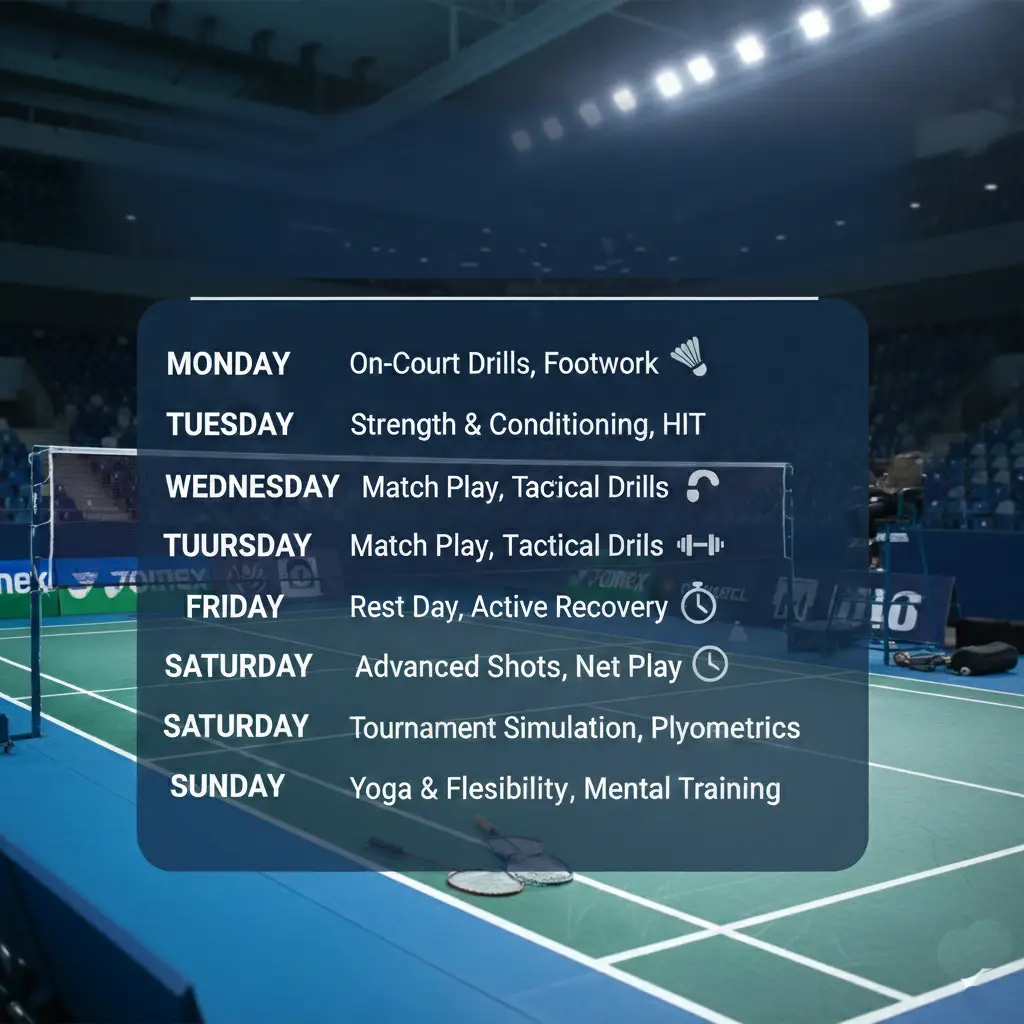
For example:
Monday: Technical drills + Strength training
Tuesday: Agility + Matchplay
Wednesday: Recovery + Light technical work
Thursday: Strength + High-intensity shuttle drills
Friday: Tactical practice + Net play
Saturday: Match simulation
Sunday: Rest or active recovery
Each microcycle should align with the goals of the mesocycle and overall macrocycle.
Why Periodization Is Critical for Competitive Players
Badminton demands explosive power, high-speed reactions, and fast recovery between rallies. Training intensely year-round without structured phases can lead to:
Performance plateaus
Chronic fatigue
Decreased speed
Increased injury risk
Periodization ensures:
Gradual performance progression
Strategic intensity peaks before tournaments
Balanced workload and recovery
Long-term athletic development
This structured approach is what separates competitive athletes from recreational players and allows consistent performance throughout the season.
Weekly Microcycle Template for Competitive Players
A microcycle represents your weekly badminton training schedule. For competitive players, this is where planning becomes practical and measurable.
Depending on age, competition level, and season phase, players typically train 12–18 hours per week across 5–6 days. The key is balancing intensity, volume, and recovery.
A well-structured weekly microcycle includes:
3–4 on-court technical/tactical sessions
2–3 strength and conditioning sessions
1–2 high-intensity match simulation sessions
1 recovery or mobility-focused day
Below is a sample 6-day competitive training week.
Sample Weekly Badminton Training Schedule
Day
Morning Session
Evening Session
Total Time
Monday
On-court technical drills (footwork + multi-shuttle) – 2h
Strength training (lower body power) – 1h
3h
Tuesday
Speed, agility & plyometrics – 1.5h
Tactical matchplay – 1.5h
3h
Wednesday
Active recovery (mobility + light cardio) – 1h
Technical refinement (net play & defense) – 1.5h
2.5h
Thursday
Strength training (upper body + core) – 1h
High-intensity shuttle drills – 2h
3h
Friday
Tactical drills + rally construction – 2h
Light skill sharpening – 1h
3h
Saturday
Match simulation or tournament play – 3–4h
—
3–4h
Sunday
Complete rest or light stretching
—
0–1h
Key Weekly Planning Principles
Alternate high and moderate intensity days
Avoid scheduling back-to-back maximum intensity sessions.Schedule strength training strategically
Lower-body strength sessions should not precede important match simulation days.Include at least one recovery-focused day
Recovery is essential for long-term progress.Adjust during competition phase
Reduce volume but maintain intensity 5–7 days before tournaments.
This template can be adjusted based on:
Player age
Tournament schedule
Academic/work commitments
Injury history
Strength & Conditioning Guidelines for Competitive Badminton Players
Strength and conditioning (S&C) is essential for improving speed, power, endurance, and injury resistance. Badminton requires explosive lower-body power, fast directional changes, and shoulder stability for repeated smashes.
Primary Physical Qualities to Develop
Explosive power
Speed and agility
Muscular endurance
Core stability
Injury resilience
Lower-Body Strength & Power Exercises
Squats (barbell or goblet)
Bulgarian split squats
Deadlifts (moderate load focus on technique)
Box jumps
Lateral bounds
Step-up jumps
These exercises improve lunge strength, jump height, and court movement efficiency.
Upper-Body & Shoulder Stability
Pull-ups or lat pulldowns
Push-ups or bench press
Dumbbell shoulder press
External rotation band work
Medicine ball rotational throws
Strong shoulders and upper back muscles reduce risk of rotator cuff injuries and improve smash consistency.
Core & Stability Training
Planks (front and side)
Pallof press
Russian twists
Dead bugs
Farmer’s carries
Core strength enhances balance during lunges and rapid directional changes.
How to Schedule Strength Training
2–3 sessions per week
45–60 minutes per session
Heavy strength during pre-season
Maintenance strength during competition season
Avoid heavy lifting 24–48 hours before major matches
Proper warm-up and cooldown must be included in every gym session.
On-Court Session Structure and Drill Examples
On-court training must be purposeful and structured. Each session should follow a clear format rather than random rally practice.
Standard On-Court Session Structure (90–120 Minutes)
Dynamic Warm-Up (10–15 minutes)
Light jogging
Dynamic stretching
Shadow footwork
Activation exercises
Technical Block (30–45 minutes)
Multi-shuttle drill
Net kill practice
Defensive drive drills
Smash repetition with focus on form
Footwork & Movement Block (20–30 minutes)
Six-point shadow drill
Random directional feed
Agility ladder work
Explosive lunge recovery drills
Tactical/Match Simulation (20–40 minutes)
Conditioned games (half-court, backcourt-only)
Rally construction drills
Pressure scoring games
Cool Down (10 minutes)
Light rally
Static stretching
Breathing exercises
High-Intensity Multi-Shuttle Drill Example
Coach feeds 20–30 shuttles rapidly
Player performs full-court movement
3–5 sets
60–90 seconds rest between sets
This drill improves endurance, reaction time, and explosive recovery.
Tactical Training Ideas
Practice building rallies before finishing with a smash
Work on defensive transitions into counterattack
Simulate tournament scoring pressure (e.g., start at 18–18)
Every on-court session should have a defined objective: technical improvement, tactical awareness, or conditioning — never all at maximum intensity in one session.
Recovery, Monitoring & Injury Prevention
Recovery is not optional for competitive badminton players — it is a critical part of performance development. Without structured recovery, performance declines, fatigue accumulates, and injury risk increases.
Why Recovery Matters
Badminton involves repeated lunges, jumps, and rapid directional changes. These movements place stress on:
Knees and ankles
Lower back
Shoulders and rotator cuff
Hip flexors and hamstrings
Without proper recovery, small muscle tightness can develop into chronic injuries.
Essential Recovery Strategies
1. Proper Warm-Up Before Every Session
A complete warm-up should include:
5–7 minutes light cardio
Dynamic stretching
Mobility drills
Shadow footwork
A proper warm-up improves reaction time and reduces muscle strain.
2. Post-Training Cool Down
After intense sessions:
Light rally or jogging (5 minutes)
Static stretching
Foam rolling
Cooling down reduces stiffness and improves flexibility.
3. Sleep and Nutrition
Competitive players should aim for:
7–9 hours of sleep per night
Balanced meals with carbohydrates, protein, and healthy fats
Hydration before, during, and after sessions
Recovery begins immediately after training ends.
4. Load Monitoring
Simple monitoring tools include:
Rate of Perceived Exertion (RPE scale 1–10)
Training diary
Weekly fatigue check
If performance drops or soreness lasts more than 48 hours, training intensity should be adjusted.
Common Overtraining Signs
Persistent fatigue
Slower court movement
Reduced jump height
Irritability or poor sleep
Recurring minor injuries
When these signs appear, reduce volume for 3–5 days and prioritize recovery.
A smart player trains hard — but recovers harder.
Sample 4-Week Pre-Tournament Training Block
The final 4 weeks before an important tournament should focus on sharpening skills while reducing unnecessary fatigue.
Week 1: High Volume, Moderate Intensity
Focus on technical repetition
3–4 on-court skill sessions
2 strength sessions
1 match simulation
Goal: Reinforce technique and build conditioning.
Week 2: Increased Intensity
Add high-speed multi-shuttle drills
Increase tactical match scenarios
Maintain 2 strength sessions
Goal: Improve match sharpness and reaction speed.
Week 3: Peak Intensity
High-intensity rally sessions
Tournament-style matches
Reduce gym volume slightly
Goal: Simulate competition conditions.
Week 4: Taper Week
Reduce overall training volume by 30–40%
Maintain speed and sharpness
Light technical drills
Short match simulations
Goal: Enter tournament fresh, explosive, and confident.
During taper week:
Avoid heavy strength training
Prioritize sleep
Avoid trying new techniques
The objective is performance — not improvement — during this week.
Common Mistakes in Competitive Badminton Training
Even dedicated players often make planning errors that limit progress.
1. Training Too Hard Year-Round
Without periodization, players burn out or get injured. Intensity must fluctuate across the season.
2. Ignoring Strength Training
On-court practice alone is not enough. Strength and conditioning enhance power, injury resistance, and endurance.
3. Skipping Recovery Days
Recovery is part of training. Skipping rest reduces long-term progress.
4. No Tactical Focus
Playing matches without tactical objectives does not improve decision-making skills.
5. Overloading Before Tournaments
Increasing training volume just before competition leads to fatigue rather than peak performance.
Avoiding these mistakes significantly improves consistency and long-term development.
Frequently Asked Questions (FAQ)
How many hours per week should competitive badminton players train?
Most competitive players train between 12–18 hours per week depending on age, experience, and season phase.
How often should strength training be included?
Two to three sessions per week during preparation phase, and one to two sessions for maintenance during competition season.
Should players train every day?
No. At least one full rest day per week is recommended to allow physical and mental recovery.
What is tapering in badminton training?
Tapering means reducing training volume before a tournament while maintaining intensity to ensure peak performance.
How long should an on-court session last?
A typical session lasts between 90–120 minutes depending on focus and intensity.
Is footwork training really that important?
Yes. Efficient footwork improves court coverage, reduces energy waste, and lowers injury risk.
Conclusion: Build a Smart, Structured Badminton Training Plan
A competitive badminton training schedule is more than just daily practice — it is a structured system built around periodization, balanced weekly microcycles, strength training, recovery, and tournament preparation.
By organizing your training into macrocycles, mesocycles, and microcycles, you can:
Improve performance consistently
Reduce injury risk
Peak at the right time
Sustain long-term athletic development
Whether you are preparing for state-level tournaments or aiming for national competition, a smart and structured training schedule is the foundation of success.
Train with purpose. Recover with discipline. Compete with confidence.