If you have ever walked into a badminton facility and been asked to choose between a turf court and a wooden court, you probably made your decision based on whichever one looked more appealing in that moment. Most recreational players never think deeply about court surfaces. They show up, play, and go home.
But here is the truth. The surface you play on affects almost every aspect of your game. Your footwork, your speed, your shot accuracy, your stamina, and most critically, your long-term joint health are all directly influenced by what is beneath your feet.
This is not a small detail. It is one of the most important decisions you make as a badminton player, whether you are a weekend warrior or someone training seriously to compete.
So let us break it down properly. Turf vs wooden court. What are the real differences, which one is better for your game, and how do you decide?
Understanding the Two Surfaces
Before we compare them, it helps to understand what each surface actually is.
What Is a Wooden Badminton Court?
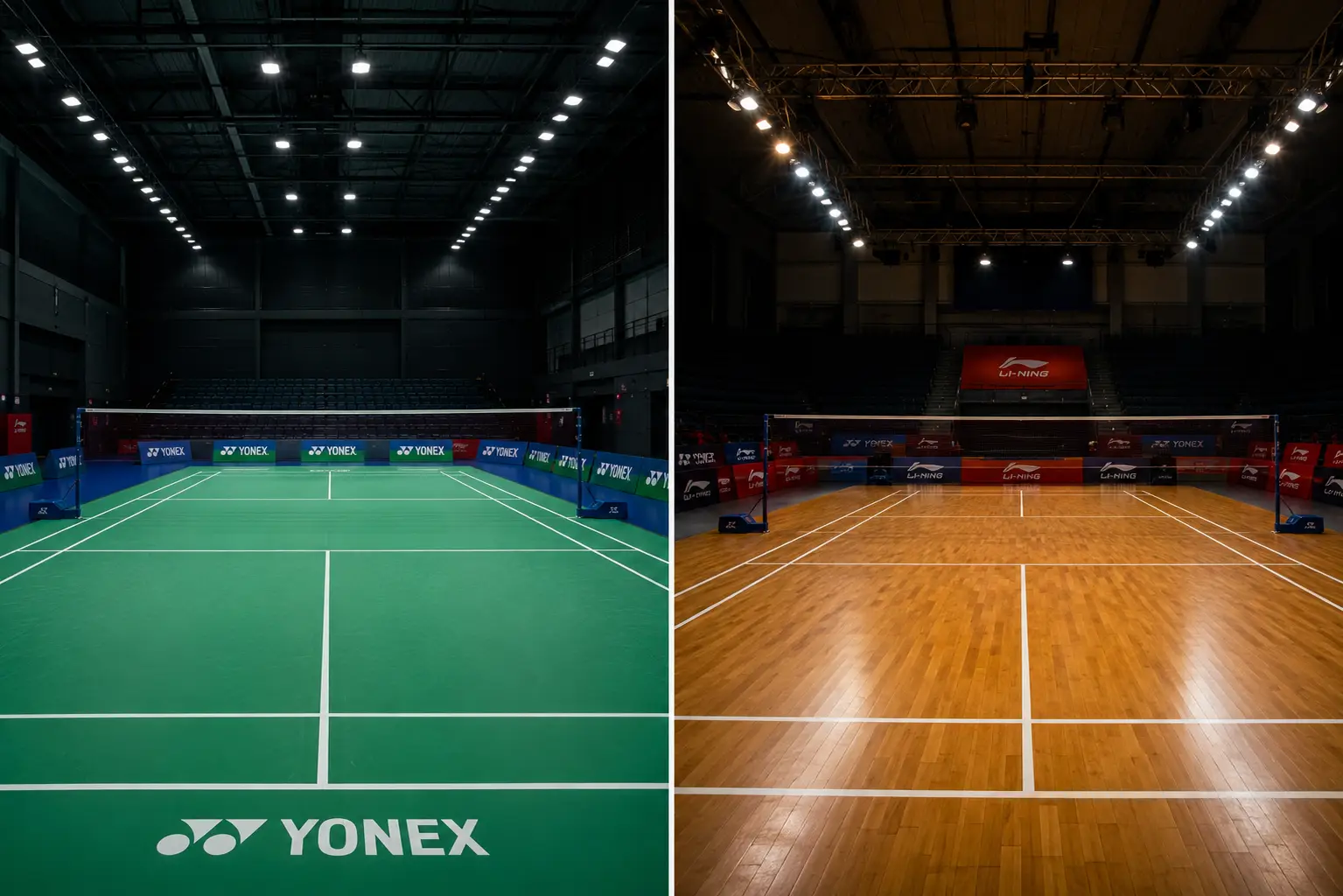
A wooden badminton court uses either solid hardwood or engineered wood panels as the playing surface. The most common wood used in professional facilities is maple or a similar hardwood that offers consistent grip and durability. Many premium facilities use a layered system where the wooden surface sits on top of a cushioned base, providing shock absorption during play.
Wooden courts are the official standard for all BWF professional tournaments. Every major badminton championship in the world, from the All England Open to the Olympics, is played on a wooden surface. That alone tells you something important.
What Is a Badminton Turf Court?
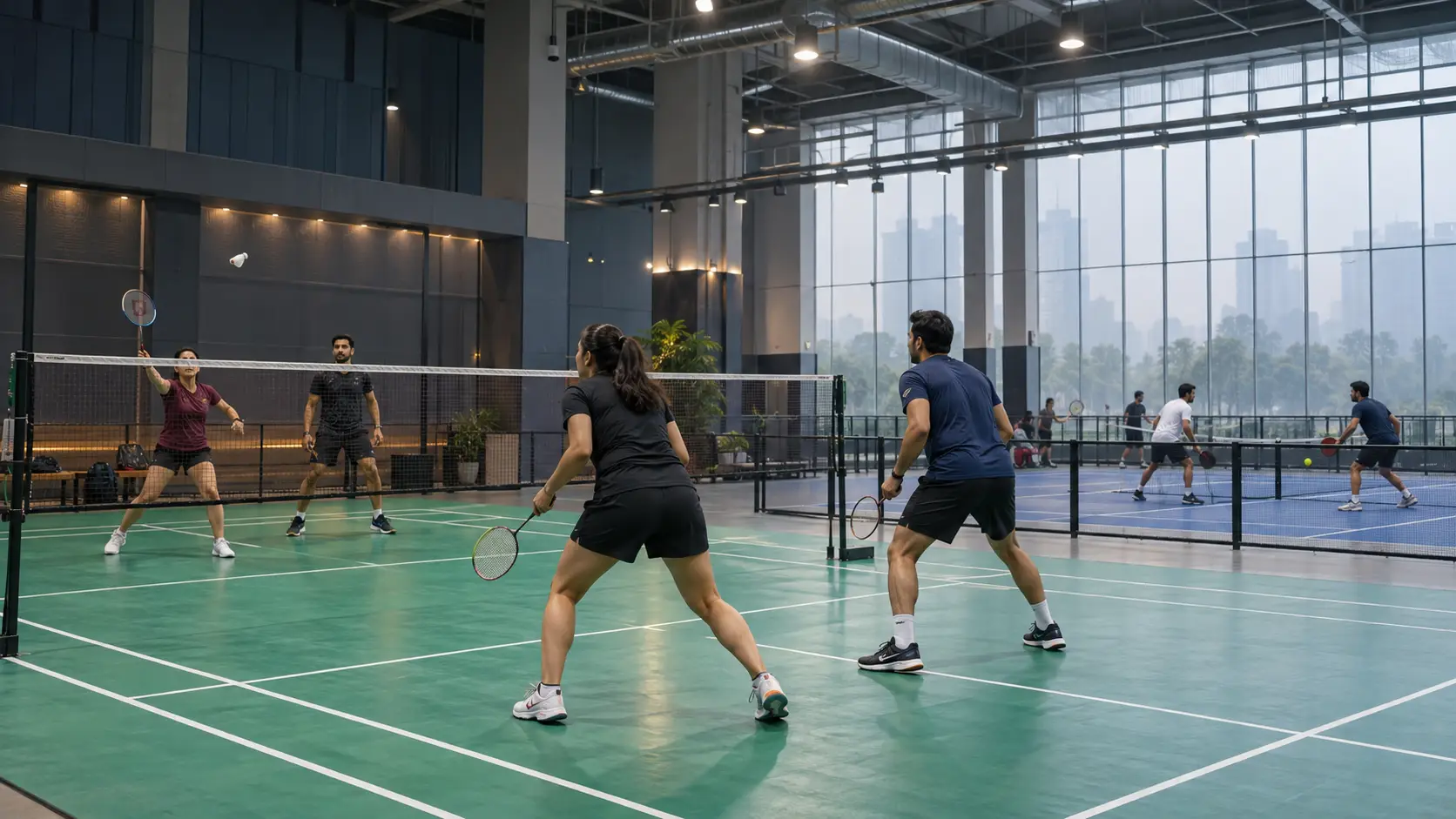
A badminton turf court uses synthetic materials, typically a short-pile artificial grass or a rubberised synthetic mat, as the playing surface. Turf courts became popular in India primarily because they are cheaper to install and maintain compared to wooden courts. You will find turf courts increasingly common in neighbourhood sports complexes, smaller academies, and multi-sport facilities across Delhi NCR and other Indian cities.
Head to Head Comparison: Turf vs Wooden Court
1. Grip and Traction
Wooden Court:
A well-maintained wooden court provides exceptional grip that is consistent across the entire surface. The grip level is predictable, which means your footwork patterns become reliable. You know exactly how much traction you have when you lunge, pivot, or push off for a jump smash.
Turf Court:
Turf surfaces can be inconsistent in grip. Depending on the quality and age of the turf, some areas may feel stickier while others feel slippery. Older turf that has flattened over time can become dangerously slick, especially when players sweat and the surface gets slightly damp.
Winner: Wooden Court ✅
2. Shock Absorption and Joint Safety
This is where the difference becomes critically important, especially for players who train regularly.
Wooden Court:
A properly installed wooden court with a cushioned underlay absorbs a significant amount of impact from jumps, sudden stops, and directional changes. This reduces stress on your knees, ankles, and hips considerably. Professional players who train for several hours daily rely on this shock absorption to protect their bodies over long careers.
Turf Court:
The shock absorption of a turf court varies enormously based on the thickness and quality of the synthetic material. Basic turf courts with thin rubber backing offer very little cushioning. This means the impact from every jump and hard stop travels directly into your joints. Players who train frequently on poor-quality turf courts often experience knee pain and shin splints earlier than those training on wooden surfaces.
Winner: Wooden Court ✅
3. Shuttle Flight and Bounce Behaviour
Wooden Court:
Wooden surfaces have minimal impact on shuttle flight since shuttles do not bounce off the floor in the same way a tennis ball does. However, on a wooden court the shuttle lands cleanly and the surface does not interfere with the shuttle's natural flight path during low net play or deceptive drops.
Turf Court:
One surprising issue with turf courts is that the slightly uneven texture of synthetic fibres can occasionally cause a shuttle to behave unpredictably when it clips the surface. For competitive or serious training play this inconsistency can be frustrating and counterproductive.
Winner: Wooden Court ✅
4. Footwear Compatibility
Wooden Court:
Wooden courts require proper non-marking badminton shoes with a gum rubber sole. These shoes are specifically designed to grip wooden surfaces safely. Wearing the wrong shoes on a wooden court is both dangerous and damaging to the surface itself.
Turf Court:
Turf courts are generally more forgiving with footwear. Some turf facilities allow players to use regular sports shoes or running shoes, which makes them more accessible for casual players who have not yet invested in proper badminton footwear.
Winner: Turf Court ✅ (for casual and beginner players)
5. Maintenance and Durability
Wooden Court:
Wooden courts require regular maintenance including cleaning, polishing, and periodic refinishing to maintain their playing quality. Water and moisture are enemies of wooden courts. A single water leak or flooding incident can cause significant and expensive damage. However, a well-maintained wooden court can last 15 to 20 years or more.
Turf Court:
Turf courts are significantly easier and cheaper to maintain. They do not require polishing or refinishing. Cleaning is straightforward and they are not damaged by moisture in the way wood is. However, the playing quality of turf degrades over time as the synthetic fibres flatten and wear down. Most turf surfaces need to be replaced every 5 to 8 years depending on usage intensity.
Winner: Turf Court ✅ (for facility owners and budget-conscious setups)
6. Cost of Installation
Wooden Court:
Installing a professional-grade wooden badminton court in India typically costs between ₹8 lakh and ₹20 lakh per court depending on the wood quality, cushioning system, and finishing. This is a significant investment that puts wooden courts out of reach for many smaller facilities.
Turf Court:
A synthetic turf badminton court costs considerably less, typically between ₹2 lakh and ₹6 lakh per court. This lower entry cost is why turf courts have proliferated so rapidly across India, particularly in smaller cities and neighbourhood sports complexes.
Winner: Turf Court ✅ (from a cost perspective)
7. Performance for Competitive Players
Wooden Court:
If you are training to compete at any serious level, wooden courts are non-negotiable. All competitive badminton tournaments use wooden surfaces. Training consistently on turf and then competing on wood creates a significant adjustment problem. Your footwork patterns, speed, and movement instincts are all calibrated to the surface you practice on most.
Turf Court:
Turf courts are perfectly adequate for recreational play and casual badminton. But for players with competitive ambitions, relying solely on turf for training is a genuine disadvantage. The difference in grip, speed, and movement feel between turf and wood is substantial enough to affect match performance.
Winner: Wooden Court ✅ (for serious and competitive players)
So Which Surface Should You Choose?
The honest answer depends entirely on who you are as a player.
Choose a wooden court if:
You train more than 3 times a week
You have competitive ambitions at any level
You are concerned about long-term joint health
You want to develop footwork patterns that translate to tournament play
You take your game seriously and want a professional environment
Choose a turf court if:
You play casually once or twice a week for fitness and fun
You are a complete beginner just getting started
Budget is a primary concern
You do not yet own proper badminton shoes
You are looking for a quick game without the formality of a professional setup
What Most Indian Players Get Wrong
Many recreational players in India default to turf courts simply because they are more available and cheaper to book. There is nothing inherently wrong with this for casual play. The problem arises when a player starts taking their game more seriously but continues training exclusively on turf, not realising that the surface itself is limiting their development.
If you are at the stage where you are playing regularly, working on your technique, and thinking about entering local tournaments, it is time to make the switch to wooden courts for your primary training sessions. The improvement you will notice in your footwork alone will be immediate and significant.
For players in Delhi NCR looking to make that switch, the badminton court in Delhi at Rackonnect offers professional-grade wooden courts with proper flooring, excellent lighting, and easy online booking to support your transition to serious training.
A Note on Court Quality Within Each Category
It is worth emphasising that not all wooden courts are equal and not all turf courts are equal. A poorly installed wooden court with no cushioning underlay can actually be harder on your joints than a high-quality thick turf surface. Similarly, a premium synthetic court surface from a reputable manufacturer can outperform cheap or worn-out wooden flooring.
Always evaluate the specific court in front of you rather than assuming all wooden courts are automatically superior. Visit the facility, walk on the surface, check the maintenance standard, and ask questions before committing to regular sessions.
If you want to experience what a properly maintained professional badminton arena feels like, Rackonnect's Noida Sector 141 arena and the Rackonnect Smashers Badminton Arena both offer premium court surfaces that meet professional playing standards.
Frequently Asked Questions
Q1. Is turf good for badminton practice?
Turf is acceptable for casual and recreational badminton. However for serious practice and competitive training, wooden courts are strongly recommended. Turf surfaces can develop inconsistent grip over time and do not replicate the playing conditions of tournament courts, which are always wooden.
Q2. Why do professional badminton tournaments use wooden courts?
Professional tournaments use wooden courts because they provide consistent grip, reliable shuttle behaviour, superior shock absorption, and a playing surface that rewards precise footwork and technical skill. The BWF mandates wooden surfaces for all sanctioned international events.
Q3. Can I wear running shoes on a wooden badminton court?
No. Wooden badminton courts require non-marking badminton shoes with gum rubber soles. Running shoes can damage the wooden surface and do not provide the lateral support and grip needed for safe badminton movement. Always wear proper badminton footwear on wooden courts.
Q4. How long does a wooden badminton court last?
A well-maintained wooden badminton court can last between 15 and 20 years. Regular cleaning, polishing, and prompt attention to any moisture issues are key to maximising the lifespan of a wooden court surface.
Q5. Which surface is better for beginners, turf or wood?
Beginners can start on either surface. Turf courts are more accessible and forgiving with footwear. However if possible, starting on wooden courts from the beginning is ideal because it builds correct footwork habits calibrated to the surface used in all competitive play.
Final Thoughts
The debate between badminton turf and wooden court is not really about which one looks better. It is about understanding what each surface offers and matching that to your goals as a player.
For casual fun and fitness, turf gets the job done. For serious development, competitive ambition, and long-term joint health, wooden courts are the clear and unambiguous choice.
Play smart. Choose the right surface. And invest in facilities that take your game as seriously as you do.