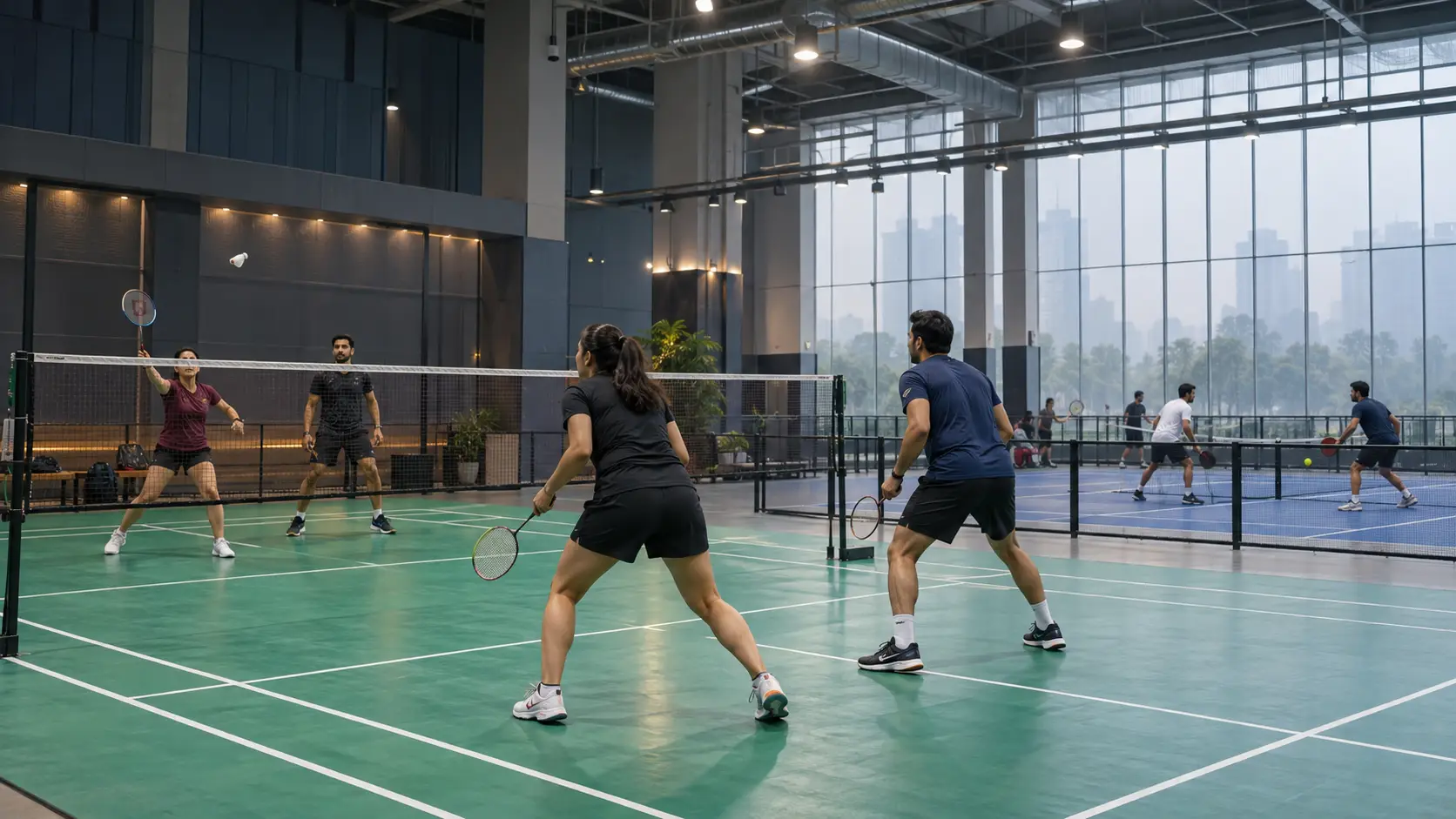
Badminton is India's most-played indoor racket sport - and for good reason. It is fast, intensely physical, endlessly skillful, and deeply social. Millions of Indians grow up watching it, but surprisingly few ever receive structured coaching that helps them move beyond casual rallying into confident, purposeful play.
If you have been thinking about learning badminton properly - whether you are a complete beginner who has never held a racket, someone returning to the sport after years away, or a casual player who wants to finally get their technique right - this guide is written for you. We will walk you through everything you need to know to start your journey at a Rackonnect academy.
Why Badminton Is the Perfect Sport to Start With
Among all racket sports, badminton offers the fastest path from complete beginner to genuinely enjoyable play. Unlike tennis, where it takes weeks before you can sustain a meaningful rally, badminton beginners are typically rallying back and forth within their very first session. The shuttle moves slower than a tennis ball, the court is smaller, and the underarm clear is an intuitive stroke that most people execute reasonably well on their first attempt.
Badminton is also one of the most physically complete sports you can choose. A 45-minute singles match at moderate intensity burns roughly 400–500 calories, works your legs, core, and arms simultaneously, and demands quick reflexes and spatial awareness that sharpen over time. The health benefits of regular badminton practice extend well beyond the physical - it has been associated with improved focus, reduced anxiety, and better sleep quality.
For a full picture of what racket sports do for your health, read our detailed guide on the science-backed health benefits of playing racket sports regularly.
And if you eventually want to try other sports on Rackonnect's courts, badminton gives you an excellent physical and spatial foundation for padel and pickleball as well.
Basic Rules Every Beginner Must Know
Court and Scoring
A badminton court measures 13.4 metres long and 6.1 metres wide for doubles (slightly narrower for singles). The net is positioned at 1.55 metres at the edges and dips to 1.524 metres at the centre.
Points are scored using the rally point system - meaning whoever wins the rally wins the point, regardless of who served. Games are played to 21 points, with a 2-point lead required to win. At 20–20, play continues until one side leads by 2 points, with a maximum score cap of 30–29 in tournament play. A match is best of 3 games.
Serving Rules
The serve must always be underarm - the racket head must be below the server's waist at the moment of contact
Both the shuttle and the racket head must be below the server's waist at the point of impact
The server and receiver must stand diagonally opposite each other in their respective service courts
The shuttle must land in the correct service court diagonally - failing to do so gives the point to the opponent
In Play and Faults
The shuttle must not touch the ground during a rally - if it does, the rally ends
If the shuttle hits the net and falls on the opponent's side, it is a valid point
Players must not touch the net during play
The shuttle must not be struck twice consecutively by the same player
5 Fundamental Skills Coaches Focus on First
At Rackonnect academies, beginner programmes are structured around five foundational skills. Mastering these creates the platform on which all advanced technique is later built.
1. Grip
The single most important technical element for a beginner. Most self-taught players develop a "frying pan" grip - holding the racket like a pan with the face parallel to the ground - which severely limits their ability to generate power and execute different strokes. The correct forehand and backhand grips must be established early. Poor grip is extremely difficult to correct once it becomes habitual.
2. Ready Position and Footwork
Badminton is won and lost on footwork. The ready position - knees slightly bent, weight on the balls of the feet, racket up and centred - is the neutral base from which all movement begins. Beginners are taught split-step timing, basic 4-corner and 6-corner footwork patterns, and recovery to the centre after each shot.
3. Clear (Overhead)
The defensive clear - a high, deep shot to the back of the opponent's court - is the first overhead stroke beginners learn. It creates time and space to recover position. Learning the correct throwing-action motion for the clear also unlocks the smash, drop, and drive later.
4. Net Play and Drop Shots
Gentle net shots and drop shots teach touch, finesse, and deception - the qualities that separate a developing player from a novice. They also shift the game from pure fitness to strategy, which keeps learning engaging and rewarding.
5. Service (Short and Flick)
The short service and the flick service are the two primary serves used in competitive doubles badminton. Beginners learn both early so they can participate in match play with appropriate tactical variation from the very first game.
What Gear Do You Actually Need?
One of the great things about badminton is that the initial investment is low. Here is a realistic gear guide for beginners:
Racket
Do not buy a cheap racket from a general sports store for your first sessions at an academy - light, flexible rackets in the Rs. 800–1,500 range break quickly and create bad habits. Rackonnect coaches typically recommend an entry-level racket from Yonex, Victor, or Li-Ning in the Rs. 2,500–4,500 range for beginners. These rackets are durable, correctly balanced, and string-tight enough for proper shot development.
For your very first trial session, Rackonnect academies provide loaner rackets so you do not need to purchase anything before knowing if you enjoy the sport.
Shoes
Court shoes are non-negotiable. Regular running shoes or sneakers with rounded soles are dangerous on a badminton court - they do not provide the lateral grip needed for fast direction changes. A court shoe (Yonex, Asics, or similar) with a flat, gum rubber sole and good ankle support is essential. Budget Rs. 2,500–5,000 for a quality pair that will last you at least a year of regular play.
Clothing
Lightweight, moisture-wicking sportswear is all you need. There are no dress code requirements at Rackonnect academies beyond clean, comfortable sports clothing. Avoid heavy cotton - it traps heat and becomes uncomfortable quickly during intense rallying. In summer, this matters even more; read our full guide on staying fit while playing racket sports in India's summer heat.
Shuttlecocks
Most Rackonnect academies provide shuttlecocks during coaching sessions. If you want to practise outside of scheduled sessions, ask your coach which shuttle speed is appropriate for the venue's temperature and altitude. Feather shuttles are used for serious training and competition; plastic/nylon shuttles are fine for casual practice.
What to Expect in Your First Session at Rackonnect
Your first coaching session at a Rackonnect academy is designed to be welcoming, not intimidating. Here is a typical first-session structure:
Introduction and assessment (10 min): Your coach will ask about your experience level, fitness goals, and availability. Even if you have played casually before, this conversation helps the coach understand your current baseline accurately.
Warm-up (10 min): Light jogging, dynamic stretching, and basic footwork exercises to prepare your body safely for court activity.
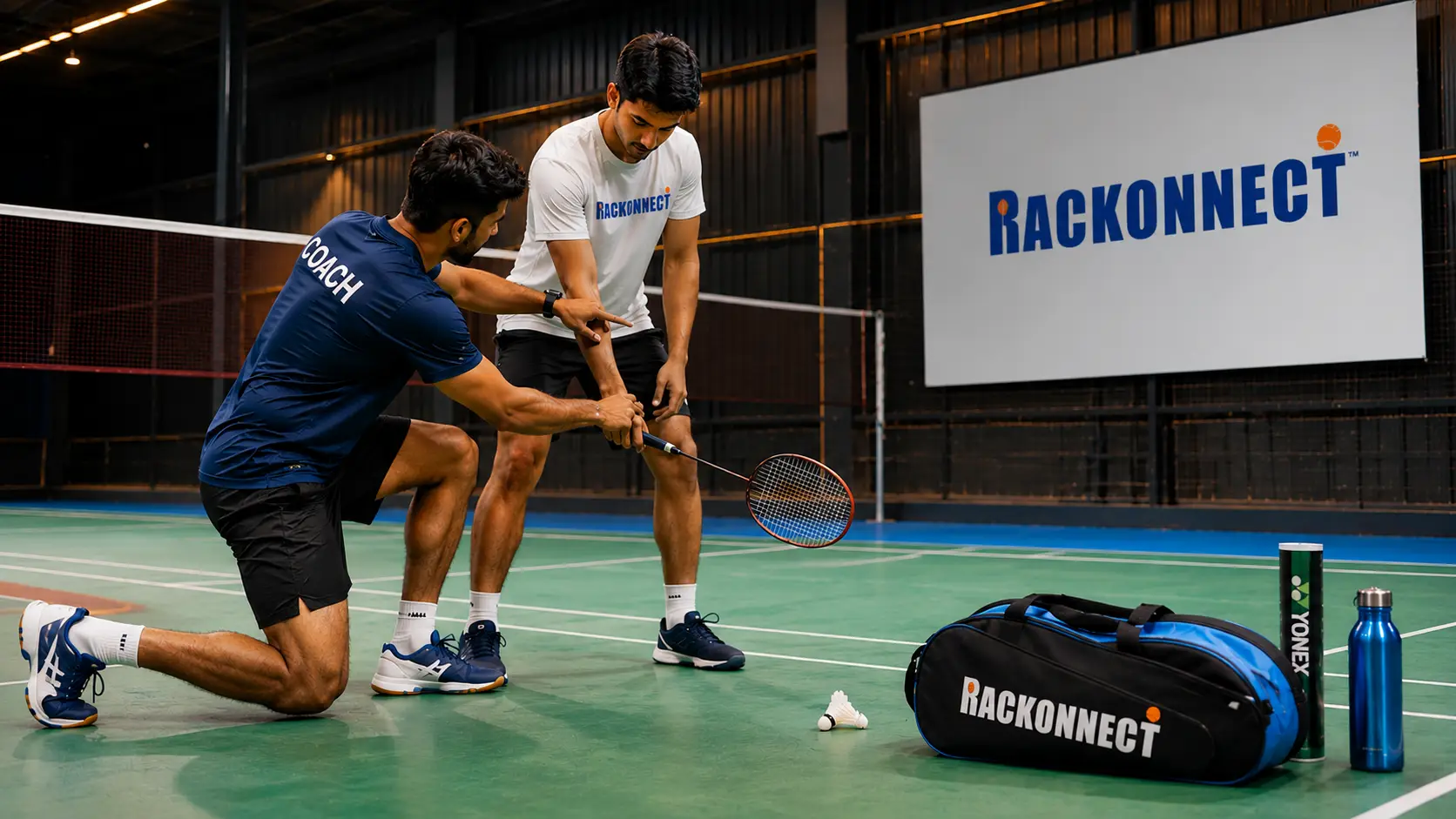
Grip and ready position (15 min): The coach corrects grip immediately if needed and establishes your ready position. These two elements form the foundation of everything that follows.
Basic rallying with coaching (20 min): Guided rallying with the coach, focusing on controlled clears and consistent contact. The emphasis is entirely on correct technique, not on who wins the rally.
Cool-down and debrief (5 min): The coach outlines what you did well, what to work on, and what the next session will focus on. You will leave with a clear understanding of your starting point and the path forward.
First sessions at Rackonnect are intentionally paced. The goal is to leave you feeling capable and excited to return - not overwhelmed.
Academy Programmes at Rackonnect
Rackonnect operates 15 top-tier badminton academies across North India, with programmes tailored to every stage of development:
Beginners Programme (0–6 months)
Focuses on the five fundamental skills outlined above. Sessions run 2–3 times per week. Suitable for complete beginners of all ages.
Intermediate Programme (6 months – 2 years)
Introduces advanced footwork patterns, smash development, net domination, and doubles strategy. Players transition from building strokes to playing purposeful tactical badminton.
Advanced and Competitive Programme
Designed for players with 2+ years of coaching experience who want to compete at club, state, or national level. Focuses on high-intensity training, match tactics, physical conditioning, and mental performance.
Kids Programme (Ages 6–14)
A dedicated programme for young players that balances skill development with age-appropriate fun and positive reinforcement. Rackonnect coaches who work with juniors are specially trained in youth sports coaching methodologies.
Corporate and Group Sessions
Short-format group sessions ideal for office teams, housing society groups, or friends wanting to learn together. These sessions are more social and relaxed in structure, with coaching support provided throughout. Learn more about corporate racket sports events at Rackonnect.
6 Common Beginner Mistakes (and How to Avoid Them)
1. Using a Frying Pan Grip
Holding the racket face parallel to the ground prevents wrist action, limits shot variety, and reduces power significantly. Learn the correct handshake grip from day one and have your coach check it every session for the first month.
2. Not Moving Back to the Centre
Many beginners stay near wherever they hit their last shot. In badminton, recovering to the centre of the court after every shot is a fundamental tactical habit. Failing to do this leaves large areas of your court open for the opponent to exploit.
3. Hitting Every Shot as Hard as Possible
Power is useful, but control and placement win more points - especially at beginner and intermediate level. Practice playing at 70% power with deliberate placement, and you will win far more rallies than by trying to smash everything.
4. Skipping the Warm-Up
Badminton involves explosive lateral movements, sudden direction changes, and overhead arm actions. Jumping straight into play without warming up is how beginners pull calf muscles and strain shoulder tendons. Always warm up, especially in summer.
5. Playing Irregularly
Two or three sessions per week is the minimum frequency for meaningful skill development. Playing once every two weeks means your body never builds the neural patterns and muscle memory that badminton technique requires. Consistency is more important than session duration.
6. Buying the Wrong Equipment Early
Very cheap rackets break quickly and teach your body incorrect swing weight feedback. Very advanced rackets (stiff, heavy, head-heavy) are unsuitable for beginners building technique. Listen to your coach's gear recommendations before purchasing.
How Quickly Will You Progress?
Progress in badminton is highly individual, but here is a realistic timeline based on what we observe at Rackonnect academies:
After 4–6 sessions: Consistent grip, ability to rally, understanding of basic rules and court positioning
After 3 months: Reliable clears, basic serve, comfortable doubles play, developing net game
After 6 months: Good footwork patterns, consistent smash, tactical awareness in doubles
After 1 year: Club-level competitive play, ability to read opponents and construct points deliberately
These milestones assume 2–3 coached sessions per week. Players who supplement coaching with additional solo footwork practice or multi-feed drills progress faster. Your coach will advise on the most effective supplementary practice for your specific development stage.
How to Book Your First Session at Rackonnect
Booking your first session is straightforward:
Download the Rackonnect app (available on Android and iOS) or visit rackonnect.com
Select the academy location nearest to you from Rackonnect's network across Delhi NCR, Jaipur, and Amritsar
Choose a beginner trial session and select a time slot that suits you
Complete your booking - your confirmation and location details are sent instantly
First-time players are encouraged to book a trial session rather than committing to a full programme upfront. The trial session gives you a realistic experience of what structured coaching feels like before making a longer-term decision.
If you are planning a group booking - for family, friends, or a corporate team - Rackonnect's group and corporate session packages offer better value. Details are available on the website or through the app.
Frequently Asked Questions
How long does it take to learn badminton basics?
Most beginners can rally comfortably and understand basic court positioning within 4 to 6 coached sessions. Developing consistent technique across all strokes takes approximately 3 to 6 months of regular practice with proper coaching.
What age is suitable to start badminton?
Badminton can be started from as young as 5–6 years old. Rackonnect academies offer programmes for kids (age 6+), teenagers, adults, and senior players. There is genuinely no upper age limit to starting - we have beginners in their 50s and 60s at several of our academies who are progressing remarkably well.
Do I need to buy my own racket before my first session?
No. Rackonnect academies provide trial rackets for beginners. Once you decide to continue, your coach will recommend the right racket based on your emerging playing style, which takes 2 to 3 sessions to assess accurately.
Can I learn badminton if I have no prior sports background?
Absolutely. A prior sports background helps with fitness and general coordination, but it is by no means required. Rackonnect coaches are experienced in working with complete beginners across all fitness levels. Patience, consistency, and a willingness to learn are the only prerequisites.
Is badminton good for weight loss?
Yes. Badminton is one of the most effective calorie-burning indoor sports available. A 45-minute moderate-intensity singles session burns approximately 400–500 calories. Combined with its cardiovascular and muscular benefits, badminton is an excellent choice for weight management and overall fitness improvement.
What is the difference between a casual session and academy coaching?
A casual session involves booking a court and playing freely without structured guidance. Academy coaching involves a dedicated coach who observes your technique, corrects errors in real time, designs progressive skill drills, and provides a structured learning pathway. Players who receive coaching consistently progress 3 to 4 times faster than those who play only casually.
About Rackonnect: Rackonnect operates 15 top-tier badminton academies across North India as part of a wider network of 50+ sports venues. Our certified coaches work with players of all ages and levels, from first-timers to national-level competitors. Book your first session at rackonnect.com or through the Rackonnect app.