Introduction: Why Defense Wins Badminton Matches
Badminton is often described as a fast, attacking sport — yet most high-level matches are decided by defense.
Strong defensive badminton strategies allow players to absorb pressure, extend rallies, and convert difficult situations into winning opportunities. A player who can consistently retrieve smashes, control blocks, and transition quickly to offense is far harder to beat than one who relies purely on attacking power.
Modern international play proves that defense is no longer passive survival. It is a structured, intelligent system built on positioning, anticipation, shot selection, and transition speed.
This complete guide covers the techniques, movement systems, drills, and tactical frameworks used globally to build elite defensive badminton skills — whether you are a beginner building your foundations or an intermediate player looking to compete more consistently.
What Are Defensive Badminton Strategies?
Defensive badminton strategies refer to structured techniques and tactical decisions used to neutralize attacking shots such as smashes, steep drops, and fast drives.
Effective defense involves:
1. Correct ready stance and split step timing → Getting into position early before the shuttle arrives
2. Fast racket preparation → Raising the racket early so reaction time increases
3. Controlled shot selection under pressure → Choosing the right defensive return — lift, block, or drive
4. Strong court recovery → Returning to base position after every defensive shot
5. Tactical transition from defense to offense → Converting a weak reply into an attacking opportunity
Elite badminton defense is proactive, not reactive. The goal is not simply to return the shuttle — it is to force weaker follow-up shots that shift the rally in your favor.
Core Defensive Techniques Every Player Must Master
1. Defensive Clear
A defensive clear is used when under heavy pressure. The objective is to send the shuttle deep into the opponent's backcourt, buying recovery time and resetting the rally.
Key points:
High and deep trajectory — depth matters more than height
Aim for the opponent's backhand rear corner when possible
Avoid mid-court lifts that invite another immediate smash
Use when you are off-balance or pulled wide out of position
A short clear is one of the most punished errors in badminton — it hands the attacker another easy smash opportunity. Always prioritize depth.
2. Block Defense
Block defense is one of the most effective ways to counter a smash, and one of the most underused tools by recreational players.
Two key variations:
Soft net block — Redirects the smash gently just over the net, forcing the attacker to rush forward and hit upward, giving you back the attack.
Tight spinning block — Adds side spin to the block, making the shuttle hug the net tape and creating a near-impossible return for the opponent.
A good block shifts pressure instantly. Players who train at structured facilities like our badminton academy in Faridabad drill repeated smash-and-block sequences to build control and confidence under pace.
3. Drive Defense (Counter Drive)
Drive defense is an aggressive counter to a smash. Instead of lifting, players return the shuttle flat and fast, directly at or past the attacker.
Benefits:
Breaks the attacker's rhythm and momentum
Forces mid-court interception errors
Creates sudden attacking opportunity
Reduces the number of rallies you spend purely defending
Timing and wrist strength are critical here. The drive must be flat and low over the net — a high drive simply becomes another easy smash for the opponent.
4. Defensive Lift
When blocks and drives are too risky — such as when the smash is very steep or you are off-balance — a controlled lift becomes the right choice.
Guidelines:
Prefer a straight lift for stability and predictability of your own recovery
Use a cross-court lift selectively to create surprise, but only when well-balanced
Maintain depth at all times — a short lift is worse than no lift
Combine lift direction with body deception to slow the attacker's read
A predictable short lift is one of the most common defensive errors at club level. When in doubt, go deep.
Footwork and Positioning in Defensive Play
Defense is 50 percent movement and 50 percent racket skill. No defensive technique works correctly if your footwork is late or your starting position is wrong.
The Ready Position
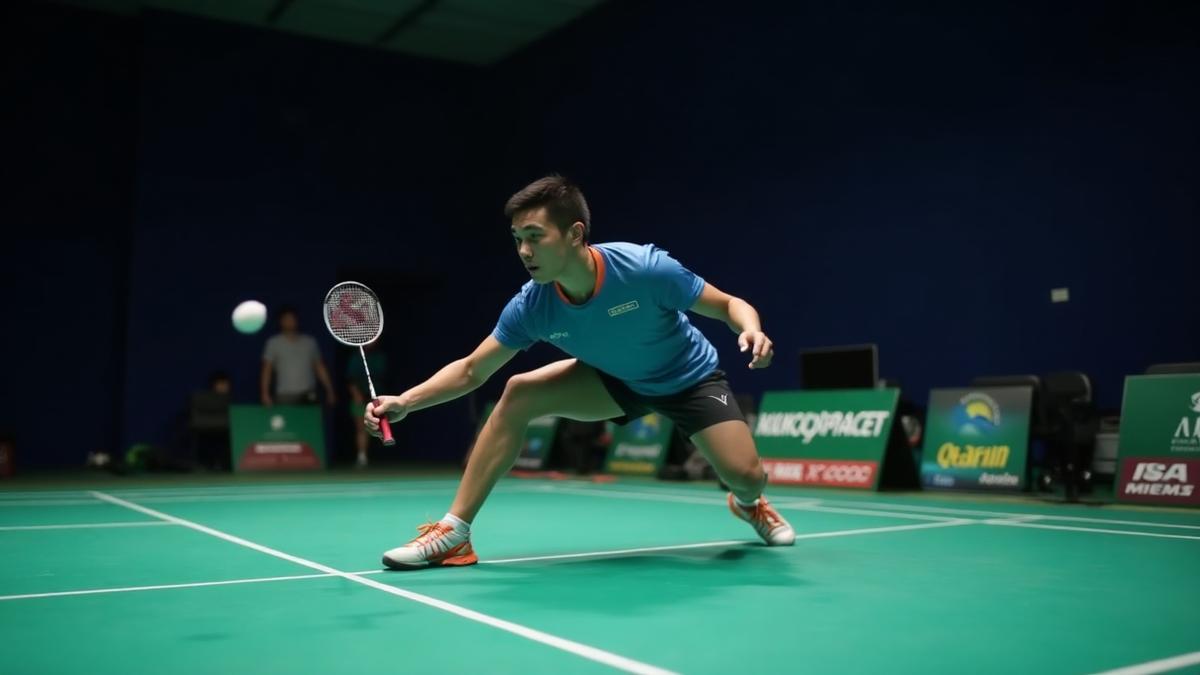
Your ready position is the foundation of fast defensive movement:
Knees bent — not straight legs
Racket raised to chest height in front of body
Weight slightly forward on balls of feet
Eyes tracking opponent's racket shoulder
Split step timed precisely with your opponent's contact moment
Singles Defensive Positioning
In singles, your defensive base is slightly behind the center midline:
Use quick chasse steps (side steps) toward the direction of the smash
Do not cross your feet — this slows recovery
Return to base position immediately after every defensive shot
Never admire your return — assume the next shot is coming
Doubles Defensive Formation
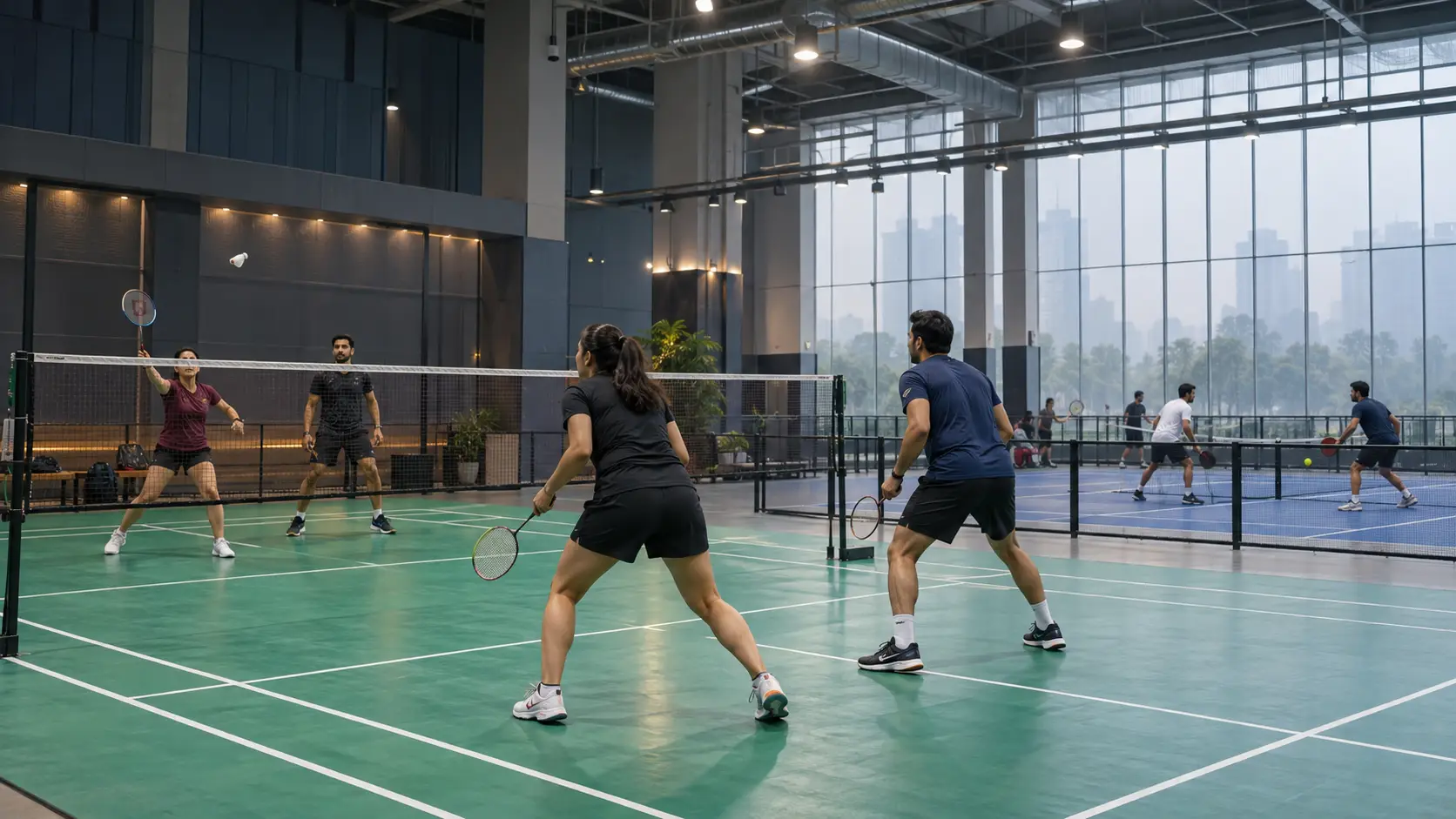
Side-by-side formation is the standard during doubles defense:
Both players cover half the court width each
Keep rackets at chest height, ready for fast drives or blocks
Communicate clearly on middle shots — call "mine" or "yours" early
Transition to front-back formation immediately after a weak reply from opponents
Players at venues like Noida Indoor Stadium and Rackonnect Noida Sector 45 benefit from consistent lighting and court surfaces that allow precise footwork pattern training year-round.
Defensive Badminton Strategies for Singles
In singles, stamina and patience are the defining qualities of strong defense.
Strategic focus for singles defense:
Force longer rallies by clearing deep and varying pace
Target the opponent's backhand corner consistently — most players are weaker on that side
Alternate between straight and cross-court blocks to create uncertainty
Mix defensive clears with the occasional fast drive to prevent the opponent from fully committing to attack
Reading your opponent:
Shoulder rotation typically signals smash direction before the racket even swings. Watch the lead shoulder, not the racket. Advanced players anticipate rather than react — defense at high level is largely predictive, built on pattern recognition developed through thousands of repetitions.
Defensive Badminton Strategies for Doubles
Doubles defense demands speed, coordination, and constant communication between partners.
Key strategies for doubles defense:
Maintain a compact side-by-side stance — resist the urge to back away from the net
Keep both rackets raised at chest level at all times during an opponent's attack
Avoid lifting repeatedly to a strong smasher — look for the earliest drive opportunity
Counter-drive when possible to break the opponents' front-back attacking formation
Rotational awareness:
If one partner is forced wide, the other must shift immediately to cover the vacated space. Doubles defense breaks down most commonly when one player fails to adjust for a partner under pressure. Drill rotational awareness explicitly in training.
Advanced Defensive Tactics Used by Professionals
Counter-Attack After Defense
Top international players do not simply survive defensive situations — they use them to set up attacks. After defending two or three smashes and drawing the opponent forward, a sudden fast drive or straight block forces the attacker into an off-balance lunge, creating an easy next shot.
Deceptive Defense
Subtle wrist angle changes can disguise block direction until the last possible moment. Showing a straight block shape and redirecting cross-court — or vice versa — creates hesitation that results in the opponent moving in the wrong direction.
Pattern Recognition
Studying opponent tendencies is advanced-level defense:
Note which direction they smash most frequently (straight or cross-court)
Identify their preferred follow-up after a lift (drop or smash)
Observe their body position signals for each shot type
Defense at elite level is built on pattern recognition combined with physical conditioning. Players who train with structured coaching develop this game-reading ability much faster than those who only play matches.
Common Defensive Mistakes to Avoid
1. Standing upright instead of staying low → Upright posture increases reaction time and slows lateral movement
2. Lifting too short → A short lift invites immediate pressure; always prioritize depth
3. Watching the shuttle too late → Read the opponent's body cues, not just the shuttle
4. Weak grip control → Tight grip before contact slows wrist speed; relax between shots
5. Panic shots under pressure → Hurried returns give away court position; focus on controlled placement
6. No recovery after defensive shot → Staying in the corner after a block is one of the most punished habits in doubles
Consistency and calmness matter more than power in defensive rallies.
Training Drills to Improve Defensive Badminton Skills
Drill 1: Multi-Shuttle Smash Defense
Coach feeds continuous smashes from the net area. Player focuses on alternating between block and lift variations on each shot.
20 consecutive smashes per set
3 sets with 90-second rest
Progress by increasing smash speed over weeks
Drill 2: Two-on-One Defense Drill
Two attackers smash alternately against one defender to build reaction speed and court coverage under realistic pressure.
Defender scores a point for every controlled return that lands in court
Attackers score a point for every forced error
Play to 15 points, rotate roles
Drill 3: Wall Drive Drill
Stand facing a wall and drive the shuttle repeatedly at a fixed target zone. Improves wrist strength, timing, and flat defensive return consistency.
3 sets of 2 minutes with 1-minute rest
Drill 4: Agility Ladder + Split Step Drill
Lateral agility ladder sequences followed immediately by a split step and direction sprint. Enhances the explosiveness of your first defensive step.
5 ladder sequences per set
3 sets with 60-second rest
💡 Want to drill these under proper guidance? Rackonnect's certified coaches run structured defensive badminton sessions tailored to your playing level. Explore coaching programmes →
Physical Conditioning for Stronger Defense
Defensive badminton is physically demanding. A fatigued defender becomes predictable — they stop blocking, start lifting short, and lose the ability to transition to offense.
Build these physical qualities specifically for defense:
Core stability — Planks, dead bugs, and rotational exercises keep your defensive stance strong under repeated pressure
Leg strength — Squats and lunges build the explosive first step needed for wide retrievals
Shoulder endurance — Resistance band shoulder rotations build the stamina for sustained rallying
Wrist strengthening — Racket wrist curls and resistance exercises improve drive and block power
Interval cardio — Short sprint intervals (15 seconds on, 15 seconds rest) closely mimic badminton rally patterns
Train conditioning at least 2–3 times per week alongside court sessions.
Mental Strength in Defensive Play
Calmness separates average players from elite defenders. The mental side of defense is as important as the physical.
Patience during long rallies — Resist the urge to force a winner when under pressure. The defensive goal is to extend the rally until the opportunity arrives, not to manufacture one.
Confidence in retrieving smashes — Players who believe they can get the shuttle back consistently do get it back more often. Build confidence through repetition in training.
Reset mindset after errors — A missed block or a short lift happens to every player. The difference is how quickly you reset to full focus for the next point.
Focus on placement, not survival — Even in defensive situations, always aim for a specific target. A directed lift to the backhand corner is strategically better than a desperate lift to anywhere.
Frequently Asked Questions (FAQ)
Q: How can beginners improve defensive badminton quickly? Focus on three fundamentals first: correct ready stance with knees bent and racket raised, split step timing with the opponent's contact, and consistent deep lifts rather than short ones. Master these before attempting advanced counter drives or deceptive blocks.
Q: Is defensive play suitable for aggressive attacking players? Absolutely. Strong defense creates more attacking opportunities — by forcing weak replies, you generate the easy shots that attackers want. The best attacking players in the world also have elite defensive skills.
Q: How do you defend against steep jump smashes? Stay low, keep your racket prepared early at chest height, and aim for tight net blocks rather than high lifts. A soft net block after a jump smash forces the attacker to rush forward and hit upward, reversing the pressure immediately.
Q: What grip is best for smash defense? A relaxed forehand grip allows the fastest wrist adjustment and reaction speed. Avoid gripping tightly before contact — tighten only at the moment of impact. For very fast drives, a slightly backhand grip gives additional leverage.
Q: How important is the split step for defense? The split step is the single most important defensive movement habit. Without it, your first step is slow and your body weight is already committed in the wrong direction. Perform a small hop so you land just as your opponent contacts the shuttle — this leaves you in a perfectly balanced, reactive position.
Q: How do I transition from defense to attack in badminton? Watch for the moment your opponent's attack weakens — a drive that sits up slightly, a smash that is not steep enough, or a drop that falls short. These are your transition opportunities. Hit a flat drive, a tight block, or a counter-drop to shift from defending to attacking in a single shot.
Build Match-Winning Defense Through Structured Practice
Defensive badminton strategies form the backbone of competitive success at every level. The ability to absorb pressure, maintain control, and transition into attack determines match outcomes far more often than pure smashing power.
Players who consistently train defensive technique, improve physical conditioning, and practice under realistic match conditions develop a sustainable competitive edge that holds up under pressure.
Defense is not about surviving rallies. It is about controlling them — and ultimately winning them.
Start building your defensive game today.
Find a Rackonnect venue near you and book your court: