Key Takeaways
Indoor air quality directly influences shuttle speed, stability, and trajectory.
Temperature, humidity, and air density alter how the shuttle travels during play.
Poor ventilation increases fatigue and reduces player stamina.
High CO2 levels can affect breathing comfort and concentration.
Balanced airflow is essential to maintain fair shuttle behavior.
Players and facilities that manage air quality gain a performance advantage.
Introduction
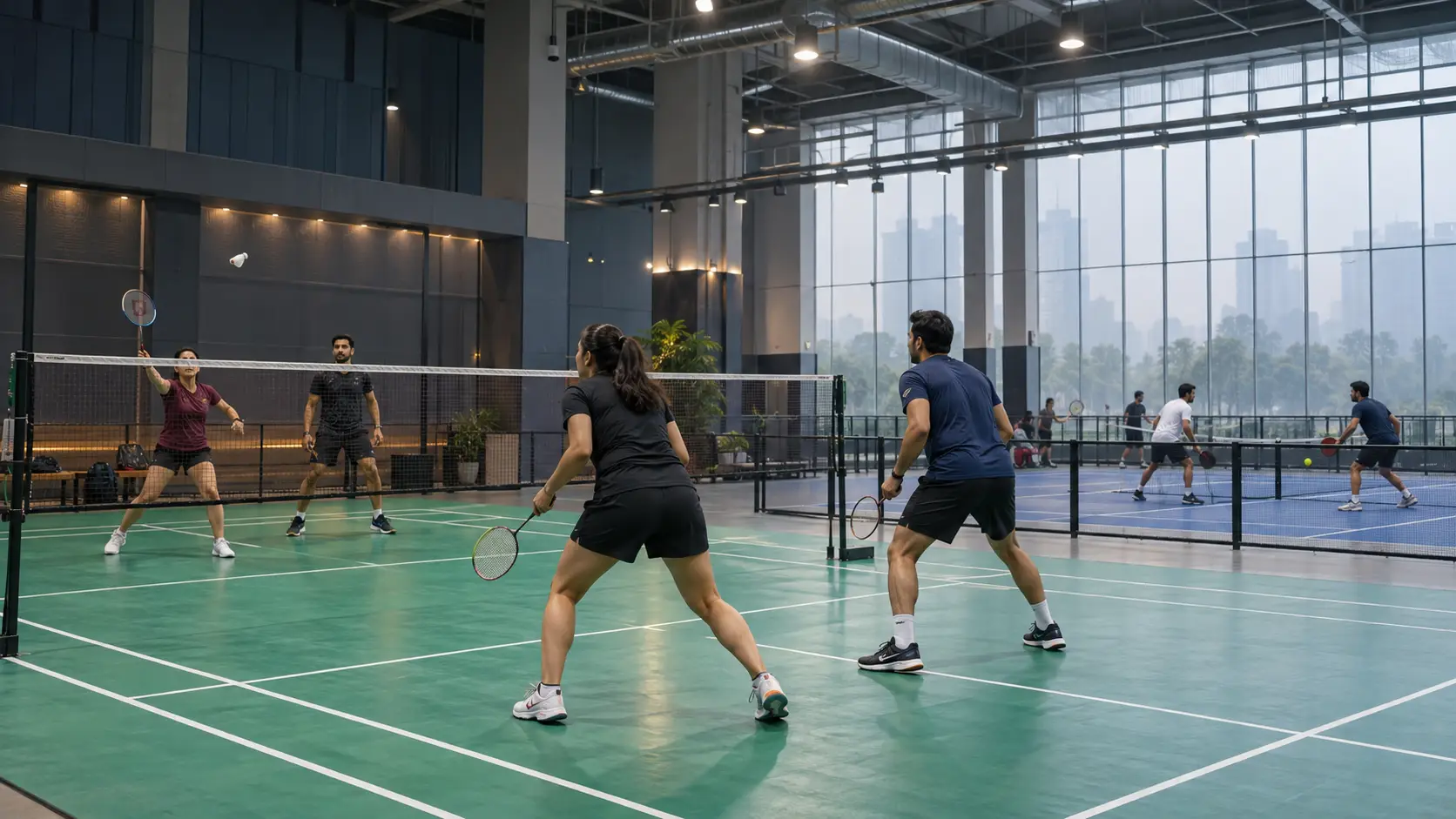
Many badminton players notice that the shuttle behaves differently from one indoor court to another. Shots that normally land deep may suddenly fall short, or clears feel unusually fast. At the same time, players often feel more fatigued indoors despite similar fitness levels.
These differences are rarely caused by skill or equipment alone. Indoor air quality plays a critical but often overlooked role in both shuttle flight and player stamina. Understanding this connection helps players adapt better and enables facilities to create superior playing environments.
Understanding Indoor Air Quality in Badminton Courts
What Indoor Air Quality Means
Indoor air quality refers to the condition of air inside a facility and is determined by factors such as temperature, humidity, ventilation, air movement, and the concentration of gases like carbon dioxide. In sports environments, these factors change rapidly due to physical activity and crowd density.
Why Indoor Air Quality Matters More in Badminton
Badminton is a fast paced sport where the shuttlecock is extremely sensitive to air resistance. Even minor changes in air density or airflow can alter shuttle behavior. Combined with high intensity movement and rapid breathing, indoor conditions strongly influence both playability and endurance.
How Indoor Air Conditions Affect Shuttle Flight
Air Density and Temperature
Air density decreases as temperature rises. In warmer indoor courts, lower air density reduces drag on the shuttle, causing it to travel faster and farther. In cooler environments, denser air increases resistance, making the shuttle slow down more quickly.
Effect of Humidity on Shuttle Stability
Humidity has a significant impact on feather shuttlecocks. In very dry air, feathers become brittle, leading to unstable flight and faster damage. Moderate humidity allows feathers to absorb slight moisture, improving shuttle stability and consistency. Excessive humidity, however, can make the shuttle heavier and slower.
Air Movement and Drafts
Directional airflow caused by poorly positioned vents or fans can disturb shuttle trajectory. Cross drafts near the net or baseline often result in unpredictable drops, floating clears, or altered smash angles. Uniform and low velocity airflow is essential for fair play.
Impact of Indoor Air Quality on Player Stamina
CO2 Levels and Oxygen Comfort
During intense badminton sessions, players exhale large amounts of carbon dioxide. In poorly ventilated halls, CO2 accumulates quickly, making the air feel heavy. Elevated CO2 levels are associated with faster fatigue, breathing discomfort, and reduced concentration.
Temperature and Humidity Stress
High temperatures and humidity increase thermal stress on the body. Players lose fluids faster and require more effort to regulate body temperature. This leads to quicker exhaustion, especially during long rallies or multi game matches.
Perceived Effort and Mental Fatigue
Poor air quality increases perceived exertion, meaning players feel they are working harder even at the same intensity. This reduces reaction speed, decision making quality, and overall match focus.
Indoor vs Outdoor Playing Conditions
Why Indoor Courts Feel Faster or Slower
Outdoor badminton is influenced by wind and open air dispersion, while indoor courts trap air within a confined space. Indoors, shuttle behavior is dictated by temperature, humidity, and ventilation design rather than natural airflow.
Adaptation Challenges for Players
Players transitioning between different indoor courts often struggle initially. Adjusting shot power, timing, and lift height becomes necessary when air conditions differ significantly from familiar environments.
What Players Can Do to Adapt
Recognising Poor Indoor Air Conditions
Shuttle behaving inconsistently without clear reason.
Feeling unusually tired early in sessions.
Heavy or stuffy air sensation.
Adjusting Play and Recovery
Increase hydration during humid or warm sessions.
Reduce rally intensity when air feels heavy.
Adapt shot power and clears based on shuttle speed.
What Facility Managers Should Prioritise
Ventilation and Monitoring
Regular maintenance of ventilation systems.
Monitoring CO2 and humidity levels.
Ensuring fresh air exchange during peak usage.
Court Design and Scheduling
Avoid placing vents directly across courts.
Limit overcrowding through structured scheduling.
Use multiple courts to reduce air stagnation.
Why Air Quality Aware Facilities Offer Better Playing Experience
Facilities that manage indoor air quality effectively deliver consistent shuttle behavior, reduced fatigue, and safer training environments. Players benefit from better performance, while venues see higher retention and satisfaction.
Well managed venues listed on platforms like Rackonnect Badminton Arena demonstrate how attention to environmental factors enhances overall play quality.
Conclusion
Indoor air quality has a direct and measurable impact on both shuttle flight and player stamina. Temperature, humidity, ventilation, and airflow shape how the game feels and how long players can perform at their best.
By understanding and managing these factors, players can adapt more effectively and facilities can deliver superior badminton experiences. Choosing courts that prioritise air quality is an investment in performance, safety, and long term enjoyment.
Frequently Asked Questions
Why does the shuttle fly differently in indoor courts
Indoor temperature, humidity, and air movement change air resistance, which directly affects shuttle speed and stability.
Can poor ventilation reduce stamina during badminton
Yes. Poor ventilation leads to higher CO2 levels, which increases fatigue and breathing discomfort.
What indoor temperature is best for badminton
A temperature range between 20°C and 24°C is considered ideal for comfort and performance.
How does humidity affect feather shuttle performance
Moderate humidity stabilises shuttle flight, while very dry or overly humid conditions reduce consistency.
How can players adapt to different indoor court conditions
Players can adjust shot power, hydrate more frequently, and modify training intensity based on air conditions.