How to Choose the Right Badminton Racket — A Practical Buyer’s Guide
Badminton may look simple, but choosing the right racket can dramatically improve your power, control, and overall performance. Whether you're a beginner learning basic strokes or an advanced player refining your smashes, the right racket should match your skill level, playing style, and physical strength.
This guide explains everything you need to know — from weight and balance to stiffness and grip size — so you can confidently choose the best badminton racket for your needs.
Quick Decision Cheat-Sheet (Start Here)
If you want a fast answer before diving deep, use this quick reference:
Beginner Player
Weight: 4U or 5U (lightweight)
Balance: Even or Head-Light
Shaft: Flexible
String Tension: 18–22 lbs
Power / Attacking Player
Weight: 3U
Balance: Head-Heavy
Shaft: Stiff
String Tension: 24–30 lbs
All-Round Player
Weight: 3U or 4U
Balance: Even
Shaft: Medium Stiff
This cheat-sheet gives you direction — but understanding the specifications will help you make the right long-term choice.
1. Key Badminton Racket Specifications Explained
When buying a badminton racket, you’ll often see technical terms like 3U, head-heavy, G5 grip, or stiff shaft. Let’s simplify them so you can make an informed decision.
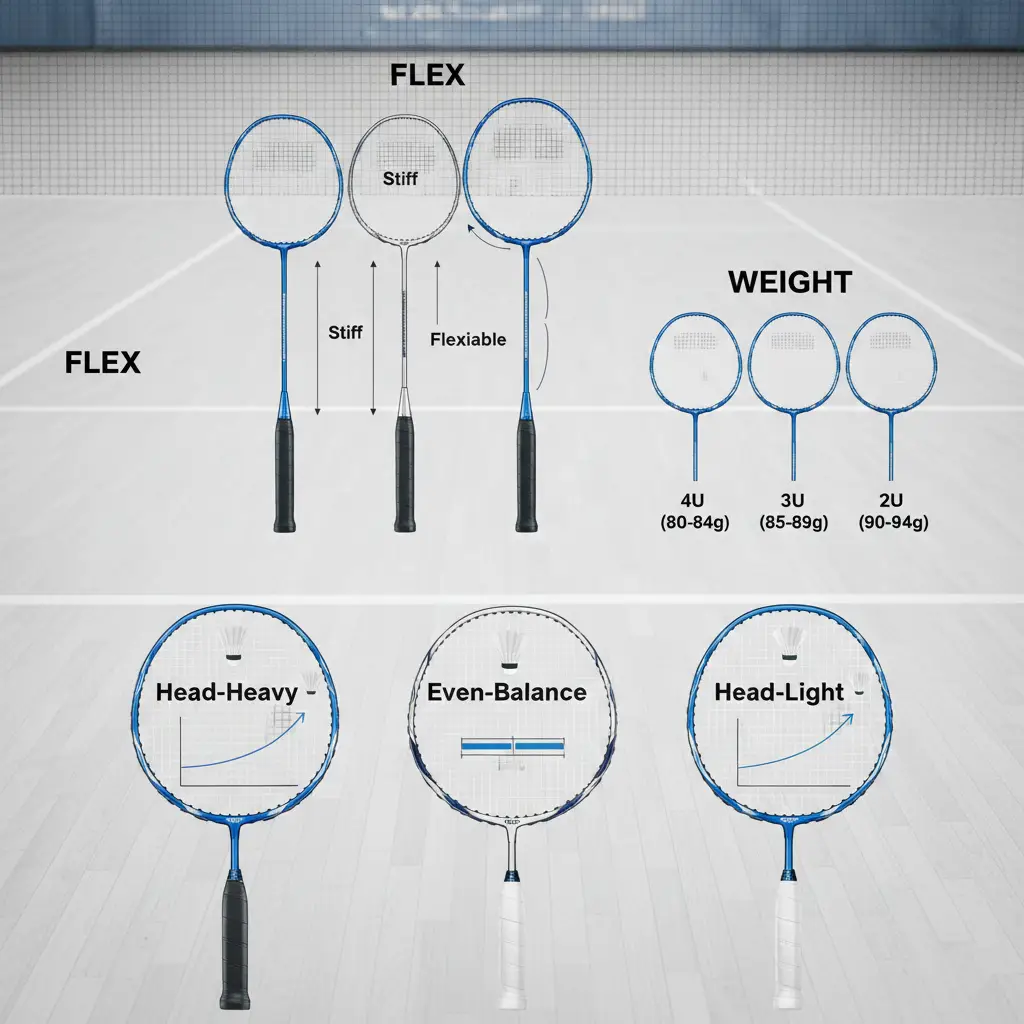
1.1 Racket Weight (2U / 3U / 4U / 5U)
Badminton rackets are categorized by weight classes:
2U: 90–94 grams
3U: 85–89 grams
4U: 80–84 grams
5U: 75–79 grams
Lighter rackets (4U, 5U):
Easier to maneuver
Faster reaction at the net
Less strain on the arm
Ideal for beginners and defensive players
Heavier rackets (3U, 2U):
More power on smashes
More stability during powerful shots
Suitable for strong attacking players
If you are just starting out, go lighter. Control and comfort matter more than raw power.
1.2 Racket Balance (Head-Heavy vs Head-Light vs Even)
The balance point determines where most of the weight sits in the racket.
Head-Heavy
More weight in the racket head
Generates powerful smashes
Best for attacking players
Head-Light
Weight concentrated toward the handle
Faster swing speed
Better for defense and quick rallies
Even Balance
Balanced between power and control
Suitable for all-round players
If you’re unsure about your playing style, start with an even balance racket. It offers the safest balance of power and maneuverability.
1.3 Shaft Flexibility (Flexible vs Stiff)
The shaft affects how efficiently the racket transfers energy during your swing.
Flexible Shaft:
Helps generate power with slower swing speeds
Larger sweet spot
Great for beginners
Stiff Shaft:
Offers better control and precision
Requires faster swing speed
Preferred by advanced players
Beginners should avoid very stiff rackets because they can reduce power and increase arm fatigue.
1.4 Grip Size (G1–G5)
Grip sizes usually range from G1 (largest) to G5 (smallest).
Smaller grips allow more wrist action
Larger grips provide more stability
Most players use G4 or G5
The correct grip size improves comfort and prevents injury. You should be able to hold the racket firmly without squeezing excessively.
2. Match the Racket to Your Playing Style
Choosing a racket based on how you play is more important than choosing based on brand or price.
2.1 Attacking / Power Players
If you enjoy smashing and finishing rallies aggressively:
Choose a head-heavy balance
Go for 3U weight
Pick a stiff or medium-stiff shaft
Use higher string tension (24–28 lbs)
This setup generates explosive power but requires proper technique.
2.2 Defensive / Speed Players
If your game focuses on fast reactions, quick drives, and net control:
Choose a head-light balance
Select 4U or 5U weight
Flexible or medium shaft
Moderate string tension
This improves maneuverability and reduces fatigue during long rallies.
2.3 All-Round Players
If you play a mix of attack and defense:
Choose even balance
3U or 4U weight
Medium stiffness
This provides a balanced combination of control, speed, and power.
3. Choosing the Right Racket Based on Skill Level
Your experience level plays a major role in selecting the right badminton racket.
3.1 Beginner Players
If you are learning footwork, grip technique, and basic strokes:
Choose lightweight (4U or 5U)
Flexible shaft
Even or head-light balance
Lower string tension (18–22 lbs)
A forgiving racket reduces injury risk and helps you develop proper technique.
Avoid very stiff or heavy rackets at this stage.
3.2 Intermediate Players
If you play regularly and understand your playing style:
Choose based on your preferred style (attack or control)
Medium stiffness shaft
3U or 4U weight
Slightly higher string tension
At this level, you can experiment more with balance preferences.
3.3 Advanced Players
Advanced players should select rackets that match:
Swing speed
Tactical role (singles or doubles)
Precision and control requirements
Most advanced players prefer:
3U weight
Stiff shaft
Higher string tension
However, at this level, the choice becomes highly personal and depends on feel and competitive requirements.
4. Understanding Strings and Tension
Many players focus only on the racket frame, but strings and tension significantly impact performance. The same racket can feel completely different depending on how it is strung.
4.1 What String Tension Means
String tension is measured in pounds (lbs). It refers to how tightly the strings are pulled when strung.
Lower tension = more power and larger sweet spot
Higher tension = more control and precision
4.2 Recommended String Tension by Skill Level
Beginner (18–22 lbs)
Larger sweet spot
More forgiving on off-center hits
Less strain on the arm
Easier power generation
Intermediate (22–26 lbs)
Balanced power and contro
Better shot placement
Suitable for developing technique
Advanced (26–30+ lbs)
Excellent control and precision
Smaller sweet spot
Requires proper technique and strong wrist action
Always check the manufacturer’s recommended maximum tension printed on the racket frame. Exceeding it may damage the racket.
4.3 String Type and Thickness
Strings vary in thickness (gauge).
Thinner strings:
Better feel and control
More repulsion (extra power)
Break more easily
Thicker strings:
More durable
Slightly less feel
Suitable for frequent players
If you are unsure, ask the stringing professional to recommend a balanced option for your skill level.
5. How to Test a Badminton Racket Before Buying
Choosing a racket based only on specifications is not enough. If possible, always test the racket before purchasing.
5.1 Check the Swing Feel
Hold the racket and perform a few shadow swings (without a shuttle).
Ask yourself:
Does it feel too heavy?
Is it easy to maneuver?
Does the head feel too loaded?
The racket should feel natural in your hand.
5.2 Test Clears and Smashes
If you have access to a demo court:
Try baseline clears to test power.
Hit a few smashes to check stability.
Notice vibration or discomfort.
A good racket should feel stable and controlled during powerful shots.
5.3 Test Net Play and Drives
Perform quick net taps and flat drives.
Check:
Reaction speed
Maneuverability
Control during fast exchanges
Head-light rackets usually feel faster at the net, while head-heavy rackets feel stronger on smashes
5.4 Check Grip Comfort
Your grip should feel comfortable and secure.
You should not:
Squeeze too tightly
Feel slipping
Experience wrist strain
Comfort is more important than brand reputation.
6. Buying Online vs In-Store
Where you buy your badminton racket can affect your overall experience.
6.1 Buying In-Store
Advantages:
You can hold and test the racket
Immediate purchase
Expert advice from staff
Possible demo rackets available
Disadvantages:
Limited selection
Sometimes higher prices
If you are a beginner, buying in-store can be helpful because you get professional guidance.
6.2 Buying Online
Advantages:
Wider range of models
Better discounts
Easy comparison of specifications
Disadvantages:
Cannot test before buying
Risk of choosing the wrong specs
Return policies may vary
If buying online:
Carefully read specifications
Check verified customer reviews
Confirm return and warranty policies
6.3 Which Option Is Better?
Beginners: Prefer in-store purchase if possible.
Intermediate/Advanced: Online buying is fine if you already know your preferred specifications.
The key is understanding your requirements before making the purchase.
7. Budget Guide and Brand Considerations
Your budget plays an important role when choosing the right badminton racket. However, expensive does not always mean better — especially if the racket does not match your skill level
7.1 Entry-Level Rackets (Budget Range)
These rackets are ideal for beginners and casual players.
Price Range: Low
Best For: Learning basic strokes and techniques
Features:
Lightweight construction
Flexible shaft
Forgiving sweet spot
Durable but basic materials
If you are just starting, avoid investing heavily in high-end rackets. Focus on comfort and learning proper technique first.
7.2 Mid-Range Rackets
These rackets are suitable for regular club players and intermediate-level athletes.
Price Range: Medium
Best For: Players developing consistent technique
Features:
Improved materials (graphite/carbon composite)
Better balance customization
Medium or stiff shaft options
Higher maximum string tension support
This category offers the best balance between performance and affordability.
7.3 Premium / Professional Rackets
Designed for competitive and advanced players.
Price Range: High
Best For: Tournament-level players
Features:
High-quality carbon materials
Advanced frame technology
Precise balance and stiffness options
Higher string tension tolerance
Premium rackets are designed for performance precision. However, they require proper technique to maximize benefits.
7.4 Popular Badminton Brands
Well-known badminton brands are trusted for quality and innovation. Some of the leading brands include:
Yonex
Li-Ning
Victor
Carlton
Babolat
Each brand offers rackets for beginners, intermediate, and professional players. Instead of choosing based on brand alone, focus on specifications that match your playing style.
8. Frequently Asked Questions (FAQs)
Below are commonly searched questions related to choosing a badminton racket.
Q1. What is the best badminton racket for beginners?
A lightweight (4U or 5U), flexible shaft racket with even or head-light balance is best for beginners. It provides comfort, easier power generation, and reduces injury risk.
Q2. Is a head-heavy racket better for smashing?
Yes, a head-heavy racket can generate more power during smashes because of the added momentum in the racket head. However, proper technique is still essential for effective power.
Q3. What string tension should I use?
Beginners: 18–22 lbs
Intermediate: 22–26 lbs
Advanced: 26–30+ lbs
Higher tension gives more control but requires better technique.
Q4. How do I know the right grip size?
Choose a grip size that feels comfortable and secure in your hand. Most players use G4 or G5. You should be able to hold the racket without squeezing too tightly.
Q5. How often should I replace my badminton racket?
Replace your racket if:
The frame is cracked
The shaft is bent
Performance significantly drops
It no longer matches your playing level
Proper care can extend a racket’s lifespan for several years.
Q6. Should I buy an expensive racket as a beginner?
No. Beginners should focus on comfort and flexibility rather than premium technology. As your skills improve, you can upgrade to higher-end models.
9. Final Thoughts: How to Choose the Right Badminton Racket
Choosing the right badminton racket is not about selecting the most expensive or most popular model. It is about finding a racket that complements your skill level, playing style, and physical comfort.
To summarize:
Beginners should prioritize lightweight and flexible rackets.
Attackers benefit from head-heavy rackets.
Defensive players prefer head-light rackets.
All-round players should consider even balance models.
Always choose the right string tension and comfortable grip size.
When possible, test the racket before buying. Comfort and feel matter more than technical specifications alone.
By understanding weight, balance, stiffness, grip size, and tension, you can confidently select a racket that enhances your performance and helps you enjoy the game even more.