Introduction
Mental training for badminton players is the difference between reacting emotionally and responding strategically under pressure. In high-speed rallies and tight match situations, physical skill alone is not enough. What separates consistent winners from inconsistent performers is mental strength — the ability to stay focused, composed, and confident regardless of the score.
Badminton is one of the fastest racket sports in the world. Players must track the shuttle at high speed, anticipate their opponent’s moves, make split-second tactical decisions, and execute precise shots — all while managing pressure and emotions. One small lapse in concentration can cost an entire rally. One emotional reaction can shift momentum.
Research in sport psychology shows that structured mental training techniques such as visualization, attention control, emotional regulation, and positive self-talk significantly improve competitive performance. Mental conditioning enhances reaction time, reduces anxiety, and increases confidence during high-pressure moments.
In this guide, you will learn:
Why mental training is critical in badminton
The psychological demands of competitive play
The core mental skills every badminton player must develop
Whether you are a beginner, intermediate, or tournament-level athlete, integrating mental training into your routine can dramatically improve consistency, confidence, and match control.
Why Mental Training Matters in Badminton
Badminton is not just a physical sport — it is a cognitive and psychological sport. Every rally challenges both the body and the mind.
1. Reaction Speed and Decision-Making
Badminton requires rapid visuomotor coordination. Players must track the shuttle, anticipate direction, decide on the correct response, and execute it within fractions of a second. Mental fatigue negatively affects reaction speed and decision accuracy. When players are mentally tired, their anticipation slows down, shot selection weakens, and unforced errors increase.
Mental training strengthens cognitive sharpness and helps maintain high-level performance even during long rallies and extended matches.
2. Managing Competitive Anxiety
Tournament settings naturally trigger pressure. Increased heart rate, muscle tension, shallow breathing, and negative thoughts can reduce technical precision. Without mental control strategies, anxiety interferes with timing and shot accuracy.
Structured mental training helps players:
Regulate breathing under pressure
Maintain composure after mistakes
Stay tactically aware in crucial moments
Players who actively train mental skills often report improved confidence and reduced match anxiety.
3. Consistency Under Pressure
Many athletes perform well in practice but struggle during competition. The difference lies in psychological pressure. Practice environments usually lack crowd noise, ranking consequences, and emotional intensity.
Mental training develops:
Emotional resilience
Quick recovery after losing points
Stable focus throughout the match
A mentally strong player resets immediately after an error. A mentally untrained player carries frustration into the next rally, increasing mistakes.
4. Focus and Attention Control
Selective attention is essential in badminton. Players must ignore distractions such as crowd noise, opponent behavior, previous mistakes, or scoreboard pressure.
Strong focus improves:
Shot timing
Anticipation
Defensive reactions
Tactical awareness
Mental training enhances attention control, allowing players to stay locked into each rally without mental drift.
In summary, physical training prepares the body. Mental training prepares the mind to execute skills under stress.
Core Mental Skills Every Badminton Player Needs
Mental training for badminton players focuses on developing specific psychological skills. These skills are trainable and improve with consistent practice.
1. Focus and Selective Attention
Sustained concentration throughout rallies is critical. Badminton demands intense awareness of shuttle trajectory, opponent positioning, and court spacing.
Training focus improves:
Faster reaction to smashes and drop shots
Better defensive positioning
Reduced unforced errors
Attention drills and concentration exercises help players remain mentally engaged from the first point to the last.
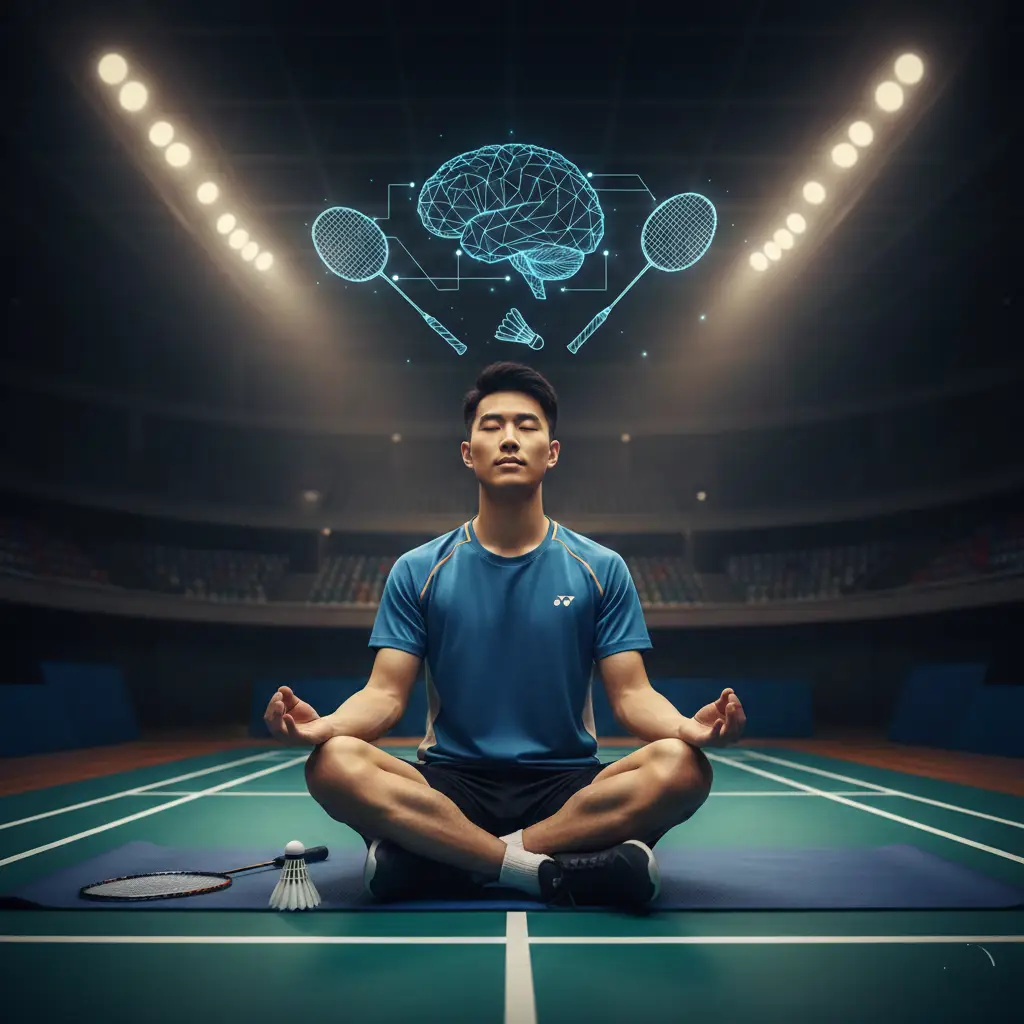
2. Visualization (Mental Imagery)
Visualization is one of the most powerful techniques in sport psychology. It involves mentally rehearsing movements, match situations, and successful outcomes before physically performing them.
Effective visualization includes:
Seeing the court clearly
Feeling movement patterns
Imagining successful execution of smashes, net kills, and defensive saves
Mentally rehearsing calm responses after mistakes
When imagery is realistic and detailed, the brain activates neural pathways similar to actual performance. This strengthens confidence and improves technical consistency.
For example, before a match, a player can visualize:
Walking confidently onto the court
Winning long rallies
Executing a precise cross-court smash
Maintaining composure after losing a point
Regular visualization builds mental familiarity with competitive situations.
3. Positive and Instructional Self-Talk
Every athlete has internal dialogue. The quality of that dialogue directly influences performance.
Negative self-talk:
“I always miss this shot.”
“He’s better than me.”
“I’m losing control.”
Constructive self-talk:
“Focus on footwork.”
“One point at a time.”
“Stay low, stay ready.”
Instructional self-talk improves technical execution. Motivational self-talk strengthens emotional resilience.
Developing controlled, purposeful self-talk reduces panic and increases clarity during tight rallies.
4. Emotional Regulation
Mistakes are inevitable in badminton. The key is not avoiding errors — it is responding correctly to them.
Emotionally skilled players:
Accept mistakes quickly
Avoid visible frustration
Maintain tactical awareness
Keep body language confident
Techniques for emotional regulation include:
Three-second deep breathing reset
Short cue words such as “Reset,” “Calm,” or “Next point”
Controlled posture and steady eye contact
Opponents often read emotional signals. Stable body language maintains psychological advantage.
5. Pre-Point and Pre-Match Routines
Consistency builds confidence. Structured routines create mental stability before and during matches.
A simple pre-point routine may include:
Take a deep breath
Visualize serve placement
Repeat a focus cue word
Assume ready position
Pre-match routines may include light visualization, breathing exercises, and reviewing tactical plans.
Routines reduce anxiety, enhance concentration, and create psychological readiness for competition.
6. Goal Setting (Process Over Outcome)
Outcome goals such as “I must win” increase pressure. Process goals improve performance.
Examples of process goals:
Maintain low center of gravity
Attack opponent’s backhand
Extend rallies beyond eight shots
Keep consistent net pressure
Focusing on process goals reduces anxiety and improves tactical clarity. Over time, process consistency leads to better match outcomes.
8 Practical Mental Training Drills and Routines
Mental skills improve with structured practice. Below are eight practical mental training drills badminton players can integrate into weekly training sessions.
1. Focus Window Drill
Purpose: Improve sustained concentration during rallies.
Duration: 10–15 minutes
Frequency: 2–3 times per week
How to perform:
Play short rallies with maximum focus for 60 seconds.
During the rally, focus only on shuttle trajectory and footwork.
Rest for 30 seconds.
Repeat for 6–8 rounds.
This drill trains the brain to maintain high attention intensity and prevents mental drift during long matches.
2. Structured Visualization Session
Purpose: Improve confidence and tactical clarity.
Duration: 5–10 minutes before practice or matches
Frequency: 4–5 times per week
Steps:
Sit comfortably and close your eyes.
Visualize the court environment clearly.
Mentally rehearse key movements — smashes, net kills, defensive lifts.
Imagine responding calmly after losing a point.
Finish by visualizing winning a tight rally.
The more realistic and detailed the imagery, the stronger its impact on performance.
3. Controlled Adversity Training
Purpose: Build emotional resilience under pressure.
Duration: 15–20 minutes
Frequency: Once or twice per week
How to perform:
Start practice games at 15–19 (down by four points).
Play short sets with scoring pressure.
Focus on staying calm and tactical.
Training under artificial pressure conditions prepares the mind for tournament stress.
4. 7-Step Pre-Match Routine
Purpose: Reduce anxiety and improve readiness.
Duration: 5–7 minutes before match
Routine Example:
Light physical warm-up
Deep breathing (5 slow breaths)
Visualize first three rallies
Review tactical plan
Repeat focus cue word
Maintain confident posture
Enter court calmly
Consistency in pre-match routines creates psychological stability.
5. Between-Point Reset Breathing
Purpose: Quick emotional control after mistakes.
Duration: 3–5 seconds between points
Method:
Inhale through nose for 3 seconds.
Exhale slowly for 3 seconds.
Mentally say: “Next point.”
This prevents emotional carryover into the next rally.
6. Reaction and Dual-Task Drill
Purpose: Enhance cognitive sharpness under movement.
Duration: 10 minutes
How to perform:
Coach calls random directions while player performs footwork.
Player must react instantly while maintaining correct posture.
Increase speed gradually.
This strengthens reaction time and mental adaptability.
7. Video Decision Training
Purpose: Improve tactical anticipation.
Duration: 15 minutes weekly
Method:
Watch recorded match clips.
Pause before opponent’s shot.
Predict shot direction and response.
This improves reading ability and strategic awareness.
8. Post-Session Reflection Journal
Purpose: Improve self-awareness and mental growth.
Duration: 5 minutes after training
Questions to answer:
When did I lose focus today?
How did I respond to mistakes?
What mental cue worked best?
Reflection reinforces learning and builds long-term mental discipline.
Weekly Mental Training Plan Example (8-Week Structure)
Mental skills improve progressively, just like physical conditioning. Below is a simple weekly framework.
Weeks 1–2: Foundation Phase
Focus Window Drill (2x/week)
Visualization (3x/week)
Between-Point Reset Practice
Goal: Build awareness and basic focus control.
Weeks 3–4: Pressure Integration
Controlled Adversity Training (1–2x/week)
Visualization before practice
Begin reflection journaling
Goal: Improve emotional control under mild pressure.
Weeks 5–6: Competitive Simulation
Pressure games starting at disadvantage scores
Full pre-match routine practice
Video decision training
Goal: Develop tournament-level psychological readiness.
Weeks 7–8: Performance Optimization
Combine all techniques in full match simulations
Focus on consistency and emotional stability
Reduce volume but maintain intensity
Goal: Sharpen mental execution for competition.
Consistency is more important than duration. Even 10–15 minutes of focused mental training per session can create significant improvements over time.
How Coaches Should Integrate Mental Training into Practice
Coaches play a critical role in developing mental strength in badminton players. Mental training should not be separate from physical practice — it should be integrated.
1. Add Mental Cues During Drills
During footwork or smash drills, coaches can reinforce focus cues such as:
“Stay low.”
“Reset quickly.”
“Next shot focus.”
This connects mental and technical training.
2. Simulate Match Pressure
Introduce:
Score disadvantages
Timed rallies
Consequence-based drills
This builds resilience and prepares athletes for tournament stress.
3. Encourage Emotional Control
Coaches should:
Model calm behavior
Reinforce positive body language
Provide constructive feedback after mistakes
Athletes often mirror their coach’s emotional tone.
4. Monitor Mental Fatigue
Mental exhaustion reduces reaction speed and decision-making quality. Signs include:
Slower responses
Increased frustration
Loss of concentration
When these appear, short breaks or breathing resets should be introduced.
Common Mental Training Mistakes Badminton Players Must Avoid
Even with the right intentions, many players make mistakes while implementing mental training. Avoiding these errors ensures consistent psychological growth.
1. Treating Mental Training as Optional
Many athletes focus only on physical drills and ignore mental conditioning. Mental training should be structured and scheduled just like footwork, smash drills, or endurance sessions.
Consistency creates results.
2. Practicing Visualization Incorrectly
Visualization must be realistic and detailed. Simply “thinking about winning” is not effective.
Effective imagery includes:
Realistic court environment
Tactical scenarios
Emotional control after errors
Physical sensations of movement
Vague visualization produces limited performance benefits.
3. Overtraining Mentally
Just like physical fatigue, mental fatigue affects reaction speed and decision-making. Long sessions of intense concentration without recovery can reduce performance.
Balance focus drills with short breaks and recovery strategies such as breathing exercises.
4. Ignoring Emotional Control
Some players work on tactics and skills but neglect emotional regulation. Visible frustration, negative body language, or arguing with oneself gives psychological advantage to the opponent.
Mental discipline includes emotional discipline.
5. Focusing Only on Winning
Outcome-focused thinking increases pressure. Instead of obsessing over match results, focus on process goals:
Footwork quality
Shot selection
Consistent net control
Staying calm between points
Process consistency leads to long-term success.
Match-Day Mental Checklist (Before, During & After Match)
A structured mental checklist helps players stay composed throughout competition.
Before the Match
Complete light physical warm-up
Practice 5 minutes of visualization
Review tactical strategy
Perform deep breathing (5 slow breaths)
Repeat focus cue word (e.g., “Calm and sharp”)
Maintain confident posture while entering court
Goal: Enter the match mentally prepared and emotionally stable.
During the Match
Focus on one rally at a time
Use 3-second breathing reset after each point
Avoid scoreboard fixation
Maintain strong body language
Repeat process-focused cues (“Stay low”, “Quick feet”)
Goal: Stay present and prevent emotional carryover.
After the Match
Reflect on mental performance
Identify moments of strong focus
Note emotional triggers
Plan improvements for next session
Goal: Continuous mental development.
Conclusion
Mental training for badminton players is not an advanced luxury reserved for elite athletes — it is a fundamental component of performance development. In a sport where matches are decided by milliseconds, the mind becomes the deciding factor.
By developing focus, visualization skills, emotional control, structured routines, and process-based goals, players can significantly improve their consistency and confidence. Mental strength allows athletes to recover quickly after mistakes, handle pressure effectively, and maintain tactical clarity during long rallies.
Physical training builds strength and endurance.
Mental training builds composure and resilience.
Together, they create complete badminton athletes.
Start integrating structured mental drills into your weekly routine and treat psychological conditioning with the same seriousness as technical practice. Over time, the results will become visible not only in match performance but also in confidence and consistency.
Frequently Asked Questions (FAQ)
1. How long does mental training take to show results?
Most players begin noticing improvements in focus and emotional control within 2–4 weeks of consistent practice. Long-term benefits such as improved match composure typically develop over 6–8 weeks.
2. Can mental training reduce unforced errors?
Yes. Improved attention control and emotional regulation reduce rushed decisions and frustration-based mistakes, leading to fewer unforced errors during matches.
3. How often should badminton players practice visualization?
Visualization can be practiced 4–5 times per week for 5–10 minutes. Short daily sessions are more effective than occasional long sessions.
4. Is breathing training useful during a match?
Yes. Controlled breathing between points helps lower heart rate, reduce anxiety, and restore focus before the next rally.
5. Do beginner players need mental training?
Absolutely. Developing mental discipline early creates stronger long-term performance habits. Beginners benefit from focus drills and simple pre-point routines.
6. Can mental fatigue affect badminton performance?
Yes. Mental fatigue slows reaction time, reduces decision accuracy, and increases mistakes. Balanced training and recovery are essential to maintain cognitive sharpness.