
Understanding Badminton Scoring System — Rules, Examples & Common Questions
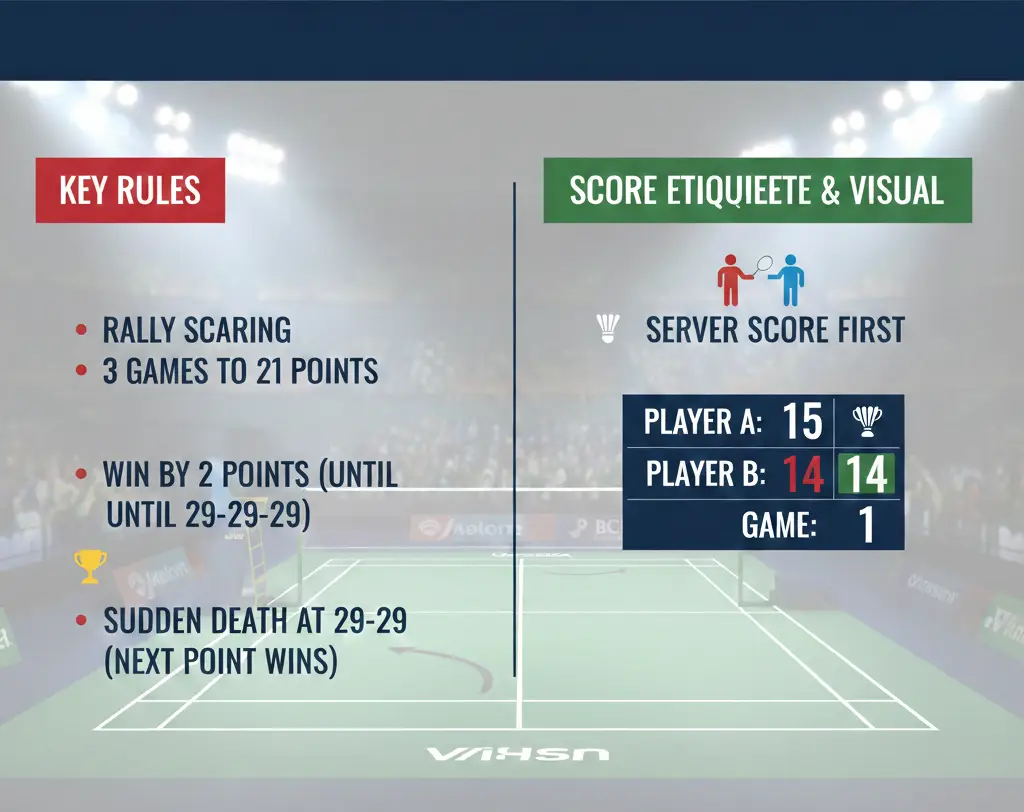
The modern badminton scoring system follows a rally-point format: best of 3 games to 21 points, with a two-point lead required and a cap at 30 points.
Badminton is one of the fastest racket sports in the world, and understanding its scoring system is essential whether you are a beginner, club player, or competitive athlete. The current format is designed to make matches more exciting, fair, and time-efficient.
The official rules are governed by the Badminton World Federation (BWF), the global authority responsible for regulating international badminton competitions. This guide clearly explains how the scoring system works today, including key rules for singles and doubles play.
1. What Is the Badminton Scoring System Today?
The modern badminton scoring system uses the rally-point format, which means a point is awarded on every rally — regardless of which side served.
Here are the core rules:
Best of Three Games
A standard badminton match is played as the best of three games.
The first player or team to win two games wins the match.
If one side wins the first two games, the third game is not played.
If both sides win one game each, a deciding third game is played.
21-Point Game Format
Each game is played to 21 points. However, simply reaching 21 does not automatically mean the game is over.
For example:
If the score is 21–18, the game ends.
If the score is 21–20, play continues because a two-point lead is required.
Rally-Point Scoring
Under the rally-point system:
A point is awarded after every rally.
The side that wins the rally earns one point.
The side that wins the rally also serves next (or continues serving).
This system replaced the older serve-only scoring method and is now used in all professional tournaments, including international championships and the Olympic Games.
2. Quick Rules: Scoring in Singles vs Doubles
Although the 21-point rally system applies to both singles and doubles, the serving rotation rules differ slightly between the two formats.
A. Scoring in Singles
In singles, scoring and service positions are straightforward.
Key rules:
If a player's score is even (0, 2, 4, 6…), they serve from the right service court.
If the score is odd (1, 3, 5, 7…), they serve from the left service court.
If the server wins the rally, they score a point and continue serving from the alternate service court.
If the server loses the rally, the opponent scores a point and gains the serve.
Example:
If the score is 4–2, the player with 4 points serves from the right side (even number).
If they win the rally, the score becomes 5–2, and they serve from the left side (odd number).
This alternating pattern continues throughout the game.
B. Scoring in Doubles
Doubles follows the same 21-point rally scoring format but includes a specific service rotation system.
Important rules:
Only one player serves at a time.
There is no second server (unlike older scoring systems).
If the serving team wins the rally, they score a point and the same server continues serving, switching service courts.
If the receiving team wins the rally, they score a point and gain the right to serve.
In doubles:
Even team score → serve from the right service court.
Odd team score → serve from the left service court.
Players must maintain their correct service order throughout the game. Mistakes in rotation can result in confusion or faults during competitive matches.
3. Deuce, Setting & the 30-Point Cap — Explained with Examples
Understanding what happens at 20–20 is crucial in badminton because this is where many games are decided.
What Happens at 20–20? (Deuce Situation)
When both sides reach 20 points, the game enters a deuce situation.
At this stage:
A player or team must lead by two clear points to win the game.
The game continues until a two-point advantage is achieved.
Example progression:
20–20
21–20
21–21
22–21
23–21 → Game ends (two-point lead achieved)
The two-point rule ensures fairness and prevents games from ending on a narrow one-point difference at 21–20.
What Happens at 29–29?
If neither side manages to secure a two-point lead and the score reaches 29–29, the next rally decides the winner.
The first side to reach 30 points wins.
A two-point lead is no longer required at 29-all.
Final possible score: 30–29.
This 30-point cap prevents games from continuing indefinitely and ensures match duration remains manageable.
Why Deuce Situations Are Important
Deuce situations test a player’s mental strength and strategic decision-making.
During these final rallies:
Players often reduce unforced errors.
Shot selection becomes more controlled.
Risk management becomes crucial.
Focus and composure determine the outcome.
In high-level competitions governed by the Badminton World Federation, many matches are decided in deuce situations, making this rule one of the most important aspects of the badminton scoring system.
4. Detailed Scoring Examples (Step-by-Step Breakdown)
Understanding theory is helpful, but seeing real scoring sequences makes the badminton scoring system much clearer. Below are simple examples for both singles and doubles.
Example 1: Singles Match (Basic Rally Progression)
Player A vs Player B
Game starts at 0–0.
Player A serves from the right service court (even score).
Player A wins the rally → Score becomes 1–0.
Player A now serves from the left court (odd score).
Player B wins the next rally → Score becomes 1–1.
Player B gains the serve and serves from the right court (even score).
The process continues with:
One point awarded per rally.
Serve switching to the rally winner.
Service court depending on whether the score is even or odd.
Example 2: Doubles Match (Service Rotation Example)
Team X (Player X1 and X2) vs Team Y (Player Y1 and Y2)
Score starts at 0–0.
X1 serves from the right court.
Team X wins rally → Score 1–0.
X1 switches to the left court and serves again.
Team Y wins rally → Score 1–1.
Team Y now serves from the right court (even score).
Important doubles reminders:
Only one server per turn.
The serving team continues serving as long as they win rallies.
Service court depends on team score (even = right, odd = left).
Example 3: Deuce Scenario
Score reaches 20–20.
Player A wins rally → 21–20.
Player B wins rally → 21–21.
Player A wins two consecutive rallies → 23–21.
Player A wins the game because they achieved a two-point lead after 20-all.
If the score reaches 29–29:
The next rally decides the game.
Final score could be 30–29.
These examples show how simple yet strategic the rally-point scoring system is in modern badminton.
5. Common Scoring Mistakes Beginners Make
Many beginners struggle with scoring because they confuse it with older badminton rules or misunderstand service rotation. Below are the most common mistakes.
1. Thinking Only the Server Can Score
This was true in the old scoring system, but not anymore.
Under the rally-point system, a point is awarded after every rally — regardless of who served.
2. Forgetting the Even/Odd Service Rule
Players often forget:
Even score → serve from the right court.
Odd score → serve from the left court.
This mistake can disrupt rhythm and create confusion during matches.
3. Misunderstanding Deuce Rules
Some players believe the game ends at 21 automatically.
However, if the score reaches 20–20, a two-point lead is required unless it reaches 29–29.
4. Doubles Rotation Errors
In doubles, players sometimes:
Serve from the wrong court.
Forget whose turn it is to serve.
Switch positions incorrectly.
Maintaining proper service order is essential, especially in competitive tournaments.
5. Losing Focus During Score Changes
Because points are awarded after every rally, matches can change momentum quickly. Players who fail to track the score accurately may lose tactical control.
Avoiding these common mistakes will improve both your confidence and match performance.
6. How the Badminton Scoring System Changed Over Time
The badminton scoring system has evolved significantly to make the sport faster and more television-friendly.
Traditional Scoring System (Before 2006)
Earlier, badminton used a serve-only scoring system:
Only the serving side could score points.
Men’s singles and doubles games were played to 15 points.
Women’s singles were played to 11 points.
Doubles allowed a second server before service changed sides.
This format often resulted in longer and less predictable matches.
Introduction of the Rally-Point System
In 2006, the Badminton World Federation (BWF) officially introduced the 21-point rally scoring system.
Major changes included:
Point awarded on every rally.
Standardized 21-point format for all categories.
Removal of the second server in doubles.
More predictable match durations.
This change improved:
Spectator experience.
Television broadcasting schedules.
Competitive fairness across formats.
Recent Discussions and Trials
Over the years, the BWF has tested alternative scoring formats, including:
5 games to 11 points.
3 games to 15 points (with potential setting rules).
These proposals aim to make matches shorter and more dynamic. However, the 3 × 21 rally-point system remains the official format used in most international competitions today.
Understanding the history of scoring helps players appreciate why the current system is structured the way it is — balancing fairness, excitement, and match duration.
7. Possible Future Rule Updates & What They Mean for Players
Badminton continues to evolve as the sport adapts to modern broadcasting demands, player workload concerns, and spectator engagement. The Badminton World Federation (BWF) has periodically tested alternative scoring systems to improve match flow and reduce duration.
Proposed 3 × 15 Scoring Format
One of the most discussed proposals includes:
Best of three games
Each game played to 15 points
Possible two-point lead requirement (depending on finalized regulations)
This format aims to:
Shorten match duration
Increase match intensity
Create more decisive and faster-paced games
Previous Trials (5 × 11 System)
In earlier years, the BWF tested:
Five games to 11 points
Shorter, more explosive games
Reduced recovery time between games
While these experiments generated discussion, the 3 × 21 rally-point system remains the official format used in most international tournaments.
What Future Changes Could Mean for Players
If rule changes are officially adopted, players may need to:
Adapt match strategy for shorter games
Start aggressively from the first rally
Reduce slow starts, as recovery time between games would be limited
Increase mental sharpness in early points
For now, the 21-point rally scoring system remains the global standard. However, players and coaches should stay updated on official announcements from the Badminton World Federation.
8. Coaching Tips: Scoring Strategy & Match Management
Understanding scoring rules is important — but knowing how to use them strategically can make a real difference in match performance.
1. Play Smart at 18–20 Points
The final three points before 21 are often the most crucial.
Avoid risky smashes unless you have a clear opening.
Focus on consistency rather than power.
Force your opponent into making errors.
Many games are decided by unforced mistakes in these closing rallies.
2. Managing Deuce Situations (20–20)
At deuce:
Slow the game down mentally.
Focus on one rally at a time.
Choose high-percentage shots.
Avoid emotional decision-making.
Players who remain calm under pressure typically win deuce battles.
3. Use the Serve as a Tactical Weapon
Because every rally results in a point:
A strong, accurate serve can give immediate advantage.
Variation in serve placement keeps opponents guessing.
In doubles, short serves and tight net control are critical.
4. Score Awareness Improves Strategy
Top players constantly track:
Their own score
Opponent’s momentum
When to attack and when to defend
For example:
Leading 19–15 → Play controlled and reduce errors.
Trailing 15–19 → Increase pressure and take calculated risks.
Scoring awareness allows players to adjust tactics based on match situation rather than playing the same style throughout.
9. Frequently Asked Questions (FAQ)
How many points are required to win a badminton game?
A player or team must reach 21 points and lead by at least two points. If the score reaches 29–29, the first side to reach 30 points wins the game.
Is a point scored on every rally?
Yes. Modern badminton uses the rally-point system, meaning a point is awarded after every rally, regardless of who served.
What happens at 20–20 in badminton?
When the score reaches 20–20, the game continues until one side gains a two-point lead. For example, 22–20 or 23–21. If the score reaches 29–29, the next point wins.
Are scoring rules different for men and women?
No. Both men’s and women’s singles and doubles follow the same 21-point rally scoring format.
How many games are played in a badminton match?
A standard match is best of three games. The first player or team to win two games wins the match.
Why was the old scoring system changed?
The previous serve-only scoring system was replaced to make matches shorter, more predictable in duration, and more exciting for spectators and broadcasters.
Conclusion
The badminton scoring system is simple in structure but strategic in execution. Matches are played as the best of three games, each game to 21 points, with a required two-point lead and a maximum cap at 30 points.
Whether you are a beginner learning the basics or a competitive player refining your match tactics, understanding rally-point scoring, service rules, and deuce situations will significantly improve your performance and confidence on the court.
Master the scoring system — and you master the flow of the game.