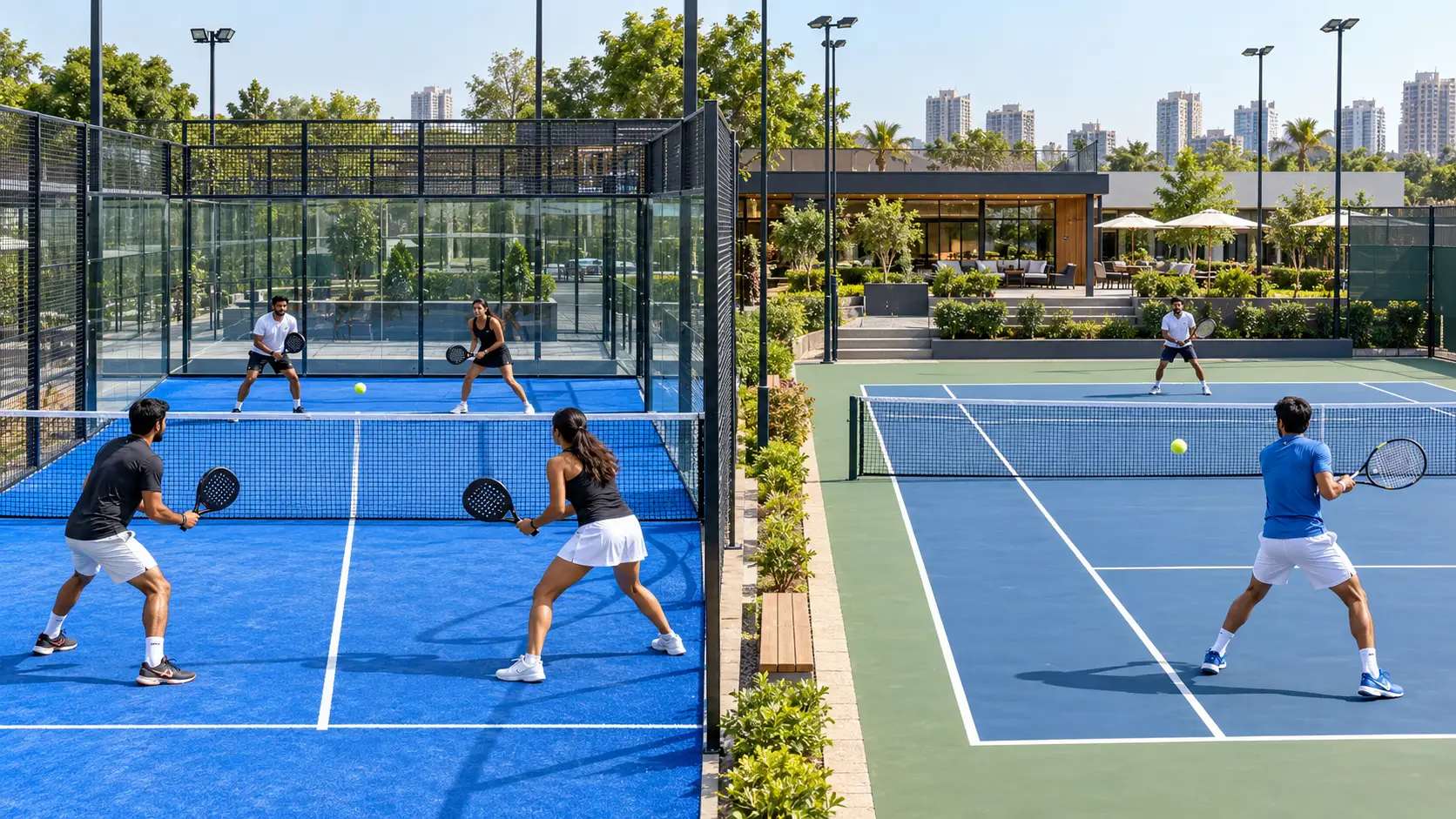
At first glance, padel looks like tennis played inside a glass box. Both sports use rackets, a ball, a net and a familiar scoring system. Watch a few rallies, however, and the differences become obvious. Padel players use the surrounding walls, work closely with a partner and rely heavily on positioning. Tennis gives players more open space and places greater emphasis on serving, groundstrokes and covering the court.
If you're trying to understand padel vs tennis before choosing which sport to play, the biggest differences involve court size, equipment, serving rules, wall rebounds and playing style. These differences affect everything from your first lesson to how you win a point.
Padel, sometimes called padel tennis, shares several features with traditional tennis but is a separate sport with its own rules. This guide compares 10 important differences and explains which game might suit you better, especially if you're planning to start playing in India.
Padel vs Tennis: Quick Comparison
Here's a side-by-side look at the main differences between padel and tennis.
Feature | Padel | Tennis |
Court dimensions | 20 m × 10 m | 23.77 m × 8.23 m (singles) or 23.77 m × 10.97 m (doubles) |
Court enclosure | Enclosed with playable walls and fencing | Open playing court without rebound walls |
Usual format | Doubles, four players | Singles or doubles |
Racket | Short, solid, perforated face | Longer frame with strings |
Ball | Padel-specific pressurised ball | Tennis ball meeting tennis specifications |
Serve | Ball bounced before contact; struck at or below waist height | Ball struck before bouncing, usually with an overhead action |
Scoring | 15, 30, 40; several approved deciding-point formats | 15, 30, 40; conventional advantage scoring and approved alternatives |
Playing style | Wall rebounds, placement and doubles coordination | Groundstrokes, serves, movement and shot variation |
1. Court Size: Is a Padel Court Smaller Than a Tennis Court?
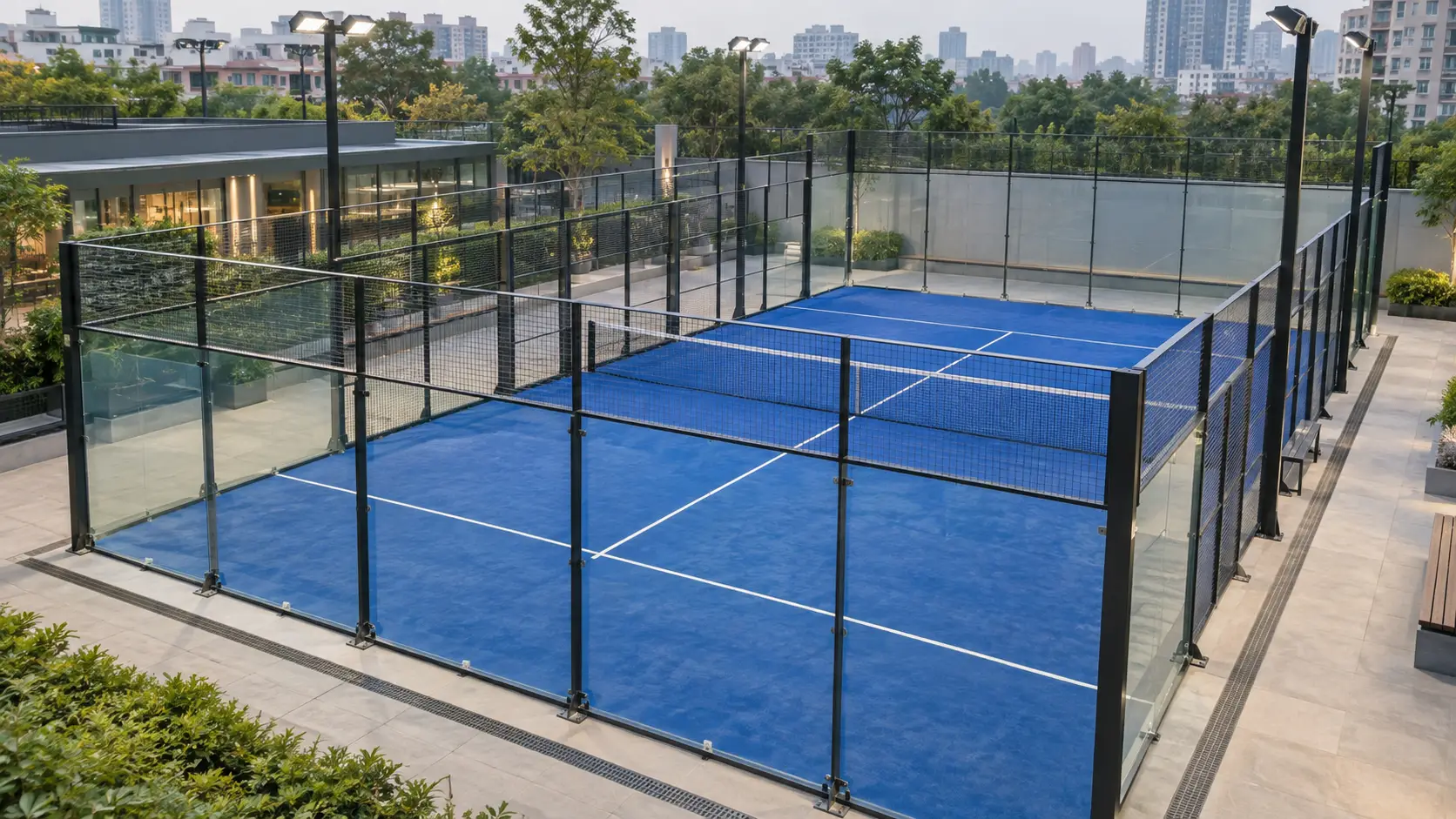
Yes. A regulation padel court measures 20 metres long and 10 metres wide, covering 200 square metres of playing surface. The court is divided into two halves by a net, with service boxes marked on each side.
A regulation tennis court measures 23.77 metres in length. Its width is 8.23 metres for singles and 10.97 metres for doubles. Although the singles court is narrower than a padel court, the tennis playing area is longer, and the doubles court has a larger total playing area.
These measurements help explain why the two games feel different. Padel players cover a relatively compact enclosed area, while tennis players generally need to move across longer distances, particularly when retrieving deep shots.
The nets also differ slightly. A regulation padel net is 0.88 metres high at the centre, while a tennis net is approximately 0.914 metres high at the centre.
What this means for beginners: Padel's compact court can make early rallies feel more manageable, but a smaller court does not make the game effortless. Rebounds and quick changes in direction introduce challenges of their own.
For a closer look at the markings, playing zones and net measurements, read Rackonnect's guide to padel court dimensions and glass walls.
2. Glass Walls: The Biggest Difference in Gameplay
The most distinctive feature of padel is its enclosed court. The surrounding glass or other permitted solid walls and metal fencing are not simply boundaries. They influence how rallies develop.
During a padel rally, the ball can bounce on your side of the court, rebound from a permitted wall and still be returned before its second bounce on the ground. Players can also use their own wall to send a legal return towards the opponents' playing area.
For example, imagine your opponent hits a deep ball towards the back of the court. In tennis, you generally need to reach the ball before it bounces twice. In padel, you may be able to let it bounce, wait for the rebound off the back glass and then play your return.
There is an important restriction: a return cannot hit the opponents' wall or metal fence directly before landing in their court. It must first make a legal landing in the opponents' playing area.
Tennis has no equivalent system of playable rebound walls. Once a shot lands outside the relevant court boundaries, or strikes a permanent fixture before landing legally in the opponent's court, the rally is decided according to tennis rules.
Why it matters: Padel rewards players who read rebounds and anticipate angles. Tennis rewards players who cover open space and control where the ball lands.
3. Singles vs Doubles: How Many Players Do You Need?
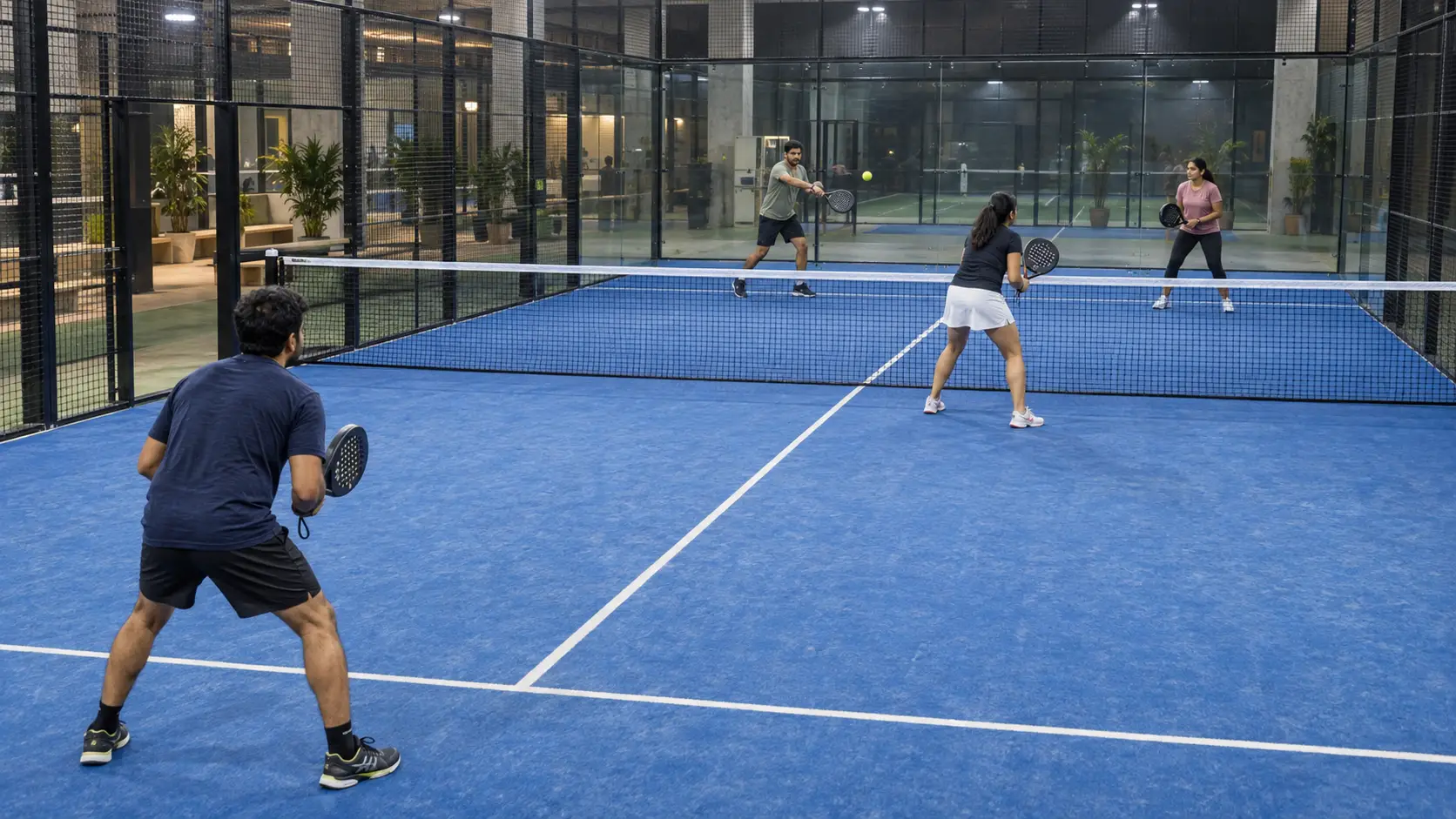
Standard competitive padel is played in doubles, with two players on each side of the net. Partners share responsibility for defending, attacking and covering the centre of the court.
Tennis supports both singles and doubles as established competitive formats. Singles requires one player to cover the applicable court width alone, while doubles introduces teamwork and different positioning.
In padel, a typical doubles team moves together. When both players advance towards the net, they can reduce the opponents' available angles. When pushed backwards by a lob, they often retreat together to defend.
This coordination makes communication particularly important. Calling shots, deciding who covers the middle and avoiding gaps between partners can be just as valuable as hitting harder.
Specialised narrower singles padel courts do exist, but the standard regulation court and the main competitive format are designed for doubles.
Which is better? Choose padel if you specifically want a four-person team game. Choose tennis if you value the option of playing either singles or doubles.
4. Padel Racket vs Tennis Racket: Design and Control
The difference between a padel racket and a tennis racket is easy to recognise.
A tennis racket has an open frame fitted with tightly tensioned strings. Its longer handle and string bed allow players to generate a wide range of spin, power and ball trajectories.
A padel racket is shorter and has a solid hitting surface with perforations rather than strings. Padel rackets commonly use composite materials such as fibreglass or carbon fibre, with a foam or EVA-based internal core.
Under international padel regulations, a racket may be no longer than 45.5 centimetres. An approved safety cord attached to the handle must be worn around the wrist during play.
Padel rackets are also available in different shapes:
Round: Often chosen by beginners who prefer a manageable balance and forgiving hitting area.
Teardrop: A versatile option for players seeking a balance of control and attacking performance.
Diamond: Frequently designed for players who prefer a higher balance and an attacking style.
Actual performance also depends on racket weight, balance, construction and individual technique, not shape alone.
If you want to understand the materials before purchasing, explore Rackonnect's padel racket materials and equipment guide.
5. Padel Ball vs Tennis Ball: Are They Interchangeable?
Padel balls and tennis balls look similar. Both usually have a felt-covered rubber construction and are commonly yellow, but they are regulated under different equipment specifications.
Under the International Padel Federation's 2026 rules, an official padel ball has a diameter of 6.35–6.77 centimetres and weighs 56.0–59.4 grams. Tennis balls must comply with the applicable International Tennis Federation specifications for their ball type.
The difference is not simply the colour or appearance. Ball dimensions, internal pressure, rebound characteristics and construction affect how a ball behaves during play.
Padel balls are designed to work with the sport's enclosed court and rebound-based gameplay. Tennis balls are designed for the playing conditions and ball standards used in tennis.
Can you use a tennis ball for padel? A tennis ball may be usable for casual practice, but it should not automatically be treated as a regulation padel ball. For matches played under padel rules, use balls that meet the appropriate padel specifications.
Beginners should check whether balls and rackets are provided by the venue before purchasing their own equipment.
6. Serving Rules: Bounce Serve vs Tennis Serve
The serving method is one of the clearest differences between padel and tennis.
How serving works in padel
In padel, the server stands in the correct service position behind the service line, bounces the ball on their side and strikes it at or below waist height. At least one foot must remain in contact with the ground at the moment of contact.
The serve travels diagonally over the net into the correct opponent's service box. Players alternate service sides after each point, and a second serve is allowed if the first attempt is a fault.
A legal serve can bounce in the receiver's service box and then strike the glass. However, a serve that lands correctly and subsequently touches the metal fence before its second bounce is a fault.
How serving works in tennis
In tennis, the server strikes the ball before it bounces, usually after tossing it into the air and using an overhead service motion. Underarm serves are also permitted when performed legally.
The serve must land in the diagonally opposite service court. As in padel, players normally have two service attempts to start the point successfully.
Tennis serves can place substantial emphasis on pace, spin and placement. Padel serves are generally more focused on creating a useful position for the next shot and helping the serving team approach the net.
Beginner takeaway: Padel's bounce-before-contact serve may be easier for some newcomers to learn initially. Tennis serving often requires more practice to develop a consistent toss, timing and contact point.
7. Scoring Rules: Is Padel Scored Like Tennis?
Padel and tennis share the familiar points progression of 15, 30 and 40. Both also use games and sets, which means tennis players can recognise much of the padel scoreboard immediately.
Under conventional advantage scoring, a game tied at 40–40 reaches deuce. One side must then win two consecutive points to take the game. A typical set is won by reaching six games with at least a two-game lead, with a tie-break commonly used at 6–6.
However, not every padel competition uses the same deciding-point procedure. The 2026 International Padel Federation rules recognise advantage scoring, golden point and a Star Point alternative. Competition organisers determine which permitted format applies.
Tennis also uses conventional advantage scoring, while certain competitions adopt approved alternatives such as no-ad scoring or match tie-breaks.
This makes scoring one of the similarities between the sports rather than their biggest difference. The important practical step is to confirm the scoring format before starting a match or entering a tournament.
8. Playing Style: Why Padel and Tennis Rallies Feel Different
In tennis, successful rallies often involve powerful or well-placed groundstrokes, serves, changes in direction, spin and movement between the baseline and net.
Padel has its own attacking shots, but the presence of walls makes patience, placement, court positioning and shot selection particularly important.
For example, a tennis player might respond to a shorter ball with an aggressive groundstroke. In padel, a player may choose a controlled lob to move the opposing team away from the net, creating a chance to advance.
Padel also has specialised shots such as the bandeja, a controlled overhead commonly used to handle lobs while maintaining a favourable court position.
Because the ball can rebound from the walls, hitting harder is not always the most effective option. A powerful shot may give the opponent a useful rebound rather than end the rally.
Players transitioning from tennis frequently need to shorten their swings, become comfortable waiting for wall rebounds and learn to move with a partner.
Rackonnect's article on common padel mistakes beginners make explains several of these adjustments in more detail.
9. Fitness and Learning Curve: Is Padel Easier Than Tennis?
For many beginners, padel can feel more approachable at first. The shorter racket, compact court and bounce serve may make it easier to begin exchanging shots without advanced technique.
But that does not mean padel requires little skill or physical effort. Competitive padel involves repeated changes in direction, quick reactions, lunges, rotational movement and fast transitions between attacking and defending.
Tennis can place greater demands on covering longer distances, particularly in singles. Players must also develop reliable groundstrokes, movement patterns and serving technique to sustain more competitive rallies.
Both sports can provide meaningful cardiovascular exercise. The actual intensity depends on the players' skill levels, match format, rally duration and individual playing style.
If your main goal is to start playing with friends, padel may offer a welcoming introduction. If you enjoy independent competition, singles play and developing a varied stroke repertoire, tennis may appeal more.
Neither is universally better for fitness or safer from injury. Proper technique, suitable footwear, warm-ups and gradual progression matter in both sports.
10. Playing Cost and Accessibility in India
The final difference to consider is how easily you can find a court, book a game and access equipment where you live.
Tennis has an established presence in India through clubs, coaching academies, schools and sports facilities. Padel is a newer option in many Indian cities, so access can be more dependent on dedicated venues.
For padel, standard doubles play means four players can share the court booking cost. This can make the per-person cost more manageable, although the actual price depends on the facility, city, time slot and session duration.
Tennis costs vary considerably too. Public facilities, coaching centres, private clubs, membership arrangements and court rentals can have different pricing structures.
Before booking either sport, check:
Whether court pricing is per person or per court.
How long each booking slot lasts.
Whether rackets and balls are available to rent.
Whether coaching or beginner sessions are offered.
What footwear and court-use policies apply.
For players in Delhi NCR, Rackonnect offers access to dedicated padel facilities. You can explore the padel courts at REPPP in Mehrauli or learn more about the REPPP racket sports experience, which includes padel and pickleball facilities.
To understand how booking slots are priced, see Rackonnect's padel court booking cost guide for Delhi. Always check the current price and availability before making a booking.
Padel or Tennis: Which Should You Choose?
The best choice depends on what you want from a racket sport.
Padel may be a better fit if:
You enjoy doubles and playing regularly with a group of four.
You want to learn a racket sport with a relatively approachable starting technique.
You like tactical rallies involving placement, angles and rebounds.
You prefer a compact court with frequent teamwork and communication.
Tennis may be a better fit if:
You want the choice of singles and doubles.
You enjoy developing serves, groundstrokes, spin and varied shot techniques.
You prefer playing on an open court without rebound walls.
You are interested in the established competitive and coaching pathways available in tennis.
Already play tennis? Your racket-sport experience can help you adjust to padel, particularly with coordination, timing and reading opponents. However, wall play and doubles positioning still require practice.
Completely new to both? Try an introductory session before investing in expensive equipment. A sport you enjoy enough to play consistently is usually a better choice than one that simply looks easier.
Frequently Asked Questions About Padel vs Tennis
What is the main difference between padel and tennis?
The main difference is the playing environment. Padel is normally played in doubles on a smaller enclosed court where the walls are part of gameplay. Tennis is played on an open court in singles or doubles, without playable rebound walls.
Is padel easier than tennis for beginners?
Some beginners find padel easier to start because of its compact court, shorter racket and bounce serve. However, learning wall rebounds, court positioning and doubles tactics takes practice. Neither sport is universally easier at advanced levels.
Can tennis players play padel?
Yes. Tennis players can transfer skills such as hand-eye coordination, racket control and shot anticipation. They will need to adapt to the smaller racket, underarm-style bounce serve, wall rebounds and teamwork.
Can you play padel with a tennis racket?
No, not under standard padel equipment rules. Padel uses a purpose-built, solid, perforated racket with specific dimensions and safety requirements. Tennis rackets have strings and a different construction.
Is a padel court the same size as a tennis court?
No. A regulation padel court measures 20 × 10 metres. A tennis court measures 23.77 metres long and is 8.23 metres wide for singles or 10.97 metres wide for doubles.
Does padel use the same scoring system as tennis?
Both use 15, 30 and 40, with games and sets. Conventional advantage scoring is familiar to tennis players, but padel competitions may also use other approved formats such as golden point or Star Point.
Where can I play padel in Delhi?
You can find dedicated padel courts through Rackonnect, including REPPP in Mehrauli, South Delhi. Check the venue page for court details, booking options and current availability.
Final Verdict: Two Racket Sports, Two Different Experiences
The biggest difference between padel and tennis is not simply court size or racket design. It is how the games are played. Tennis emphasises open-court coverage, stroke development and singles or doubles competition. Padel introduces playable walls, compact doubles tactics and a different approach to attacking and defending.
If you enjoy racket sports, there is no need to choose just one permanently. Tennis can improve your understanding of stroke mechanics and ball control, while padel offers new challenges in teamwork, positioning and reading rebounds.
Want to experience padel for yourself? Explore padel courts in Delhi through Rackonnect, check available sessions and organise your first game.
Rules References
Official measurements and playing rules referenced in this guide are based on the International Padel Federation's Rules of Padel (2026) and the International Tennis Federation's tennis rules and court guidance. Individual competition formats and local venue policies may vary.