A padel court may look like a smaller tennis court placed inside a glass enclosure, but its dimensions and boundaries create a very different game. The walls are playable, the court is designed primarily for doubles, and positioning depends heavily on the service boxes, net and enclosed corners.
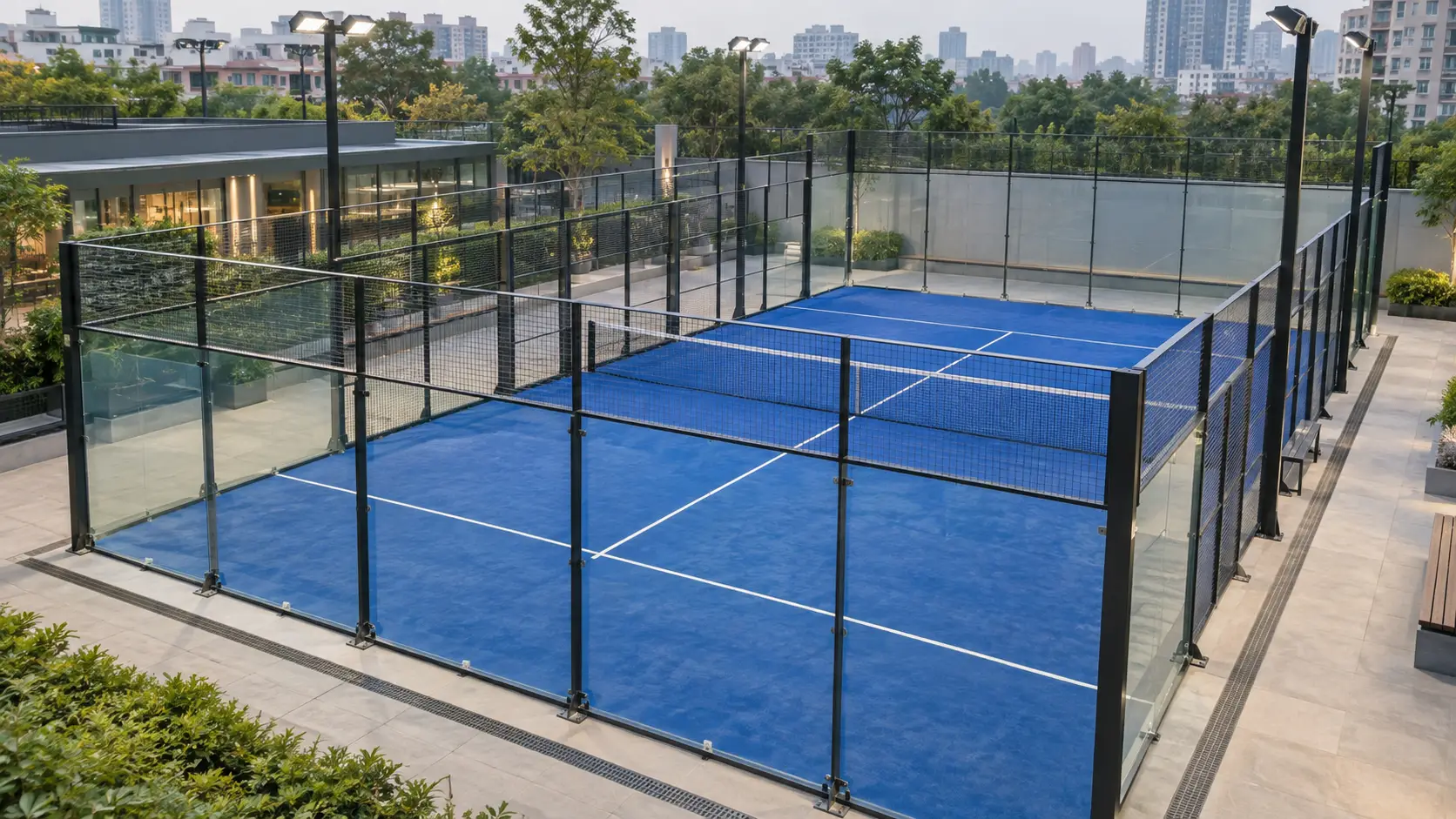
Official padel court dimensions are 20 metres long and 10 metres wide. A net divides the court into two equal halves, while glass or solid walls and metal fencing enclose the playing area.
This guide explains the padel court size, net height, service lines, glass walls and important playing zones. It is useful for beginners learning the layout, regular players improving their positioning and facility owners trying to understand what separates a proper padel court from a rectangle with optimistic marketing.
Standard Padel Court Dimensions
A regulation padel court measures 20 metres long and 10 metres wide. In feet, that is approximately 65 feet 7 inches long and 32 feet 10 inches wide.
The net runs across the middle of the court and divides it into two equal sections measuring 10 metres by 10 metres. The total marked playing surface covers 200 square metres.
Court Element | Official Measurement | Approximate Imperial Measurement |
Total court length | 20 metres | 65 feet 7 inches |
Total court width | 10 metres | 32 feet 10 inches |
Each half of the court | 10 × 10 metres | 32 feet 10 inches × 32 feet 10 inches |
Total playing area | 200 square metres | Approximately 2,153 square feet |
Service-line distance from net | 6.95 metres | Approximately 22 feet 10 inches |
Net height at centre | 0.88 metres | Approximately 2 feet 10.6 inches |
Maximum net height at ends | 0.92 metres | Approximately 3 feet |
These measurements refer to the marked playing area. A complete facility needs additional space for entrances, structural supports, lighting and, where permitted, out-of-court play.
How Big Is a Padel Court Compared with a Tennis Court?
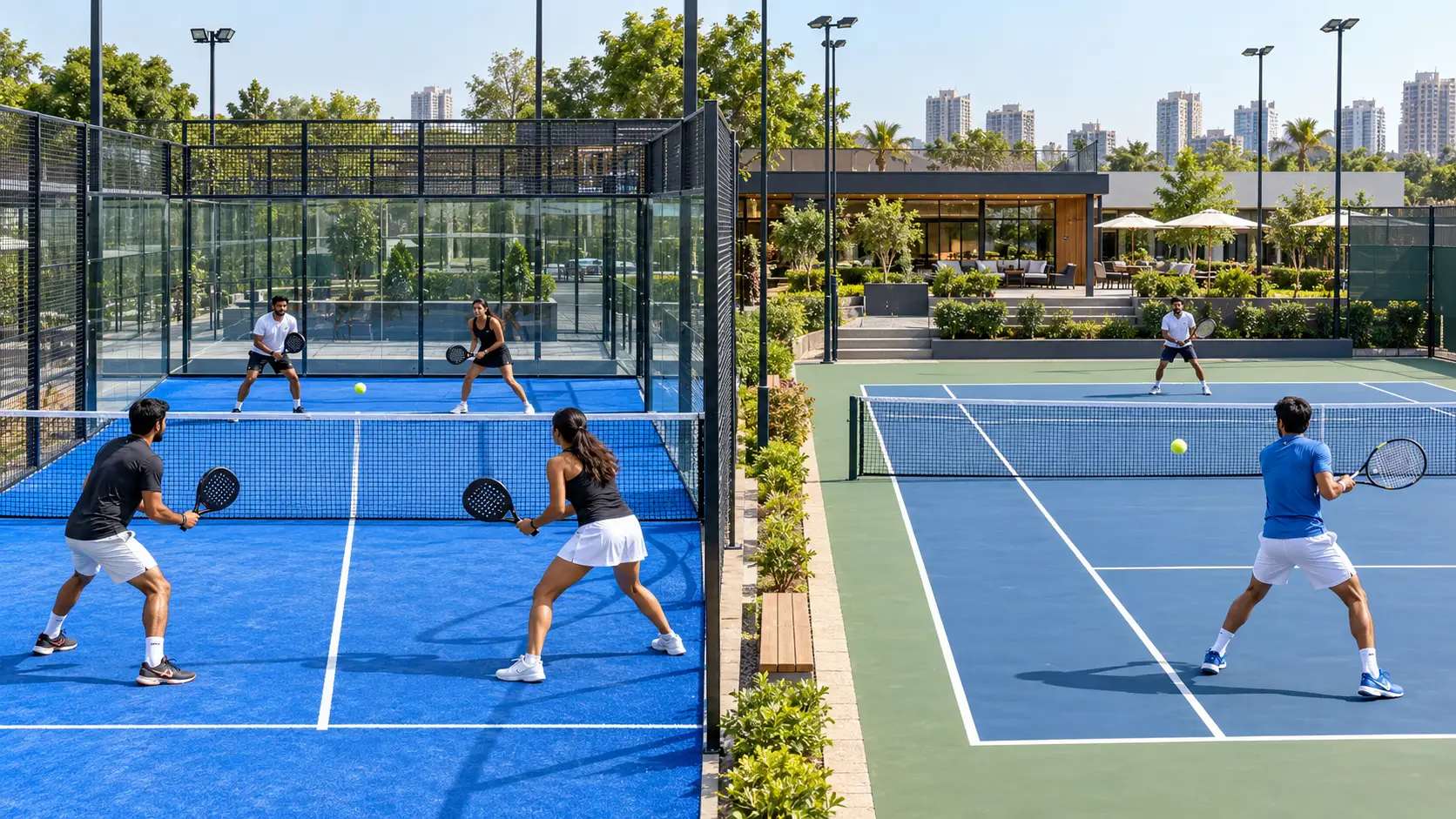
A padel court is considerably smaller than a full tennis court. Its compact size makes doubles rallies quick and places every player close to the action.
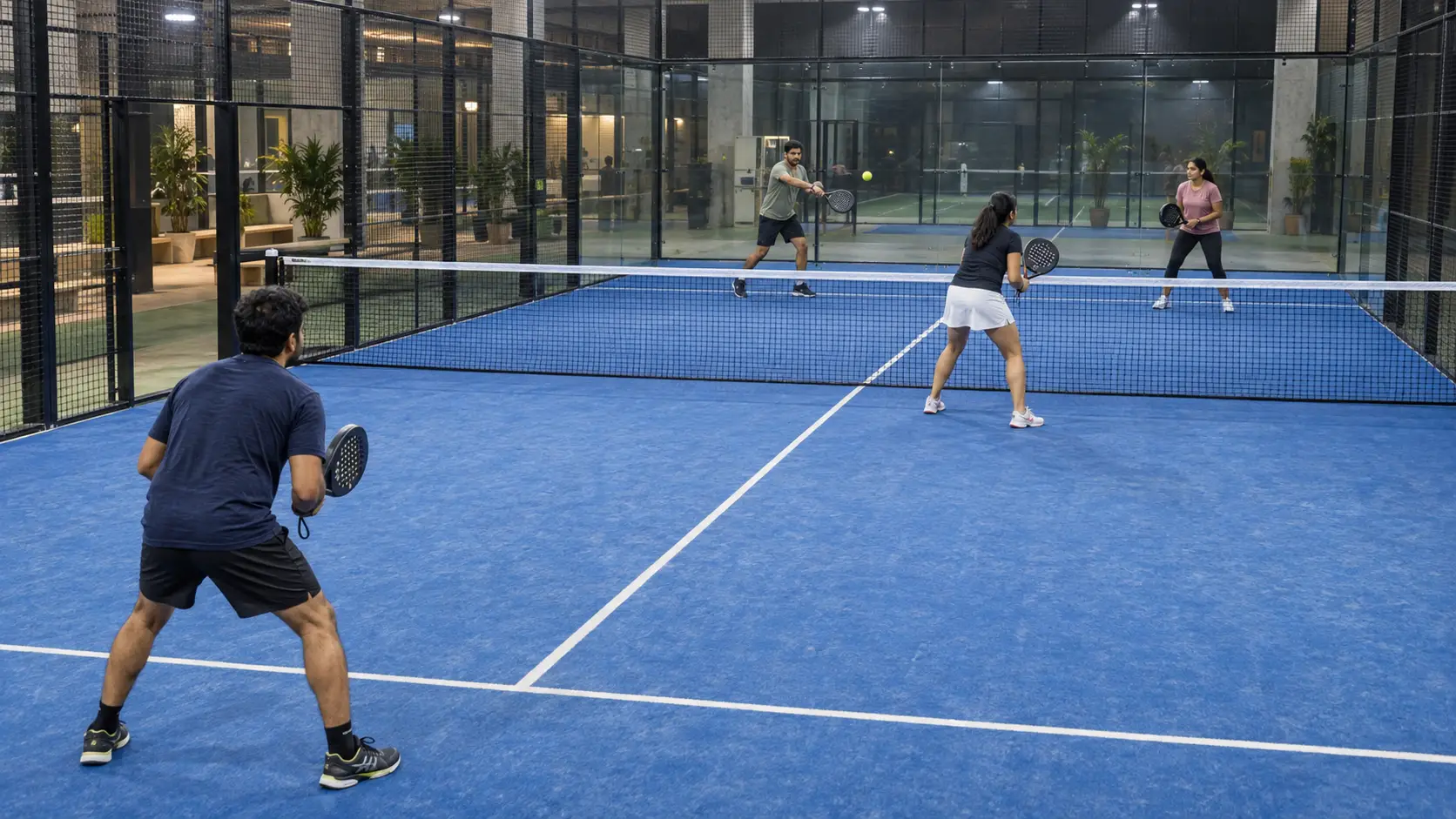
The 10-metre width gives each pair five metres of court to cover horizontally when standing side by side. That may sound manageable, but the glass rebounds create additional angles and make poor positioning surprisingly expensive.
Unlike tennis, the enclosure forms part of the game. Players must understand not only the marked floor but also how the ball behaves after striking the back or side walls.
Padel Net Height and Position
The net is placed across the centre of the court. It divides the 20-metre length into two equal halves.
The official padel net height is 0.88 metres at the centre and may rise to a maximum of 0.92 metres at the ends. This slight difference is created by the way the net is supported and tensioned.
The net must extend across the court so that there is no playable gap between the net and the side posts or enclosure. Its upper edge is finished with a visible band that contains the supporting cable.
Players often attack through the centre because the net is marginally lower there. However, a low shot over the middle can still be intercepted by opponents occupying a strong net position.
Padel Service Lines and Service Boxes
A service line is marked on each side of the court, parallel to the net. Each service line sits 6.95 metres from the net.
A central service line runs from the service line towards the back wall and divides the area into left and right service boxes. This creates two receiving boxes on each half of the court.
All court lines are five centimetres wide and form part of the area they define. A serve landing on the correct service line is therefore considered in.
How the Serve Uses These Areas
The server stands behind the service line and serves diagonally into the opponent’s service box. The ball must bounce on the server’s side before being struck at or below waist height.
After crossing the net, the serve must bounce inside the correct diagonal box. It may then strike the glass wall. A serve that bounces correctly and then touches the metal fence is a fault.
For a wider introduction to serving, scoring and gameplay, read Rackonnect’s guide on what padel is and how to play it.
Why Does a Padel Court Have Glass Walls?
The walls are not decoration or merely a way to stop balls from escaping. They form an active part of padel.
During a rally, the ball may bounce on the court and then strike the glass or another permitted solid wall. The receiving player can return it before the second bounce. This rule creates the rebounds that distinguish padel from tennis and pickleball.
Modern courts commonly use tempered glass because it provides a clear view for players and spectators. Other approved solid materials may be used if they provide a consistent rebound and meet the applicable safety requirements.
The back enclosure commonly consists of a solid or glass wall up to three metres high, with metal fencing extending the enclosure to four metres. The side enclosure combines wall sections and metal mesh, although approved configurations may vary.
The surface should be even and free from projections that could create unpredictable rebounds or safety risks.
How the Ball Interacts with the Walls
Understanding the order of contact is essential. During a normal rally:
The ball must first bounce on the opponent’s court before touching their wall.
After the bounce, it may strike the glass or solid wall and remain in play.
The receiving player must return it before it bounces a second time.
A player may deliberately hit the ball against their own permitted wall to send it over the net.
A direct shot into the opponent’s wall or fence before the ball bounces is out.
Beginners often panic when the ball travels towards the back glass. Moving away from the wall and allowing the rebound to develop can provide more time and a better contact point.
Players who want to understand these rebounds in match situations can read the guide to padel glass-wall play and the bandeja.
Metal Fencing and Mesh Areas
Metal mesh completes the enclosure where solid walls or glass are not used. It keeps the ball inside the court while allowing visibility, ventilation and access.
Fence contact behaves differently from glass contact. During a rally, a ball that bounces on the opponent’s court and then touches the metal mesh remains playable. The rebound is often less predictable than it is from glass.
On a serve, however, a ball that bounces in the correct service box and then touches the metal fence is a fault. This is one of the first court-specific rules new players should learn.
Players must also avoid touching the net, posts or the opponents’ side of the enclosure while the ball is in play.
The Main Playing Zones on a Padel Court
Official lines define the service areas, but players also use several tactical zones that are not physically marked.
1. The Net Zone
This is the attacking area close to the net. A team controlling this position can volley, apply pressure and reduce the opponents’ available angles.
Standing too close to the net creates vulnerability to a lob. Good net positioning usually leaves enough room to move backwards when required.
2. The Transition Zone
The space between the service line and the net is often called the transition zone. Players pass through it when moving forward or recovering backwards.
Remaining in this area without a clear reason can be risky. You may be too far from the net to attack effectively and too far from the back wall to defend a deep ball comfortably.
3. The Service Boxes
The four marked service boxes determine where serves must land. During open play, their lines have no special effect, but they remain useful reference points for positioning.
4. The Back-Court Zone
This is the area between the service line and the back wall. Defensive teams often begin here because it provides room to judge deep shots and use rebounds from the glass.
5. The Corners
The back corners combine the effects of the side and rear walls. Balls can rebound from one surface or both, creating difficult changes in direction. Learning to read corner rebounds is an important step beyond beginner-level padel.
Is There an Out-of-Court Playing Area?
Some courts allow players to leave the enclosure through side openings and return a ball from outside. This feature is often seen in high-level competition.
Out-of-court play requires suitable access openings and a clear external safety area on both sides. Not every recreational venue supports it. Doors, narrow walkways, structural objects or nearby courts may make outside retrieval unsafe or impossible.
Ask the facility whether out-of-court play is permitted before attempting it. Heroics are best saved for courts designed to accommodate them.
How Much Vertical Clearance Does a Padel Court Need?
The playing area should have at least six metres of unobstructed height above the court. Greater clearance is preferable, particularly for new facilities and competitive play, because lobs are a central part of padel strategy.
Indoor facilities must position lights, beams, ducts and other equipment outside the required clear space. A ceiling that is too low can interfere with defensive lobs and change the way the game is played.
What Surface Is Used on a Padel Court?
The playing surface should provide a consistent ball bounce and sufficient grip for safe movement. Common surfaces include synthetic turf and approved porous or cement-based systems.
Many modern courts use synthetic turf with a sand infill. The amount and distribution of sand influence player movement, grip and ball speed. Maintenance is important because uneven infill can make some parts of the court faster or more slippery than others.
The surface is commonly blue, green or terracotta, although other colours may be used if they provide suitable visibility against the walls and surrounding area.
Indoor vs Outdoor Padel Court Dimensions
The marked dimensions remain 20 metres by 10 metres for both indoor and outdoor regulation courts. The main differences involve the roof, lighting, drainage, wind and exposure to weather.
An outdoor court needs suitable drainage and materials capable of handling local conditions. An indoor court needs adequate ceiling height, ventilation and lighting without structural obstructions above the playing area.
If you want to try the game in Delhi, explore padel courts in Delhi or learn more about REPPP by Rackonnect.
Frequently Asked Questions
What are the official padel court dimensions?
A regulation padel court measures 20 metres long and 10 metres wide. The net divides it into two equal 10-metre by 10-metre halves.
How high is a padel net?
The net is 0.88 metres high at the centre and may reach a maximum height of 0.92 metres at each end.
How far is the service line from the net in padel?
The service line is 6.95 metres from the net on each side of the court.
Are padel court walls always made of glass?
Modern courts commonly use tempered glass, but regulations may permit other suitable solid materials. The surface must provide a consistent rebound and meet safety requirements.
Can the ball hit the glass wall in padel?
Yes. During a rally, the ball can bounce on the court and then hit the glass wall before being returned. A shot that hits the opponent’s wall before bouncing on their court is out.
Is a singles padel court the same size?
Standard competitive padel is played as doubles on a 20-metre by 10-metre court. Narrower singles courts exist at some facilities, but they are not the standard doubles layout described here.
Understanding the Court Makes Padel Easier
A standard padel court is 20 metres long, 10 metres wide and enclosed by a combination of playable walls and fencing. Its net, service boxes, glass rebounds and tactical zones shape every rally.
Once you understand the layout, you can position yourself earlier, use the back wall with greater confidence and make better decisions near the net.
Ready to see the dimensions in real life? Explore padel courts in Delhi, review padel court booking prices in Delhi or discover the premium racket-sports experience at REPPP.