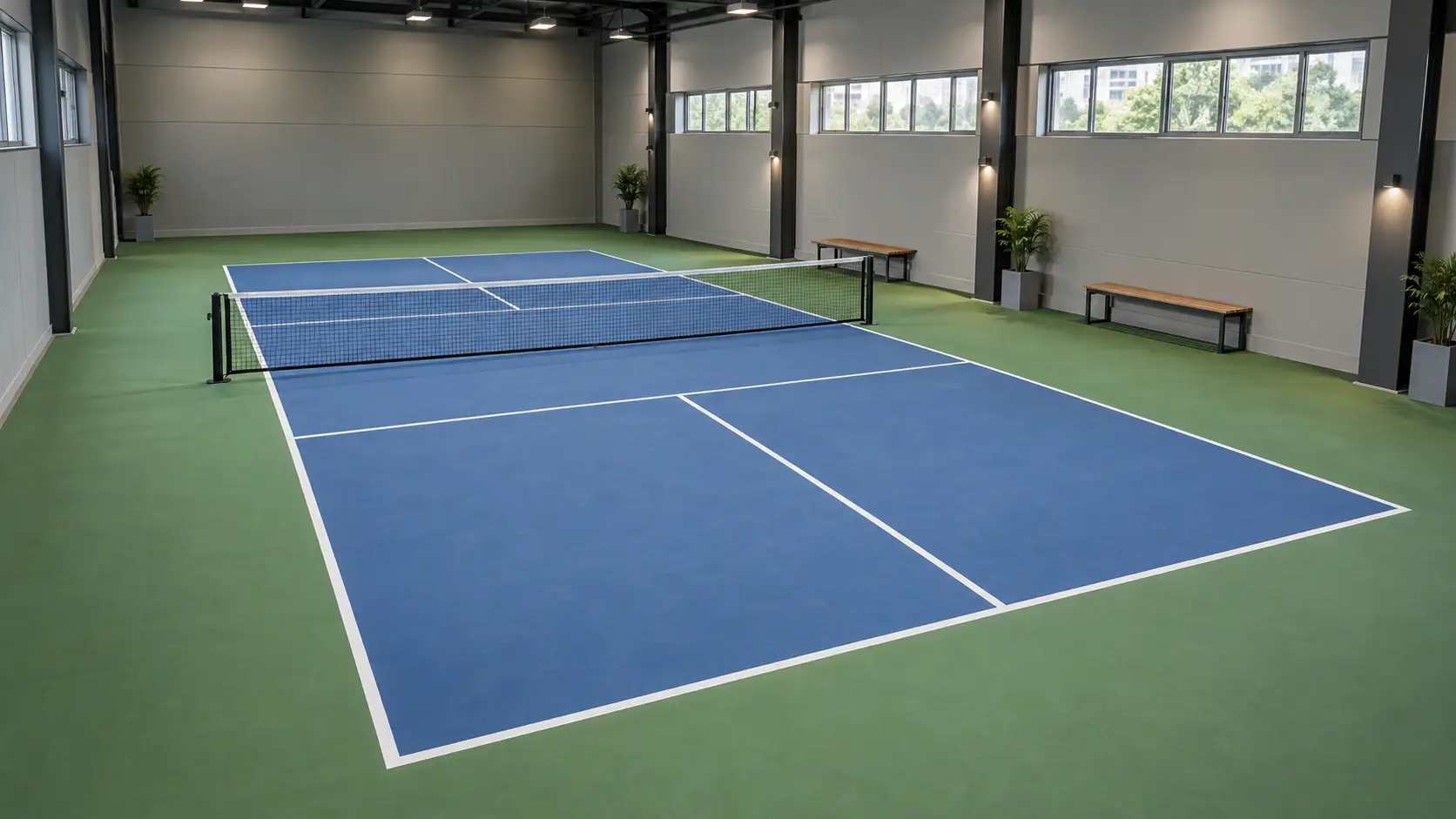
A pickleball court is smaller than a tennis court, but every line has a specific purpose. The kitchen controls where players can volley, the centreline divides the service areas, and the net sits slightly lower in the middle than at the sidelines.
Official pickleball court dimensions are 20 feet wide and 44 feet long. The same court size is used for both singles and doubles. What changes is the number of players and the way they cover the available space.
This guide explains the pickleball court size, net height, kitchen dimensions, service areas and recommended space around the court. It also shows how the same layout works differently in singles and doubles.
Official Pickleball Court Dimensions
A regulation pickleball court measures 20 feet wide by 44 feet long, which is approximately 6.10 metres wide by 13.41 metres long.
The net divides the court into two equal halves. Each half extends 22 feet from the net to the baseline.
Court Element | Measurement in Feet | Approximate Metric Measurement |
Total court length | 44 feet | 13.41 metres |
Total court width | 20 feet | 6.10 metres |
Each half of the court | 20 × 22 feet | 6.10 × 6.71 metres |
Non-volley zone depth | 7 feet on each side | 2.13 metres |
Net height at sidelines | 36 inches | 91.44 centimetres |
Net height at centre | 34 inches | 86.36 centimetres |
Line width | 2 inches | 5.08 centimetres |
The marked court occupies 880 square feet, or approximately 81.75 square metres. A complete playing facility needs additional clearance outside these lines so players can move safely.
Is the Pickleball Court Size Different for Singles and Doubles?
No. Singles and doubles use the same 20-foot by 44-foot court. The sidelines, baselines, kitchen and service courts do not move when the number of players changes.
This differs from sports such as badminton and tennis, where singles and doubles may use different sidelines. In pickleball, every boundary line remains the same.
The tactical demands still change considerably:
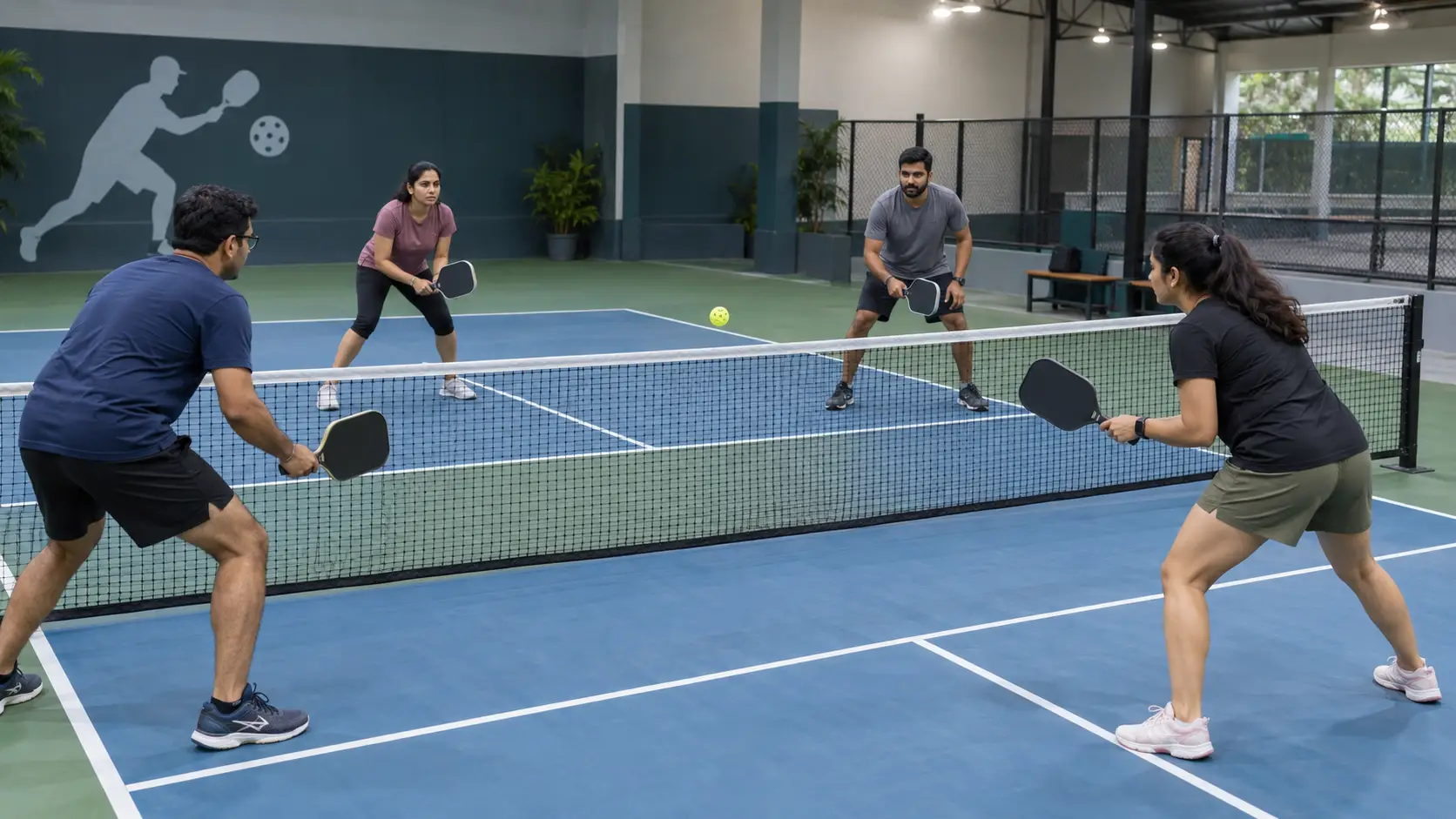
Singles players must cover the entire 20-foot width alone.
Doubles partners divide responsibility for the width and middle.
Singles generally demands more lateral movement and open-court coverage.
Doubles produces more exchanges near the non-volley zone line.
Communication becomes essential when two partners share the court.
Players learning doubles positioning can read Rackonnect’s guide to pickleball doubles strategy for beginners once that article is live.
Pickleball Net Height
The pickleball net is 36 inches high at the sidelines and 34 inches high at the centre. This means the middle of the net is two inches lower than the outer edges.
The slight dip affects shot selection. Cross-court dinks travel over the lower central part of the net and have more distance in which to land. This is one reason players frequently use diagonal dinks during patient kitchen-line rallies.
The net should stretch across the entire court width, with the posts placed outside the sidelines. It must be properly tensioned and should not sag below the required centre height.
A net that is too high changes the difficulty of serves, dinks and drives. A net that is too low rewards shots that would not clear a regulation setup. Portable nets should therefore be measured after installation rather than trusted because the packaging contains an enthusiastic photograph.
What Is the Kitchen in Pickleball?
The kitchen is the informal name for the non-volley zone. It extends seven feet from the net on each side and covers the entire 20-foot width of the court.
Each non-volley zone therefore measures 20 feet wide by 7 feet deep. Together, both kitchen areas occupy a 20-foot by 14-foot space around the net.
A player cannot volley while touching the kitchen or its boundary lines. A volley means striking the ball before it bounces.
Players may enter the kitchen at any time to play a ball that has bounced. They must then establish both feet outside the non-volley zone before volleying a later ball.
The kitchen rule prevents players from standing directly beside the net and attacking every ball downwards. It creates the soft dink exchanges and tactical movement that define pickleball.
Do the Kitchen Lines Count as Part of the Kitchen?
Yes. The non-volley zone lines form part of the kitchen. A player touching the line while volleying commits a fault.
Momentum also matters. If you volley from outside the kitchen and your movement carries you onto the line or into the zone, the shot is a fault even if the ball is already dead.
The kitchen line has a different status during a serve. A served ball must clear the non-volley zone completely. A serve landing on the kitchen line is a fault.
For a detailed explanation, read Rackonnect’s guide to pickleball serving rules, kitchen faults and foot faults.
Pickleball Service Court Dimensions
Behind each kitchen line, the remaining area extends 15 feet to the baseline. A centreline divides this space into right and left service courts.
Each service court is approximately 10 feet wide and 15 feet long. Court lines are generally included within the area they define, except that the non-volley zone line belongs to the kitchen rather than the service court.
The server sends the ball diagonally into the opponent’s correct service court. The serve must clear the kitchen and land within the appropriate boundaries.
The centreline runs from the non-volley zone line to the baseline. It does not continue through the kitchen because players do not serve into that area.
Understanding Every Pickleball Court Line
Baseline
The baseline runs across the full width at each end of the court. Players serve from behind it. A ball that touches the baseline during a rally is in.
Sidelines
The sidelines define the 20-foot width. The same sidelines apply to both singles and doubles.
Non-Volley Zone Lines
These lines sit seven feet from the net and run parallel to it. They define the outer edge of each kitchen.
Centreline
The centreline divides the area behind the kitchen into right and left service courts. It is used to judge whether a serve has landed in the correct diagonal box.
Pickleball lines are two inches wide and should contrast clearly with the playing surface. Poorly visible or overlapping markings can make close calls difficult, particularly on converted multi-sport courts.
Minimum Playing Surface Around the Court
The official marked court is 20 feet by 44 feet, but players need additional space beyond the sidelines and baselines.
A commonly used minimum playing surface is approximately 30 feet wide by 60 feet long. A larger area, such as 34 feet by 64 feet, offers more comfortable clearance and is often preferred for new or competition-oriented facilities.
This surrounding space allows players to:
Move beyond the baseline to return deep balls
Reach wide shots safely
Avoid nearby walls, fences and equipment
Enter and leave the court without interrupting play
Reduce the risk of collisions on neighbouring courts
A court can have accurate lines and still feel cramped if a wall sits immediately behind the baseline. When comparing venues, examine the run-off area as carefully as the painted rectangle.
Indoor Pickleball Court Ceiling Height
Indoor courts require sufficient vertical clearance for serves, lobs and defensive returns. There is no single ceiling height that suits every type of facility, but higher unobstructed clearance produces better play.
Lights, beams, fans and hanging equipment should not interfere with the normal path of the ball. A low object above the court can turn a sensible lob into an architectural dispute.
Competitive facilities generally provide more vertical space than casual converted halls. Players should check the venue’s local rules for balls that strike ceilings or overhead structures.
Pickleball Court Surface and Marking
Pickleball can be played on dedicated courts or suitable converted tennis, badminton and multi-sport surfaces. The surface should be level, consistent and capable of providing a predictable bounce.
Common surfaces include:
Acrylic-coated hard courts
Indoor wooden sports flooring
Suitable synthetic sports surfaces
Temporary courts created using tape or removable lines
The surface should provide adequate grip without preventing safe changes of direction. Outdoor courts also need suitable drainage so that water does not collect within the playing area.
Can Pickleball Be Played on a Badminton Court?
A badminton court is close enough in overall length to make conversion possible, particularly inside indoor halls. However, the widths, line systems and net specifications differ.
A proper temporary setup requires clearly marked pickleball boundaries, non-volley zones and service courts. The net must also be adjusted to pickleball height.
Simply lowering a badminton net and guessing the kitchen line may work for an informal introduction, but it does not create a regulation pickleball court.
Can Pickleball Be Played on a Tennis Court?
Yes. Tennis courts are frequently converted for pickleball because they provide a suitable hard surface and generous surrounding space.
Temporary pickleball lines and portable nets can be used, or multiple permanent pickleball courts may be installed within the larger tennis area. Players must follow the pickleball markings rather than the original tennis lines.
Too many overlapping colours can make the court difficult to read. Dedicated pickleball lines should contrast clearly without creating confusion during fast rallies.
Singles vs Doubles Positioning on the Same Court
Playing Situation | Singles | Doubles |
Court width covered | One player covers all 20 feet | Two partners share the width |
Movement demand | Greater side-to-side coverage | More coordinated team movement |
Middle coverage | No partner confusion | Partners must decide who takes the ball |
Kitchen-line play | More open passing angles | Both partners often defend the line together |
Serving position | Changes according to score | Depends on score, server and team rotation |
Although the boundaries remain identical, singles often feels much larger because one person must protect every angle. Doubles feels more compact but demands better communication and spacing.
Where to Play Pickleball in Delhi
A properly marked court makes it easier to learn serves, kitchen movement and doubles positioning. Players can explore pickleball courts in Delhi through Rackonnect.
You can also discover pickleball and padel experiences at REPPP by Rackonnect. Before joining a public session, compare pickleball open play and private court reservations to find the format that suits you.
Frequently Asked Questions
What are the official pickleball court dimensions?
A regulation pickleball court measures 20 feet wide and 44 feet long, or approximately 6.10 metres by 13.41 metres.
Is a singles pickleball court narrower than a doubles court?
No. Singles and doubles use the same sidelines and the same 20-foot by 44-foot court.
How high is a pickleball net?
The net is 36 inches high at the sidelines and 34 inches high at the centre.
How big is the kitchen in pickleball?
The non-volley zone extends seven feet from the net on each side and covers the complete 20-foot width.
How large is each pickleball service court?
Each service court is approximately 10 feet wide and 15 feet long, running from the kitchen line to the baseline.
What is the recommended total space for a pickleball court?
The marked court is 20 by 44 feet. A minimum overall playing surface of about 30 by 60 feet is commonly used, while 34 by 64 feet provides more comfortable clearance.
One Court, Two Formats
Pickleball singles and doubles use the same 20-foot by 44-foot layout. The net stands 36 inches high at the sidelines and 34 inches at the centre, while each kitchen extends seven feet from the net.
Understanding these measurements helps players judge serves, recognise kitchen faults and choose better positions. It also makes comparing venues easier because adequate run-off space and clear markings matter almost as much as the court itself.
Ready to play? Find pickleball courts in Delhi, explore local games through Rackonnect or plan your next session at REPPP.