Learning the rules will help you complete a pickleball match. Learning how to move with your partner will help you compete in one.
Beginner doubles teams often lose points without being outplayed. One partner stays near the baseline, the other rushes forward, and a gap wide enough for a delivery van opens between them. The opponents simply place the ball into that space.
Effective pickleball doubles strategy is built on positioning, patience and teamwork. You do not need the hardest serve or fastest hands on the court. You need to move together, reach the non-volley zone line safely and select shots that make the next ball easier.
This guide explains the essential pickleball doubles strategy for beginners, including starting positions, dinks, third shots, partner communication and common tactical mistakes.
What Makes Pickleball Doubles Different?
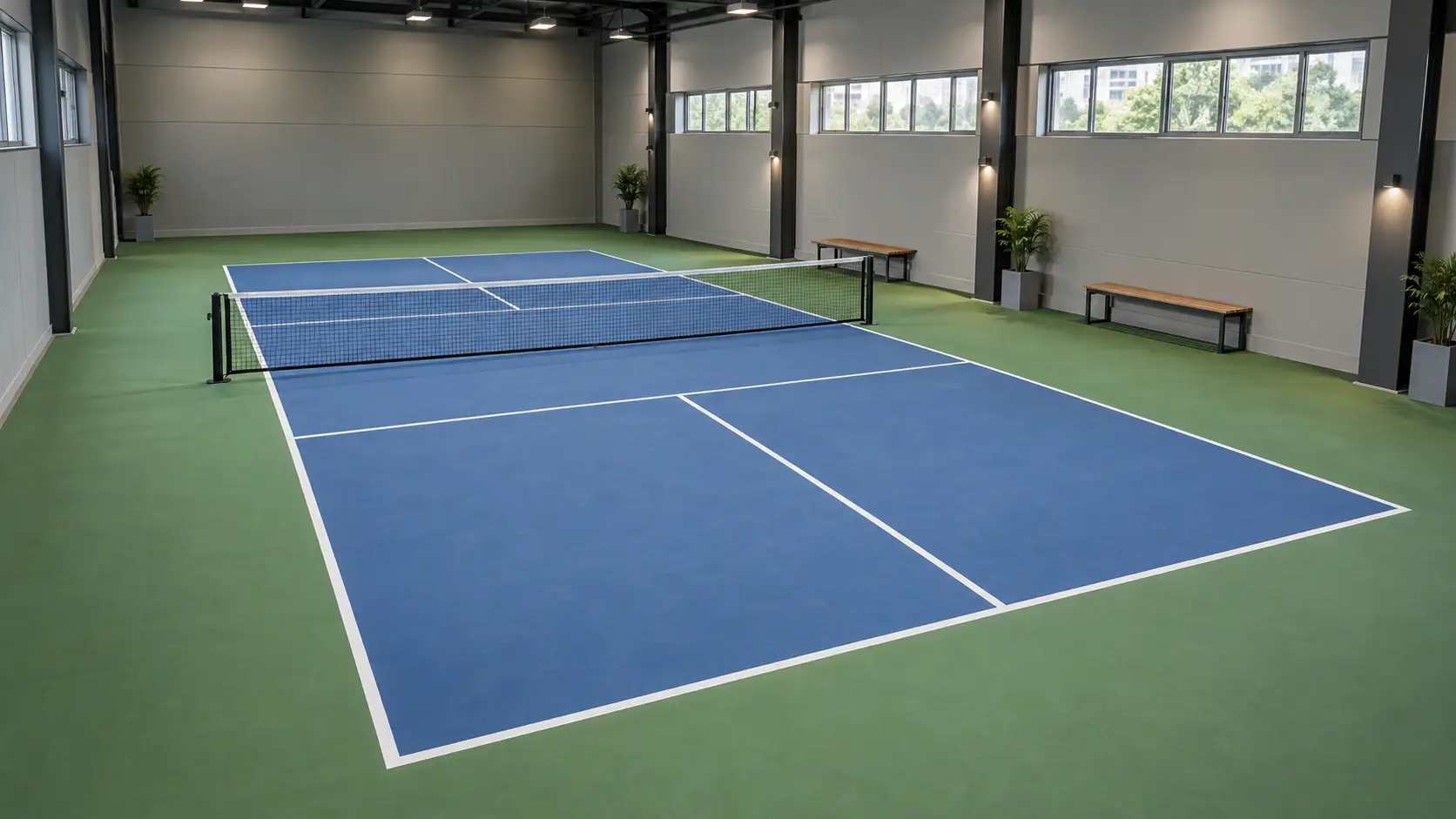
A pickleball doubles court has the same marked dimensions as a singles court, but four players share the available space. Each player is responsible for roughly half of their team’s side while also helping protect the middle.
The non-volley zone, commonly called the kitchen, extends seven feet from the net on both sides. Players cannot volley while standing in this zone or touching its lines. However, they can enter it to play a ball that has bounced.
Because the court is compact, doubles points often develop around the non-volley zone line. Teams that establish a balanced position there can attack high balls and respond to soft shots without leaving obvious gaps.
If you are preparing for your first game, read Rackonnect’s guide to your first pickleball session in Delhi before moving into tactical play.
1. Understand Your Starting Position
At the start of a point, the serving team and receiving team should not use identical positions because of the two-bounce rule.
Positioning for the Serving Team
The server stands behind the baseline and serves diagonally. The server’s partner should also remain near the baseline.
The receiving team must let the serve bounce, and the serving team must let the return bounce before striking it. If the server’s partner begins too far forward, a deep return may force an awkward retreat.
Positioning for the Receiving Team
The receiver stands behind the baseline and prepares for the serve. The receiver’s partner can begin near the non-volley zone line because they do not need to wait for another bounce before playing a volley.
After returning the serve, the receiver should move forward and join their partner near the kitchen line whenever the return provides enough time.
2. Reach the Kitchen Line Together
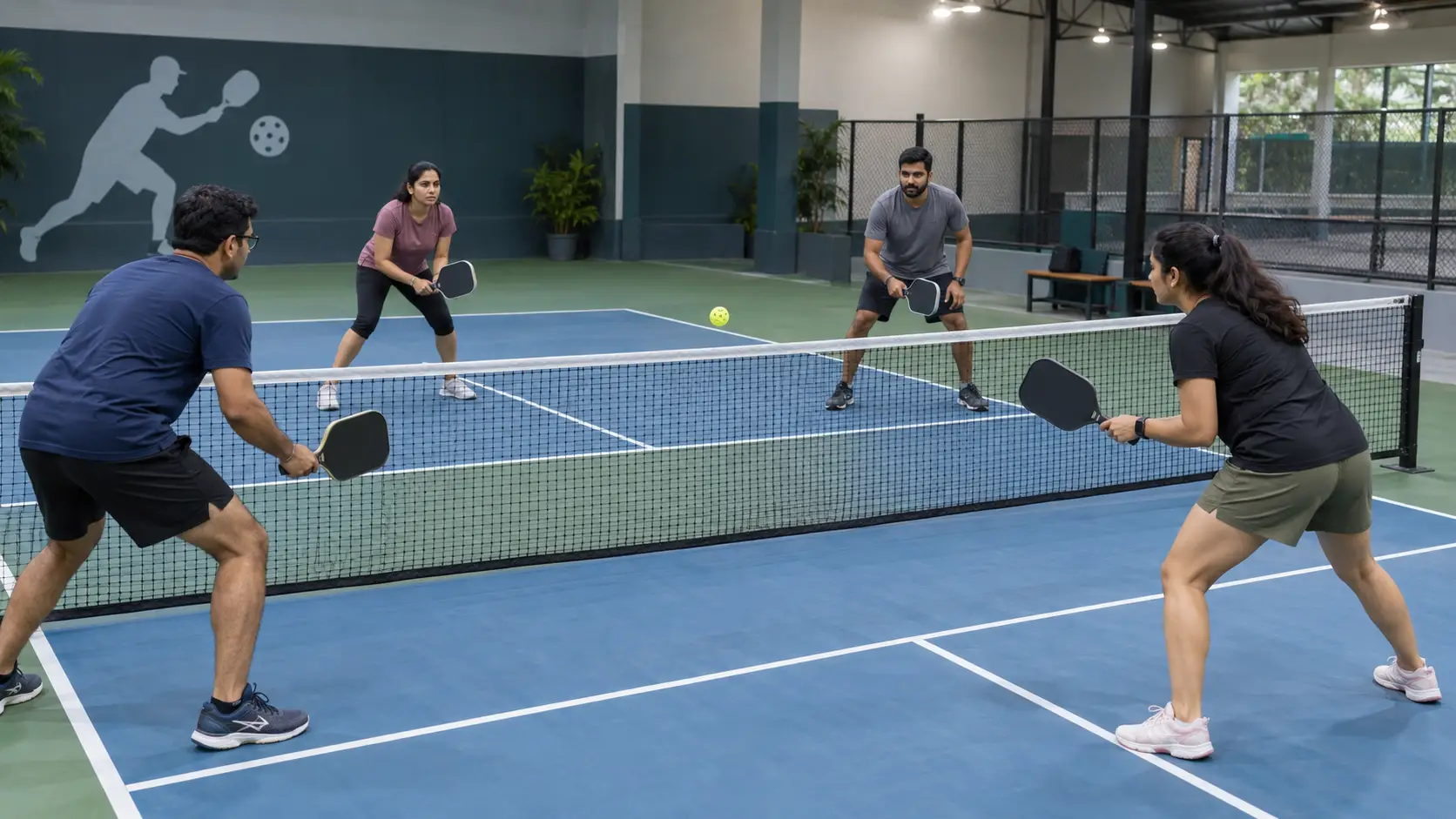
The non-volley zone line is usually the strongest doubles position because it allows you to contact the ball earlier and apply pressure with controlled volleys.
The objective is not to sprint forward after every shot. Move when your team has sent a ball that gives you enough time. A deep return, low third-shot drop or controlled drive can create that opportunity.
Partners should advance together. If one player reaches the line while the other remains deep, opponents can attack the open middle or aim towards the deeper player’s feet.
Beginner cue: Before each opponent contact, stop moving, establish balance and prepare the paddle. Running through the shot makes controlled volleys far more difficult.
3. Protect the Middle Without Crowding Your Partner
The centre of the court causes more confusion than either sideline. Both partners can often reach the ball, which means both may swing or neither may move.
Teams should agree on a simple rule for middle balls. The player whose forehand covers the centre will often have the stronger option, but this depends on whether both partners are right-handed or left-handed and where they are standing.
Protecting the middle does not mean standing shoulder to shoulder. Maintain enough space to swing safely while staying close enough to prevent a large passing lane.
When one player moves towards a sideline, the other should shift towards the centre. This coordinated movement closes the most dangerous gap.
4. Use the Return of Serve to Move Forward
A beginner may try to win the point directly with the return. A better objective is often to send the ball deep and create time to reach the non-volley zone line.
A high, deep return can be effective because it keeps the serving team near the baseline and gives the receiver more time to advance. The return does not need to skim the net or hit a sideline.
After returning:
Move towards the kitchen line immediately.
Watch the serving team’s third shot.
Slow down before they make contact.
Set the paddle in front of your body.
Join your partner in a balanced position.
5. Learn the Purpose of the Third Shot
The third shot is the serving team’s second contact after the serve and return. It is strategically important because the receiving team may already be positioned at the kitchen line.
The serving team commonly chooses between a drop and a drive.
Third-Shot Drop
A third-shot drop is a soft ball intended to land in the opponents’ kitchen. Its purpose is to prevent an aggressive volley and give the serving team time to move forward.
The drop does not need to be perfect. A ball that stays low and makes opponents contact it below net height can still help your team advance.
Third-Shot Drive
A drive is a faster, lower shot directed at an opponent or through a gap. It can force a weak volley, but it becomes risky when struck too high or without control.
Beginners often drive every third shot because the stroke feels more familiar. Learning a basic drop gives your team another way to approach the net instead of trying to blast through two prepared opponents.
6. Build a Reliable Dink
A dink is a soft shot hit after the bounce and intended to land in the opponent’s non-volley zone. It is used when both teams are positioned near the kitchen line.
The aim is not merely to keep the ball short. A good dink stays low enough to prevent opponents from attacking it comfortably.
Use a compact motion and guide the ball rather than flicking the wrist. Keep your grip relaxed and return to the ready position after every shot.
Beginners should first develop a cross-court dink. The diagonal path provides more distance and crosses the lower centre portion of the net. Once you can control it, add straight dinks and changes of direction.
7. Know When to Attack a Dink
Not every ball near the kitchen is attackable. Trying to speed up a low ball often sends it into the net or gives opponents an easy counterattack.
A better opportunity appears when the ball sits high enough to contact above net level. You can then accelerate it towards an open space, an opponent’s body or the gap between both players.
Before attacking, check:
Is the contact point above the net?
Are you balanced?
Is an opponent out of position?
Can you keep the shot inside the court?
Is your partner prepared for the next ball?
Patience matters. A dink rally is not a ceremonial exchange of soft shots. It is a search for the first safe attacking opportunity.
8. Keep the Ball Low
High balls give opponents a chance to attack downwards. Low balls force them to hit upwards, which reduces their attacking options.
Whether you are playing a drop, dink or defensive volley, focus on keeping the ball below net height as it reaches your opponent.
If you receive a difficult low ball, return it safely rather than attempting a winner. Resetting the rally is a useful skill. It gives your team time to regain balance and stops one poor position from becoming an immediate lost point.
9. Communicate Before the Ball Arrives
Good doubles communication is short and early. A long discussion is of limited use while the ball is bouncing between both players.
Useful calls include:
Mine: You will take the ball.
Yours: Your partner has the better position.
Switch: Change sides after being pulled across the court.
Stay: Maintain the current formation.
Bounce: Let a questionable ball land before deciding whether it is out.
Partners should also communicate between points. Discuss which shots are causing trouble and decide how to cover the middle. Keep these conversations practical. A doubles partner is not a customer-service department for every missed volley.
10. Move Sideways as a Team
Imagine an elastic band connecting both partners. When one player moves towards the sideline, the other shifts towards the middle. When the ball moves to the opposite side, both players adjust together.
This movement keeps the strongest defensive shape and reduces open gaps. Standing in fixed positions gives opponents clear angles through the middle or down the line.
Avoid crossing in front of your partner unless the rally forces a switch. If you change sides, communicate immediately so both players understand their new responsibilities.
11. Target Feet and Open Spaces
Hard shots aimed directly at an opponent’s paddle can be returned surprisingly quickly. A more effective target is often their feet, especially when they are moving forward or standing in the transition area.
You can also aim through the middle, behind a moving player or into the space created when opponents separate.
Beginners should prioritise large targets rather than trying to paint the sidelines. A ball landing comfortably inside the court is more valuable than a brilliant angle that succeeds once every eight attempts.
12. Avoid Staying in the Transition Zone
The area between the baseline and kitchen line is commonly called the transition zone. Players moving forward must pass through it, but remaining there can make low balls difficult to handle.
If you are caught in this area, do not continue running blindly. Stop before the opponent hits, lower your position and use a controlled reset. Move again when your shot gives you time.
The final goal is to join your partner at the non-volley zone line, not to arrive there regardless of what the ball is doing.
A Simple Beginner Doubles Game Plan
Situation | Beginner Strategy |
Serving | Serve deep, expect the return and prepare for the third shot |
Returning | Return deep and move towards the kitchen line |
Both opponents at the net | Use a drop, controlled drive or lob rather than a hopeful smash |
Both teams at the kitchen | Dink patiently and attack a high ball |
Partner pulled wide | Shift towards the middle to cover the gap |
Defending a fast attack | Keep the paddle ready and reset the ball low |
Common Beginner Doubles Mistakes
Moving to the net before the return of serve has bounced
Standing at the kitchen line while the partner remains deep
Attacking low balls from an unbalanced position
Using a large backswing during fast exchanges
Leaving the middle unprotected
Trying to hit winners from the baseline
Forgetting to stop before the opponents make contact
Remaining silent on balls between both partners
If serving rules or kitchen faults are still unclear, review Rackonnect’s explanation of pickleball serves, the kitchen and foot faults.
How to Practise Doubles Strategy
You do not need to play complete games during every practice session. Short drills can develop tactical habits more effectively.
Deep return drill: Practise returning towards the final third of the court and moving forward.
Third-shot drop drill: Feed returns to the serving team and aim soft shots into the kitchen.
Cross-court dink drill: Maintain a controlled diagonal rally without attempting winners.
Two-up movement drill: Partners move sideways together while opponents direct the ball around the court.
Reset drill: Defend attacks from the transition zone and land soft balls in the kitchen.
Where to Play Pickleball in Delhi
Regular matches are essential because positioning and communication improve through experience with different partners and opponents.
You can explore pickleball courts in Delhi through Rackonnect or discover padel and pickleball experiences at REPPP.
If you want to meet new players, review the guide to finding pickleball games in Delhi. You can also compare open play and private court reservations before deciding which format suits your group.
Frequently Asked Questions
Where should beginners stand in pickleball doubles?
The strongest general position is with both partners near the non-volley zone line. The serving team begins near the baseline because the return must bounce before being played.
Who should take the middle ball in pickleball doubles?
Partners should agree on a simple system. The player with the forehand through the middle often has the stronger shot, but position and handedness may change the decision.
What is a dink in pickleball?
A dink is a soft shot played after the bounce that lands in the opponent’s non-volley zone. It is designed to remain low and prevent an aggressive return.
Should beginners learn the third-shot drop?
Yes. A reliable third-shot drop can help the serving team move from the baseline towards the kitchen line without giving opponents an easy attacking volley.
Is power important in pickleball doubles?
Power can be useful, but positioning, control and shot selection are usually more important for beginners. Hard shots without placement often return even faster.
Play as One Team, Not Two Individuals
Good pickleball doubles strategy begins with a simple idea: both partners should move, defend and attack together.
Return deep, approach the kitchen line with control, keep the ball low and communicate before confusion arrives. Build a dependable dink and use the third shot to create a better position rather than chasing an immediate winner.
Ready to practise? Explore pickleball courts in Delhi, find local games through Rackonnect or plan your next session at REPPP.